
Miriam Valle – Parasite (2014)
The forest will answer you in the way you call to it.
—Finnish proverb
Miriam Valle – Parasite (2014)
The forest will answer you in the way you call to it.
—Finnish proverb
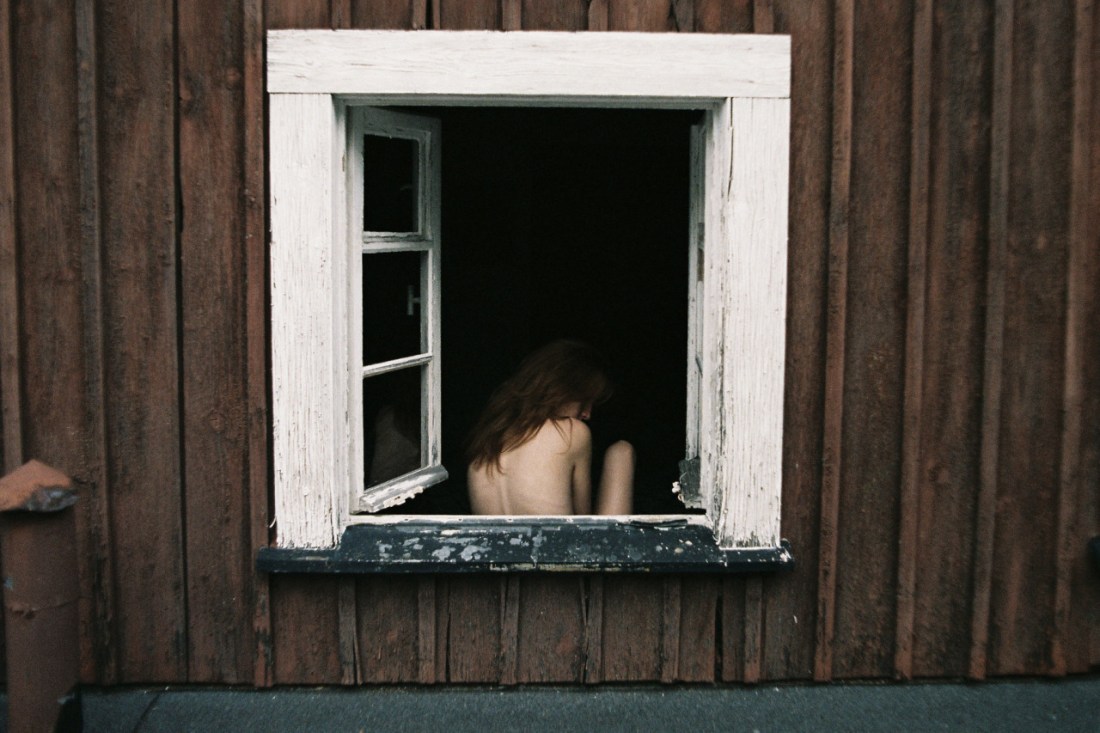
Weronika Izdebska – F1020013 (2014)
I’ve always wondered why certain historical epochs contribute more than their far share of stunning Art: the Italian Renaissance, Holland during the Dutch Golden Age; Hong Kong cinema circa the early 1990s; The Romanian New Wave for roughly the last decade.
As far as photography and image making go, I can’t think of a single place in the world that is killing it like Poland. [I actually have about a dozen pages of notes for an essay on the politics of visual representation and identity in the work of contemporary women making photographs in Poland–that’s how rich the landscape is at present.]
Izdebska work belongs to this milieu.
The image above is in one way uncharacteristic of most of her images: she usually employs a rigorously centered symmetry and then places those she shoots strategically off balance in the frame, conferring an oneiric feel to the scenes that’s straight out of mid-to-late Soviet cinema–here the camera is not square with the building; note the askew verticals compared to the frame edge as well as the lower boundary between the paneling and concrete.
It’s a small annoyance given the overall quality of the image. The limiting of the color palate is sublime and the tone that shimmers in the margin between dream and nightmare.
Also, there’s more than a casual similarity to Wynn Bullock’s famous Woman and Thistle.
(In the interest of full disclosure–I probably should admit that it’s difficult for me to be completely impartial when it comes to other image makers who are also similarly transfixed with the Icelandic landscape.)
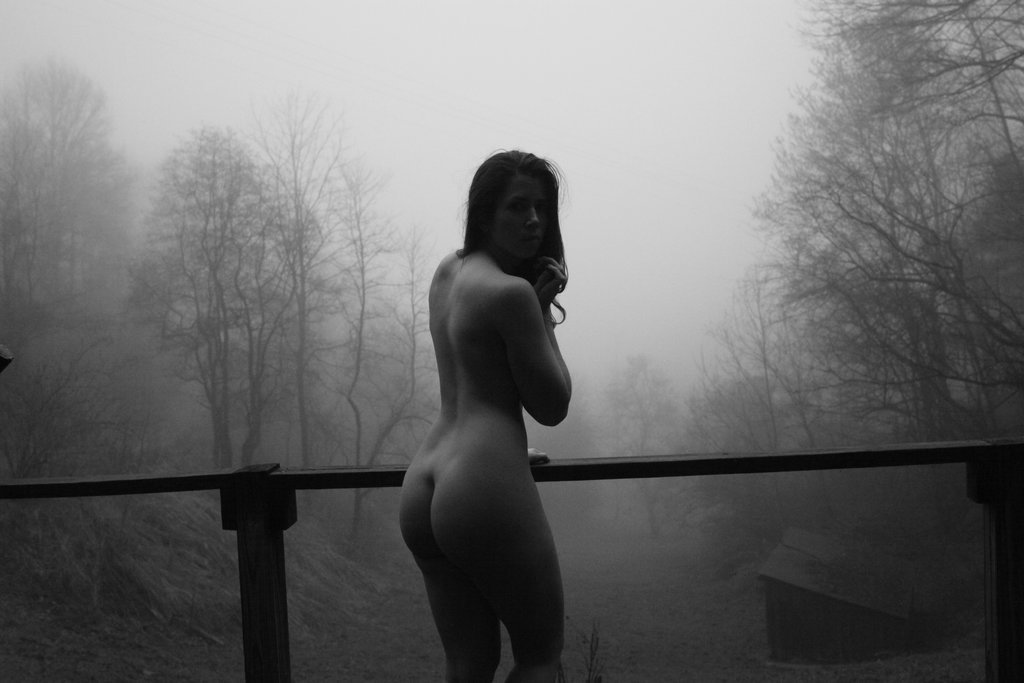 Renée King AKA atlas-7– self portrait at the cabin (2015)
I
can’t endorse the composition on this. The lower frame edge cuts right
across the knee, the off-center left position of the subject along with
the slant of the railing and that little protrusion just below the
center of the middle left frame edge set the image askew in a way that
to my eye distracts from the scene.
However, I do love pictures
featuring fog. There’s something magical about it–the foreign in the
familiar masking of it, an ephemeral, fairy tale otherworldlyness.
One of the best uses of fog I’ve encountered appears near the end of Theo Angelopoulos’ Ulysses’ Gaze.
In the scene, fog descends on war ravaged Sarajevo, halting incessant
sniper fire–allowing folks a reprieve to walk around under its cover.
Harvey Keitel’s character walks around in a field of nearly translucent
white. It’s visually arresting in a way very few things ever achieve and
contributes a chilling weight to the subsequent events.
I feel
like what this falls short on with regards to composition is more than
made up for in tone. Only the shadows are solid. As things take on light
and shape suggests a solidity that while separate from the fog still
resembles it in texture and tone.

Willy Kessels – Female nude from behind (19XX)
I’m too fuzzy on the the epoch to identify the progenitor here but this is reminiscent of both Edward Weston and Man Ray.
I’ve mentioned before that Weston’s enduring reputation is due to the brilliance of his skills as a print maker not especially as a result of his compositions.
And with Man Ray, who referred to images of himself as rayographs, there’s always a feeling I have when I look at his work that he felt the women he photographed were art only because they were fucking him at the time.
Kessels’ photo manages to skip the sentimental nostalgia for heated fumbling adolescent sexual exploration and present something unusually reserved, almost reverent.
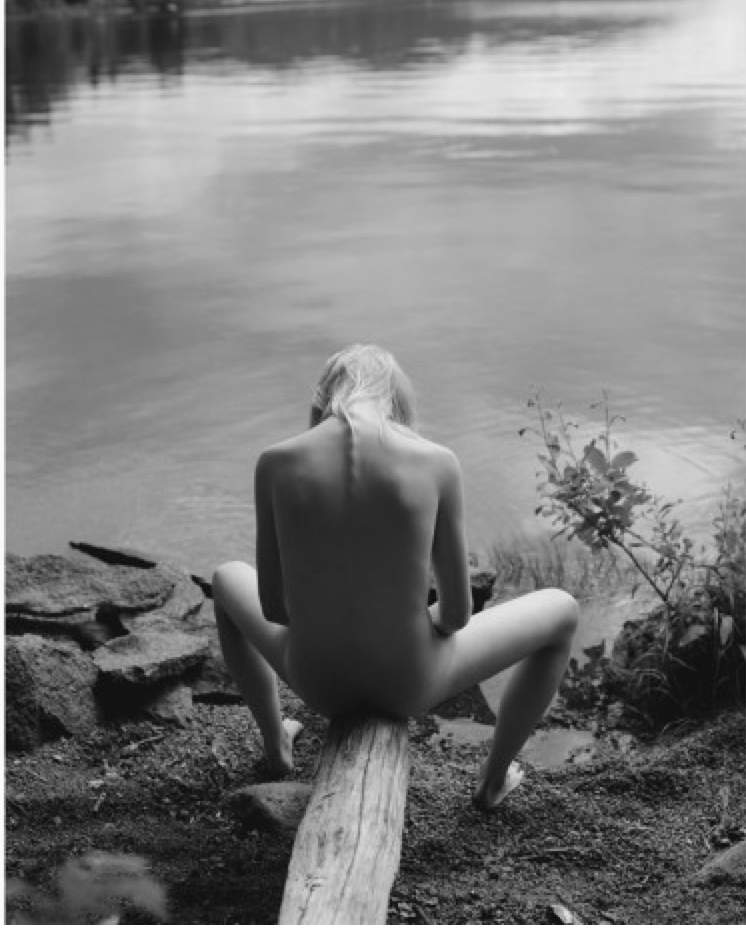
Massimo Leardini – Untitled from Scandinavian Girls (2013)
This wears its influences on its sleeve–Jock Sturges and Arno Rafael Minkkinen.
But it also shares common ground with Taiwanese genius Yung Cheng Lin insofar as it chooses implicit insinuation over explicit denotation, i.e. this could be nothing more than a simple image of a sprite nude young woman in nature, yet the pose here can just as easily be read as a sort of adolescent body curiosity which is perhaps even masturbatory; also the positioning of the log could reference Freudian misogyny or–I’ll pretend I’m an optimist today: an underdeveloped theme of genderfuckery. (I don’t really think that last suggestion fits because in this case the vertical composition is logically consistent with the image; yeah, it’s phallic as fuck but at least the skinny frame is logically consistent.)
In other words, I’m into this image on a conceptual level and not so much w/r/t technique–there’s almost no highlight detail which limits contrast and tonal separation by hazing out the middle greys. (Imagine what this would’ve looked like with the 3D pop that you can get when you effing nail the exposure with an appropriately contrasty film stock.)
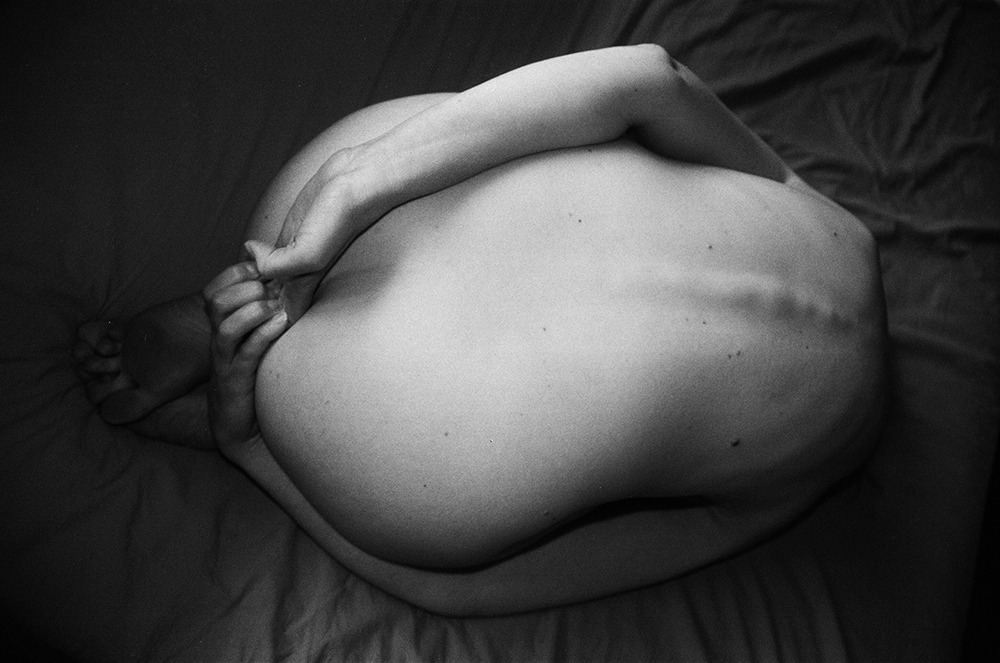
Lina Scheynius – amanda (2014)
If you do any reading on Scheynius, after the model turned photographer angle, you’ll invariable hear folks opine ever so elegantly about how her work focuses on intimacy or is preoccupied with the so-called female gaze.
I won’t object to either suggestion but I do find the tendency towards reducing a complicated, nuanced work to one or two of it’s representative elements almost always does a disservice to the artist and the work.
To my eye there is always something related to an effort to externalize and give voice to a primal, gnawing physical desire.
I don’t remember where I read it–perhaps in Scheynius’ recent interview with Zeit–where she recalls how one of her first modeling contracts stipulated that she could not gain more than a cm in any of her measurements over the course of a year.
And in much of her self-portraiture there is an element of violence in the way she documents her body that is always in dialogue with a ferociously unapologetic presentation of sexuality and a flirtatious ambivalence towards coyly implicit and outre explicit.
However, this approach to depicting herself doesn’t extend to others. The unflinching eye she turns on herself, becomes tender, seeks the wonder in light on skin, the line of the body in space–a fierce awe that acknowledges the connection between physicality and sexuality while refusing to sexualize the subject against the parameters of how they wish to be seen in any given moment.
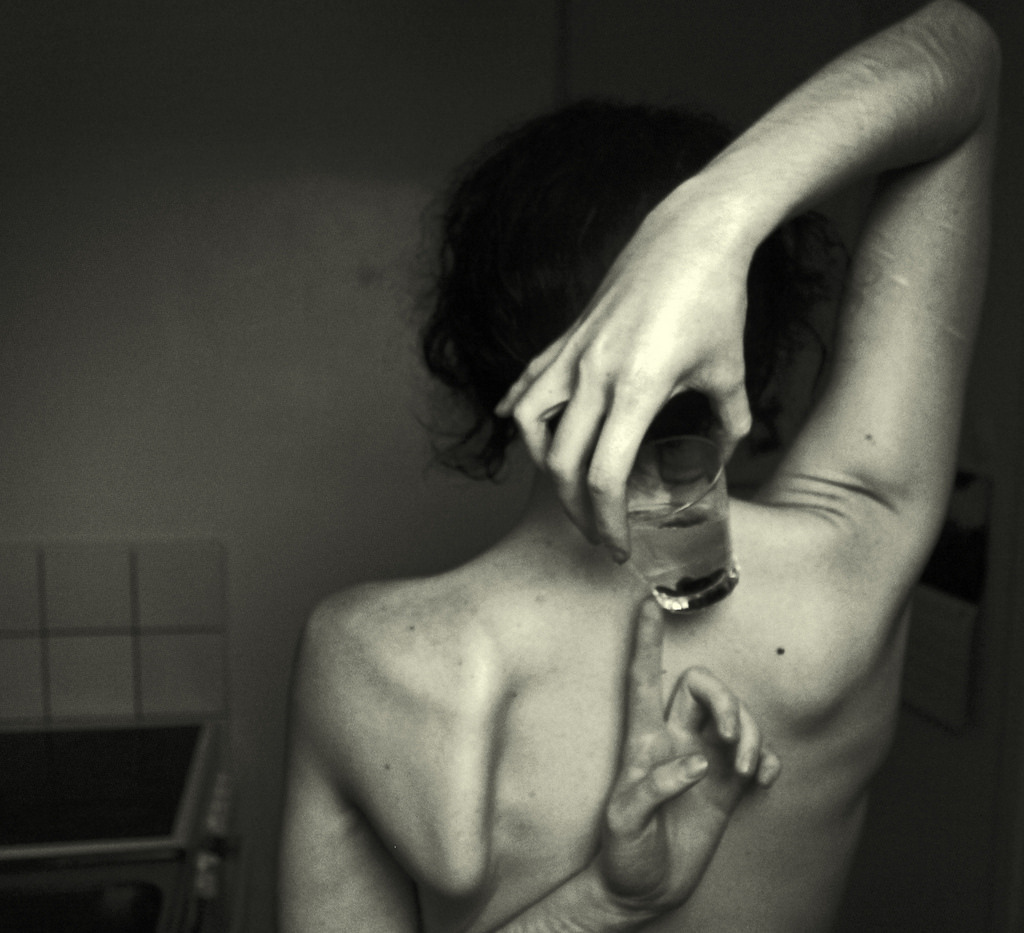
Mathilda Eberhard – Untitled (2014)
Mathilda Eberhard – Untitled (2014)
Flickr retains little more than a ghost of its late aughts glory. In fact, it’s pretty much a completely clusterfuck.
There are some notable outliers whose photostreams’ always showcase bona fide next level shit–looking at you: im_photo, chill and 3cm.
I’d include Eberhard to that list except well although I wouldn’t ever suggest that her work is better than those guys, I am just flat out enamored with her work.
This should surprise no one having followed me for any period of time–after all this is the fifth image of hers I’ve posted.
You’ll notice I tend to favor appending quotes to her images instead of commenting on them–partly because I am so awed by them that my fumbled attempts at expression seem entirely cross juxtaposed with the work and partly because I get self-conscious about the fact that I tend to compare things that move me to the very limited set of work I adore (at least initially) instead of come to terms with them on their own ‘ground’.
For example: for as many image makers as will either claim or accept the critical assignment of overlap with Francesca Woodman’s work, Eberhard is probably the image maker who most completely takes up Woodman’s mantle.
But to state that and consider the matter settle is intellectually dishonest. There’s more to it than that it and leaving it there does a disservice to both image makers.
Unfortunately, it’s not something I can express in the positive–i.e. I can say this is what makes Eberhard’s vision singular. However, it did occur to me that there’s a way I can, for the time being, point in the right direction.
Think of the word ‘desire’. We use it primarily as a noun–to describe a visceral wanting. It’s also a verb. I can say to a friend: I desire a delectable brie.–Although grammatically correct it sounds to the ear unbalanced.
In actuality when we desire, there is a tendency to express desire with metaphor–’craving’, ‘hunger’ or ‘thirst’.
Now, consider the qualifications we add to these metaphors when we use them non-metaphorically. We might say her appetite was ‘insatiable’ but we would be much less likely to say his hunger was insatiable unless we are using ‘hunger’ in some metaphorical sense. One eat until one’s hunger is sated.
I’m not sure if it’s just my pushing the point to reach a satisfactory conclusion, but it seems that we speak of thirst differently. Thirst isn’t sated, it is ‘slaked’–implying satisfaction. The space between ‘hunger’ and ‘being sated’–when measured in time–is less ephemeral than the space between ‘thirst’ and ‘slaked’.
I think when you extend this realization of the tendency in the literal to the metaphorical–desire when expressed via a thirst metaphor is more insistent than desire as expressed via a hunger metaphor.
What makes Eberhard’s work so singularly compelling is the way it methodically charts the terrain of thirst as a metaphor for desire.
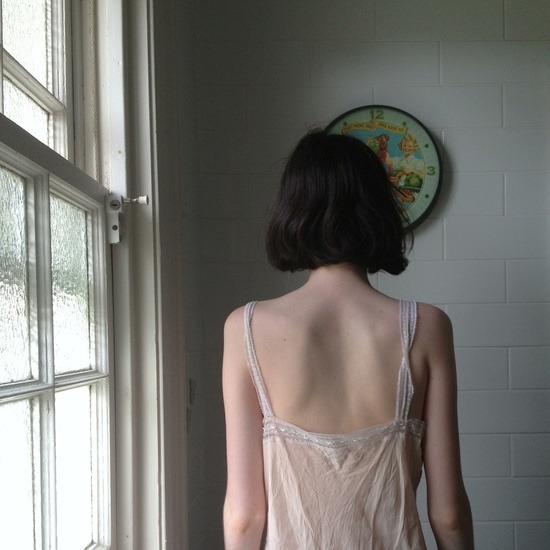
This is a self-portrait made by Zoe, a precocious, articulate and self-possessed sixteen year-old who blogs as Posh-Lost.
I admire her spunk.
Admiration aside, I have misgivings about posting this—not the least of which is the image maker being too young to ‘legally’ browse this site. Also, does displaying her work alongside more explicit content unnecessarily sexualize it?
Laurie Penny uses an ingenious coinage to refer to the well-intentioned worry we shower on the behavior of teenage girls: concern-fapping.
It is patently fucking absurd to think young women are not foundationally aware of the degree and extent to which their bodies are sexualized by society.
Further, anyone looking at this picture should know better. This is not some cell phone bathroom mirror selfie; light shines in through a window visible along the left edge of the frame, a la the Dutch Baroque. Further the staging speaks to an interest not in seeing while being seen but something closer to a preoccupation with the perception of self by another.
The flimsy, semi-sheer camisole is sexy; but whether sexy translates to something libidinous or reciprocally desiring remains pointedly unresolved.
Granted, it is not free of flaws. But it is thoughtful and I find it thoroughly and unironically interesting. But I can’t lie—there is something else to it that gets under my skin.
Long story short: I have never disclosed my gender on this blog. I’ve implied through omission, undertaken some linguistic gymnastics and mostly embraced opportunities to shore up ambiguity.
I have mild-to-medium gender dysphoria. As a child, I wanted to be a girl. When other kids played super heroes—I didn’t give a fuck about the perpetual fight over who got to be Superman because I was Wonder Woman. This was frowned upon. Frowns became stern words escalated to outright threats.
A dear friend suggested that if I was meant to be a woman, nothing would have stopped me. I think that is sage advice.
If you need a hammer but you only have a wrench, it doesn’t really work the best but you can more or less make due. From the standpoint of how my body relates to my sexual identity, this metaphor serves.
I pass as male and straight although I’d never embrace either. This creates a-whole-nother layer of complication. On the one hand, there are social expectations of me with which I find so uncomfortable they are debilitating; on the other, I have privilege in that I can somewhat function under the assumption that I am cisgendered. My ‘problems’ seem charmed compared to the struggles of the rest of the gender dysphoric community.
Additionally, I have a pathological aversion to anything related to medicine. Gender reassignment surgery is not a consideration. It’s that I feel more feminine that masculine. azura09 always says she thinks of me as a really dyke-y Daria Morgendorffer.
And yes if there was a Matrix like scenario where I could take the red pill and wake up female-bodied, I would do it without a second thought. Even if the ante was upped and I would die five years after taking the red pill, my choice would be the same.
I know this image is Zoe and she seems really amazing and the last thing I have any desire to do is co-opt her experience or her own depiction of her body but—fuck me—this is to a T the way I see myself in my head.
If there were surgical procedures that would make this awful body conform to this image, they couldn’t cut fast enough for me.
Maybe then someone might be able to love me.
Normal
0
false
false
false
EN-US
X-NONE
X-NONE
/* Style Definitions */
table.MsoNormalTable
{mso-style-name:”Table Normal”;
mso-tstyle-rowband-size:0;
mso-tstyle-colband-size:0;
mso-style-noshow:yes;
mso-style-priority:99;
mso-style-parent:””;
mso-padding-alt:0in 5.4pt 0in 5.4pt;
mso-para-margin-top:0in;
mso-para-margin-right:0in;
mso-para-margin-bottom:10.0pt;
mso-para-margin-left:0in;
line-height:115%;
mso-pagination:widow-orphan;
font-size:12.0pt;
mso-bidi-font-size:11.0pt;
font-family:”Garamond”,”serif”;}

Adam
London, June 2013
This is a thoughtful way to present a male-bodied nude: soles of both feet exposed, clenched ass, the arching line of the spine and the his right arm covers his face; except for the heavily dangling scrotum and cut definition of trapezius and deltoid musculature, it is an androgynous-to-effeminate depiction– explicit, vulnerable and mysterious.
It reminds me of one of my favorite images from last year. (That post is worth re-reading as it covers ground I’ll be skipping this time around.)
Comparing these two images does Leonidas’ work a disservice. And although I will give him credit for shooting film (Fuji’s Superia color negative, in this case), most of the faults are a result of sloppy craft.
This is the most egregious example of #skinnyframebullshit, I’ve posted. Whereas most people deploy portrait orientation to the end of reifying the verticality of the composition–lame at best as far as justification goes, lazy at worst–the subject here is not vertical.
You can feeling it just looking at the image but to see it visualize the center vertical as a fulcrum balancing the rear leg of the chair (frame left) and the top of the boy’s head (frame right). Notice the rightward thrust. Add this to the light pooling in overexposed puddles on the floor and back wall, the lack of space between the chair and wall and the flow of the composition is decidedly right leaning. The angle of the shot is an effort to use the line where the floor meets the wall as a means of adding dimensionality but this only exacerbates the existing problems with the slant.
Landscape orientation would have made a much more dynamic composition. And while this lacks the audacity of the image of which it reminds me, it might have done a better job standing on its own.
Criticisms notwithstanding, the scarcity of images depicting male-bodied persons in a simultaneously ‘formal’ and sexually charged imagery is such a rarity, that efforts, however flawed, deserve acknowledgement.

Ryan McGinley – Somewhere Place (2011)
This is easily my favorite McGinley creation–followed closely by Pickup Truck, 2013, Untitled (Bathtub), 2005, Running Field, 2007, Dakota (Hair), 2004 + Ann (Windy Truck), 2007.
As for the rest of it? I’m conflicted.
What attracts me to the work–its restless + vital physicality as well as the way the images I like thrum with a dreamlike unbounded anarchic togetherness–stems directly from party line criticism: the fuel of charmed youth, the match of absented consequences.
Plus, the work is goddamn pretty as you please; and when you tall that with it’s unmediated immediacy–so rarely seen in galleries–and it’s cleary how + why McGinley became the youngest artist to have a solo show at the Whitney.
What, to me, is off putting is the artist’s reliance on goosing the viewer’s reptile brain. I wouldn’t go so far as to say that McGinley is conceptually vacuous–but his work lacks anything even remotely resembling the conceptual sophistication of his predecessors (i.e. Nan Goldin + Larry Clark).
In the same breath, though, I can’t think of another imagemaker who so fairly divides his focus between male bodied and female bodied subjects. And that’s not nothing. Especially, given his impressive ability to unify contrived naturalism with an ultimately hollow aesthetics that still has the capacity to resonate deeply with the viewer.
 Acetylene Eyes