Source unknown – Title Unknown (2010)

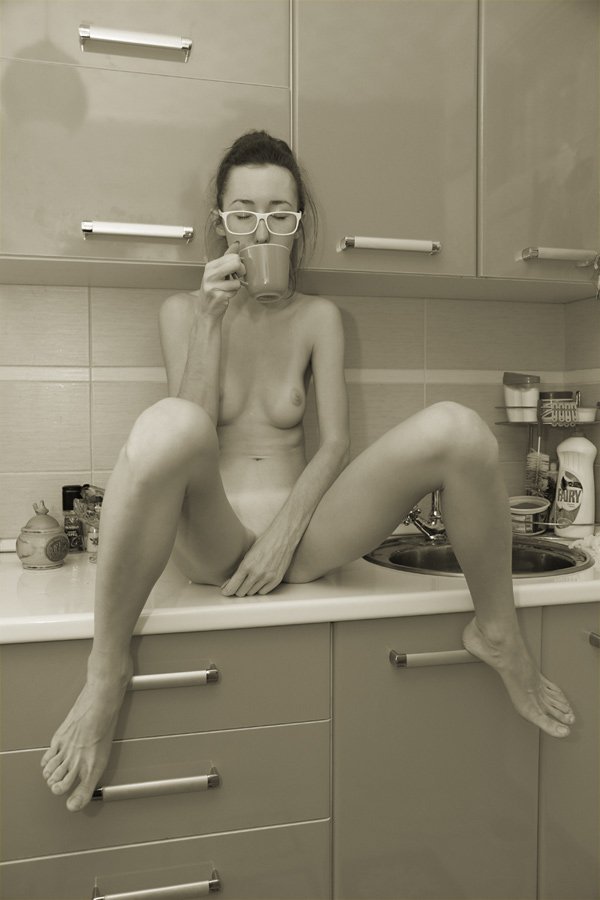
For the record: this ISN’T #skinnyframebullshit.

Which is not to say I entirely understand or agree with the orientation, but there is a persistent logic to it–the verticals are level with the left and right frame edge and the way the horizontal seams stand in relationship to the horizontals recalls Piet Mondrian.

To understand, why the vertical composition isn’t as problematic here, it’s necessary to examine the complications presented by a horizontal frame. There’s only two ways it can go: either you increase the amount of the kitchen around the subject or you place the camera closer to her.

Both these options diminish compelling facets of the original. In the first case, a wider shot of the kitchen increases negative space while decreasing immediacy/intimacy; in the second, you’d lose a good bit of the way the upper cabinet’s glossy finish blurrily reflects the rest of the room the viewer cannot at present see–suggesting a holistic and somewhat immersive totality of space.

Thus, whether I completely agree with the orientation or not, there is a clear, legible logic guiding it.

Yet, that’s not even what I like most about this image. What gets me is the way that it manages to stipulate it’s own context. Namely, if you’ve spent any time on Tumblr you know that disgusting creeps who bully, belittle or attempt to shame folks who post nudes–as if naked bodies are always inherently sexual.

I 120% support people who want to post nudes and not get shit for it. At the same time, I do often wonder to what extent failure to address such work from the vantage of its position in a particular traditions, be that nudes or fine art nudes… I do feel that there is a pervasive thread of believing that the master’s tools will eventually dismantle the master’s house.

In other words, we all just need to do better. To insist our work isn’t about sex or sexuality when it includes nudity and that’s it. Unfortunately, that ignores a shit tonne of subtlety and nuance. It can be both or neither or something else entirely.

What I like about this is it feels like a self-portrait. A sort of this is who I am when I’m authentically me–I get up in the morning and sit my bare ass on the counter while I drink my coffee.

The image conveys a real sense of comfort in one’s own skin. Simultaneously, there’s an awareness of the relationship between the subject and the camera. A sort of hey, this is how I roll and I want to document that but at the same time someone else isn’t necessarily going to see it the same way I do.

The way her eyes are closed and the way her left hand is positioned completely frustrated any sexualization of the image. And the brilliant thing about the work is it makes it seem incidental. There’s no sense that I’m covering myself because I’m ashamed, it’s more an: oh, this way I’m sitting which is super comfortable to me might be more than you want to see of me, so I’m going to address that in a way that doesn’t diminish how comfortable I am rn.

PS Super bonus points to you if you noticed the Fairy dish soap. It’s apparently a brand distributed in the UK, in case you care.

Edward WestonNude on Sand, Oceano (1936)

If you ever get the chance, I recommend going to an exhibition opening party at MoMA enough. There’s nothing like getting shitty off an open bar and then wandering around transfixed by art.

I’ve been to two such events. The one relevant to this post was for Paul Graham’s a shimmer of possibility. Graham is a grossly underappreciated photographer and the show was excellent; but being more than a little inebriated, I wandered into either the permanent photography catalog or another exhibition. Come to think of it, it might’ve been part of the broader implications of Graham’s work in an photo historical context.

However it worked out, I ended up staring at this Weston print for the better part of an hour.

I’ve noted previously that I don’t really care for Weston as a photographer but I consider his skills as a print maker unriveled. That’s not an uncontroversial opinion–given that Weston’s son apparently made the prints for the majority of his father’s work.

The thing that makes me reasonably sure that this photograph was printed by the elder west is that it’s both flatter and both shadows and highlights are more restrained.

This capture doesn’t even come close to doing the physical print justice. But you can at least see the implication of the stunning texture in the sand and the luminosity of gradations in the mid-tones shine through legibly.

As such, when I read about the tempest in a teapot over at The Guardian–where several of their ‘esteemed’ art critics got into a tiff over whether or not photography is art, I was immediately reminded of Weston’s print.

Perhaps, I’m biased but I don’t understand how anyone could stand in front of this print and argue that isn’t Art without being a troll’s asshole.

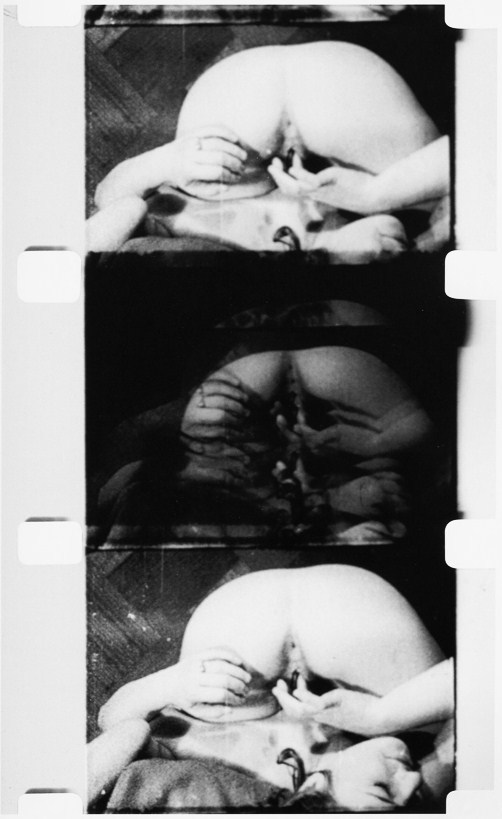
Source unknown – Title unknown (188X)

One thing you learn very quickly studying visual art in academia is the liability that is sentimentality.

The two exceptions I can think of are Nan Goldin–who, while her work is unsentimental, the raison d’etre for her work is fundamentally sentimental; and Sally Mann, whose work frequently borders on inexcusable sentimentality but always manages to maintain a rigorously formal foundation w/r/t to conceptual complexity and masterful execution.

I’m not arguing that the above image is sentimental. It is, however, very earnest and I think all too often that disqualifies certain work from being considered as art.

There are certainly compositional flaws that detract from this. The entire frame is left heavy. As all the elements either shift the eye left or are gathered at the left half of the frame. The “24.” along the right frame edge is placed as if to counter-act some of that off kilterness–but it hardly makes up for it.

Additionally, the lower frame edge cutting at the knee is just inelegant and jarring.

Yet, there is a lot to praise here. The skin tone is lovely–the subtle gradation between the curve of his body and the backdrop, the way her skin is so much lighter than his.

The backdrop borders on ridiculous; however, with the careful drape of the rug and the position of the bodies with the aforementioned gradation, it all suggests a familiarity with classical modes of visual representation.

I also adore the way her arm is bent back and she’s looking directly into the camera. There’s something calculated about it–part defiance, part fascination. Also, the dirty soles of her feet splayed in the air is inspired.

It feels to me like the photographer wanted to make images of people fucking but didn’t want it to read as frivolous. Thus, there’s an attention to detail that although it doesn’t entirely work, it adds a ring of truth to the scene.

I have no idea about the origins of this image. But there does appear to be a scratch on it–bifurcating it more or less horizontally at the center as well as a dogeared corner. It may not be accurate but it’s possible to imagine someone keeping this photo secreted away in a coat pocket.

Emmet GowinEdith, Danville, Virginia (1973)

In speaking of his work, Issac Newton famously asserted if I have seen further it is by standing on the shoulders of Giants.

It’s one of those famous quotes that much like the ubiquitous inclusion of Robert Frost’s The Road Not Taken in graduation speeches doesn’t quite mean what most people think it does. For example: people cite Frost because the feel the poem celebrates the worth of the difficulty and hardship of taking the less traveled path, when in fact, the narrator is expressing regret over his choice.

Similarly with Newton, the quote is less the by product of reverent humility and more history’s most notable humblebrag. (Newton plagiarized at least half of the revolutionary ideas history now attributes to him.)

That’s a super pretentious way of introducing the idea of influence on creative endeavors.

I find Gowin absolutely fascinating. His early figurative work is among my favorite photographic work. Conversely, there’s little canonical fine art photography that I detest more than his late-career aerial landscapes.

I can’t look at Sally Mann’s work without seeing the debt she owes Gowin. (It’s no accident that her son is named Emmet.)

And I can’t look at Gowin’s work without thinking of Harry Callahan. (No accident either given that Gowin studied under Callahan.)

All three–Callahan, Gowin and Mann–work competently by envisioning a hybrid of genres; they all focus on family, lovers as well as work that symbolically alludes to existential concerns.

Yet, the small variations in approach and execution speak volumes to the ways in which personal perception affects creative output.

It’s dangerous to deal in generalizations but although Callahan clearly loved Eleanor, there’s something cold and clinical to his images of her. It’s an issue I feel Gowin addressed fabulously–so well, in fact, that it makes me hate his later work even more; he’d figured out how to present something between portraiture and erotica, full of pathos and vitality, yet simultaneously devoid of an sentimentality. Whereas Mann is always working expertly to upend the notion that sentimentality–in and of itself–is anathema to art.

Also, I really love how this is almost certainly a reverse angle featuring the same shed in this stunning photo of Edith pissing–my second favorite Gowin photograph ever.

Nobuyoshi ArakiErotos (1993)

If there were a social media site that used Facebook-esque relationship statuses to track opinions regard an array of notable artists, my entry for Araki would be: It’s Complicated.

I appreciate his life-long commitment in documenting the erotic and/or transgressive aspects of human experience. But by the same token his prolific output–and let’s be honest, prolific isn’t even close to a strong enough word, something closer to ‘profuse’ is more apropos–is off-putting; the feeling it instills is one of throw everything at the wall and let’s see what stick instead of any coherent, contemplative, and disciplined editing.

The above photograph is causing me to rethink some things. For example: I’m not sure it changes anything about how I feel w/r/t what I interpret as lackadaisical editing. However, it’s probably intellectually dishonest to use that as a justification to disqualify everything the man has ever made. And in fairness, while I do find much of his work to be redundant and under-edited, Araki has produced six or eight images that are indelibly imprinted upon my visual imagination.

All that reminds me of one of the best pieces on understanding art that I’ve ever encountered in which Maria Popova unpacks Jeanette Winterson’s Art Objects essay.

Winterson, finds herself in Amsterdam, describes the experience thusly:

I had fallen in love and I had no language. I was
dog-dumb. The usual response of “This painting has nothing to say to me”
had become “I have nothing to say to this painting.” And I desperately
wanted to speak. Long looking at paintings is equivalent to being
dropped into a foreign city, where gradually, out of desire and despair,
a few key words, then a little syntax make a clearing in the silence.
Art, all art, not just painting, is a foreign city, and we deceive
ourselves when we think it familiar. No-one is surprised to find that a
foreign city follows its own customs and speaks its own language. Only a
boor would ignore both and blame his defaulting on the place. Every day
this happens to the artist and the art.

We have to recognize that the language of art, all art, is not our mother-tongue.

This attitude is presented as a prophylaxis for the I just don’t get it mode of art criticism.

It’s as stellar a metaphor as it is nuanced and astute. Yes, it’s great to know what you like and to be able to explain why you like it–I’d venture that it’s integral to any creative practice.

But part of seeing is resisting the tendency to avoid engagement with what you are seeing. And viewing something through the filter of past experience, of trenchant opinions, is a mistake.

One should never cease to questions assumptions, values and opinions–because to stop might mean pulling up short of the one question that toppled the entire house of cards.

This photo has made me realize that I’m likely very wrong about Araki. And as much as we strive to always be in the know and adept at negotiating understanding, taste and opinions–it really is incredible to be presented with the opportunity to correct a long, unconsciously repeated mistake.

So here’s to being wrong. Learning and growing.

vivipiuomeno1:

Judy Dater (U.S.A. 1941) Untitled (Self-Portrait with Sparkler) 1981, Gelatin silver print, 15 × 19 in.

Dater’s Self Portrait with Snake Petroglyph is the first of her photographs I encountered.

I love it. (So much in fact, that I riffed off of when I made this photograph.)

Shortly after, I tuned into Imogen and Twinka at Yosemite and it’s narrative bent couldn’t be more relevant to my own photographic preoccupations.

The above is a more resolute photo, more symbolically charged.

Victoria Gannon’s commentary Judy Dater: On Vaginas and Earthworks is a addresses the broad strokes reasonably well: the Freudian notion that vaginas are voids needing to be filled, how the sparkler Dater is holding behind her back and between her legs serves as the focal point of the photo, the work’s position within a historical context of Second Wave Feminism.

Such points are clearly valid–although I bristle a bit at the notion that Carolee Schneermann’s Interior Scroll was anything less than proto-Third Wave. 

Yet, I think in Gannon’s effort to associate the Dater with feminism, there’s an overlooking of the radical ambiguity of this image. To her credit, she does note that the space behind Dater isn’t land, it’s an expanse of water–something I completely missed.

The light is also between day and night–whether it’s dawn or dusk, remains uncertain. (Although my gut says dusk.)

Further, Dater is standing behind a steam vent or fumarole. I have no idea if it was intentional, but I was almost certain it was a geyser.

Part of my reason for thinking that is a result of visiting iGeysir in Iceland–the site from which the word originates. (Spoiler alert: it’s a tourist trap par excellence.)

The thing that visiting there made me realize is it’s not just porn where folks fixate on ejaculatory spectatorship–when Geysir spews, everyone stops and watches with rapt awe.

I have no idea if Dater meant for the viewer to think of a geyser. But the way she’s standing, defiant–with the light dying out in the sky–with fire symbolically emanating from between her thighs, there seems to be something radically talismanic about her formulation with regards to this image, a reformulation where femininity is the site of an equal but opposite force of nature. Something perhaps less historically observed, but as this photo asserts, it’s high fucking time that prejudice was upset.

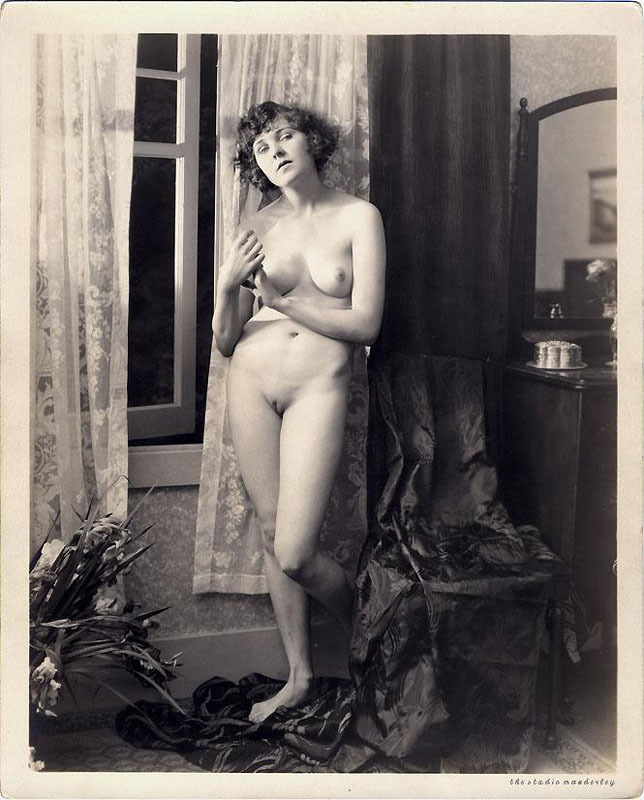
Albert Arthur Allen – Untitled (192X)

Excluding the border, sepia tinge and interior design, this could from a modern image maker who took this last year and only got around to uploading it to Tumblr last week.

But this was made sometime during the 1920s by a man born in Massachusetts, who moved to the Bay Area and started shooting nudes.

In this way he was singular in focus and profligate in output.

The work is a bit of a chimera; words like ‘camp’ and ‘contrived’ pop up whenever Allen’s work is discussed–sadly the former obscures a more important feature, the latter perhaps misses a pertinent point.

Take the above, for example. At first, it strikes one as charmingly intimate and unselfconscious. Upon further examination: the composition mostly works. The relationship of the lens to the mise en scene is studied, carefully composed–the half of the plant in the lower left corner is great as is the reflection of the room in the mirror.

Yet, as one gazes, inconsistencies take on a sharper focus: why in the hell is her ankle hooked behind the leg of the chair; did the shutter fire mid-blink or is she half asleep? That’s entirely too much fabric to be a robe and why is it draped on the chair like that–is it an effort to rubber stamp Classical Ideal ™ bonafides?

And now, almost a century after the images were made–despite their sometimes clumsy habituation, they are still better than 95% of the stuff made by so-called Tumblr famous image makers who shoot nudes and nothing by nudes.

In fact: I think there’s an argument to be made that Allen is perhaps a better photographer than someone like David Hamilton–if for no other reason than at least Allen is honest and straight-forward and owns (for better or worse) his rote repetitions and foibles.

But the interesting question here is: by seeking to document a subject which has been tested–tried and true across the ages–as perennially of interest as a subject addressed by art, to what extent does surviving 100 years render a photograph less document and more art?

I’d argue that the continued interest in Allen’s work has less to do with the work itself and more to do with what the viewer might interpolate about the longevity of fine art nudes as a photographic genre based upon the work.

We want the work to be Capital-A Art because it suggests a degree of merit to the undertaking and in so doing we subtly fixate upon the charm to the diminution of the awkward.

And really, Allen’s work is better than 95% of the work by this or that Tumblr famous image maker–I mean at least he is compellingly conversant in art history and its considerations.

But I’m not sure that which makes his work enduring is something that should in any way be seen as a voice from beyond the grave legitimating these our most earnest of efforts.