Rick Ochoadust and dusk (2014)

Ochoa passed away last year.

I didn’t know him and was not especially familiar with his work. But I did note the outpouring of grief regarding the loss of a dear friend, trusted co-conspirator and ally.

I’m a little late arriving but this image takes my goddamn breath away.

First of all it, reminds me of this iconic shot of Marlene Dietrich in Shanghai Express. Not in execution so much as substance–there’s a sense of individual agency, verve and independence. As if in the moment where the scrim separating performance of identity from bed rock selfness caught in a breeze and at the exact second the rift between the two was the largest, the shutter clicked.

Second there is something not unlike the tension in the best Vermeer’s, where you find yourself thinking that in a moment the maid will have poured all the milk out of the pitcher, that the letter will slip from the young woman’s hand and drift like an autumn leaf to the floor. Is the girl with the enormous pearl earring turning toward you or away from you?

Is the model Penelope Machine breaking eye contact to experience her own inner world exclusively on her own terms or is she about to make eye contact and share something devastatingly wordless but immediate and true in the way that only standing in the truth of the moment with another?

What I’m saying is that Ochoa–unlike so many of the rest of us who think Barthes’ notion that photography is death obsessed–find a way to make photos that if you turn your ear to them, you might well hear the faint ticking of a clock. Or in this case, the beating of a heart.

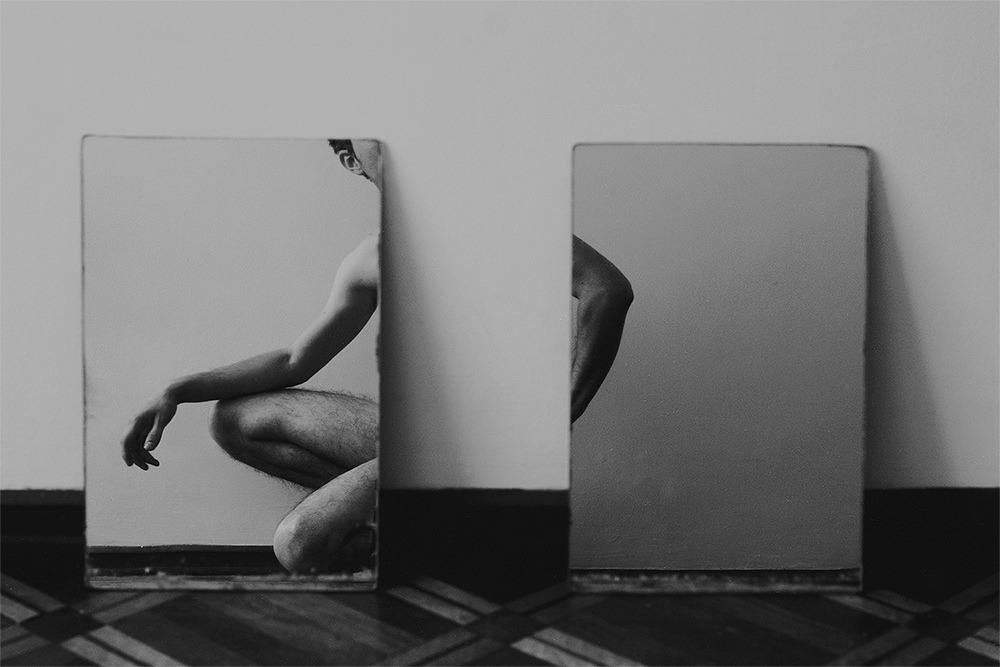
Daisuke YokotaUntitled from Taratine series (2015)

I can’t look at Yokota’s work without thinking about disintegration.

His work emphasizes imagery keen on eschewing concrete visual representation and instead offering something teetering on the brink of abstraction. The effect might best be described as a strobe used with infrared film shot in near complete darkness and the film subsequently pushed, over-developed or otherwise mangled post exposure. There’s frequently a fixation with grain enlarged to the size of golf balls, the space between grain as a sort of craquelure; fixer streaks mar the film, dust and hair become randomized, scintillating scotoma-esque focal points and the occasional hint of color reads somewhere between an opalescent oil smear on rainwet asphalt and B&W negs left to sit overnight in spent blix.

I’ll grant the use of color is masterful. But for the most part methinks the work doth seethe too much. It’s too bleak to be so entirely ambiguous about whether what it’s presenting is beautiful, a nightmare or a bit of both. (I’d wager that Yokota is probably very into Brakhage.)

That’s why the Taratine series appeals to me–unlike the rest of the work which seems clinical and detached. There’s a sense of relationship and involvement, something from which the rest of the work suffers from the abject lack of.

I object to a lot of the compositional decisions undertaken but there is something compelling about the poses in the above images. Except for the miasmatic haze hovering above the figure on the bed, the image on the right might very well be a lost Callahan of his beloved Eleanor. It’s all more painterly than that and I can’t help but think of someone like Titian or Goya.

Yet, what’s most fascinating is the image on the left. The pose is stunningly dynamic–but the visual dynamism of it is actually played away from the camera but in a way where it isn’t lost in the image.

It reminds me of Romanian auteur Cristian Mungiu’s post screening comments at the US premiere of Beyond the Hills. He spoke about working exclusively with long uninterrupted takes and how frequently at least one of the two phenomenally talented actresses wound up with their back to the camera. How does a performer convey emotion when at least half of their facilities for expressing that emotion are obscured? We in the modern world have a desire to see everything in an immediate, unmediated fashion; this urge is actually to our detriment as frequently what we don’t see is more compelling than what we do see and how an awareness of this notion permeated much of the blocking in the film.

If I had the opportunity to ask one question of Yokota, it would be: to what extent are you consciously aware of trying to formulate a new language of photographic representation of the human body exclusive to lens based visual culture?

It may not be at the forefront of his practice but it’s something that would very much be in keeping thematically with his work up to this point. Further, I think it’s actually an entirely crucial endeavor.

Source unknown – Title Unknown (20XX)

There’s things I really don’t like about this:

  • I’m not exactly fond of how the vast majority of porn targeting cis dudes fetishizes anal as the pinnacle of the heterosexual experience of intimacy (Queer depictions of anal intercourse get me super hot and bothered, tho, so I’ not kink shaming by a long shot.)
  • What is with the spreading of the labia as a motif in hetero porn featuring anal? Is it a legibility thing? Like the equivalent of look mom no hands except a look it’s in the number two hole not the number one hole?
  • The image has almost certainly been desaturated.
  • The braids and hair tie featuring a bow are clearly designed to add a barely legal lolita vibe to the scene.

That’s quite a bit to not like, I know. But the fact that the image is essentially narrative goes a hell of a long way to bridge the gap between my initial distaste and something like a reluctant interest in the image.

The scene is clearly by the side of a road somewhere–you can see the open care door and the grass in the background.

A blanket was put down first. The stud doesn’t just bend her over the hood of the car. In other words, there’s some concession to comfort.

It’s not hard to imagine how these two ended up here. They were driving and were suddenly both horny. Well, then why not road head? One gets the feeling that this is a pit stop before a weekend spent with one or the others family. They’ve pulled off the road to get one last intense fuck in before arriving.

I like that he’s watching her and dear lord, her expression–which to me reads as one of those responses to a sensation so intense and completely overwhelming that it expands to encompass all of your temporal cognition.

vivipiuomeno1:

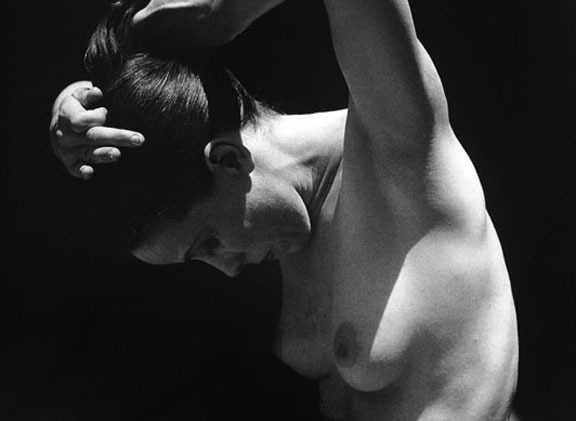
Emmanuel Sougez 

ph. (French, 1889-1972)

There’s not a great deal of information on Sougez floating about in the digital aether.

From what I’ve gleaned he was part of the New Objectivity which was among other things a rejection of Expressionism.

The term New Objectivity originates from the German, specifically: Neue Sachlichkeit.

Via Wikipedia:

Sachlichkeit should be understood by its root, Sach, meaning “thing”, “fact”, “subject”, or “object.” Sachlich could be best understood as “factual”, “matter-of-fact”, “impartial”, “practical”, or “precise”; Sachlichkeit is the noun form of the adjective/adverb and usually implies “matter-of-factness”

I’m not about to say such a definition is useless; however to me it is practically useless–I have no idea what purpose it serves much less how I am intended to apply the information henceforth.

The question this image begs–at least for me–is: what constitutes the primary focus of the image: the woman or the draped fabric?

As to an anwer: I’m inclined to say both; therefore neither.

Well, a clever interlocutor might inquire: how is it both and neither?

Here I can do little more than point. But I suspect the question of whether it’s the woman or the drape is functionally identical to the reason Uta Barth isn’t a minimalist.

It’s something to do with the interpenetration of human perception of space and human intervention in space that is perceived–in this case the area over which the camera hoveringly waits.

Mark SteinmetzTitle Unknown (20XX)

In 8 days this blog will have its 4th birthday.

As a direct result of this project I’ve been introduced to a number of image makers whose work astounds me: Allison Barnes, Mike Brodie, Kelli Connell, Stéphane Coutelle, Anna Grzelewska, Amy Montali, Igor Mukhin, @ericashires, Joanna Szproch, and Prue Stent.

Currently, I’m fascinated with Steinmetz and his work in a way that I’m not exactly sure how to articulate with any sort of clarity. Yes, he’s probably the best B&W analog print maker since Weston. Yes, his compositions are always impeccable. Yes, he fosters an empathy between viewer and subject that is fully radical–in every sense of the word.

I think what intoxicates me about his work is not that they’re narrative–strictly speaking they aren’t. However, the presentation of people not as objects but as haver’s of incisive, often complicated and conflicting inner lives. They aren’t synecdoches for ideas or conceptual metaphors. They are closer to characters in a film of which the audience is provided only one solitary frame.

So I was thrilled to stumble onto this image of his in a video interview he did for a workshop in Spain. Here’s an image the fit the structure and content of my blog that didn’t require me to digress and be like I know this doesn’t really go here but since I’m entirely preoccupied with it, I’m going to just leave this here.

Also, he’d never take me but I would quite my job and move to Georgia in half a heartbeat if he’d accept me as an apprentice. That is how much I’m blown the fuck away by his work. I’ve begun to consider him in much the same terms as Vermeer, Tarkovsky and Godspeed You! Black Emperor–my personal trinity of creative deities.

Faber Franco2rectangulos (2015)

When it comes to conceptualizing my own work, I’m like the cat that has to turn in circles a few times to find just the right spot/angle so that I can drift off.

I don’t know fuck all about Franco’s process; his work suggests a calculated effort in service of established momentum following a clearly planned trajectory. In other words, it’s less novice swordsman sheathing and unsheathing or otherwise sabre rattling, than samurai who only removes the sword from scabbard with the intent of using it to kill.

What I don’t understand is that although Franco seems to possess a complimentingly developed grasp of craft, I don’t follow his penchant for restricting the tonal range in his images.

Take the above for example: if it were mapped according to the zone system, we’d have roughly 5 full tones. In this the restricted tonal range does contribute to a sense of failing half-light (which is very much in character for the piece).

However, as there is a similar truncating of tonal range in virtually every image on Franco’s Flickr, it smacks a bit of a self-conscious stylistic ‘signature’–something I find frustrating given the overall quality of the work, taken as a whole.

I couldn’t swear to it but I’m reasonably sure there’s a Lynchian influence acting here–the primacy of angles in composition and interplay between super saturated complimentary colors.

And as much as I love most of Lynch’s work, I’m reminded of a criticism leveled against me after sighting Lynch as an influence back in college. Most of the people who claim or demonstrate influence from Lynch tend to use his work as an excuse to break rules before you’ve bothered to learn them properly.

In this case the tonal restrictions do evoke a Lynchian ambiance, while unfortunately overlooking the fact that although Lynch will definitely limit his tonal range for surrealistic effect, he almost always does so by amplifying those four or five zones to the moon while still maintaining a crisp, well defined luminous range. (As just one example consider Frederick Elmes’ cinematography in Blue Velvet, especially the scene where Jeffery finds Dorothy’s husband and the Yellow Man in Dorothy’s apartment.)

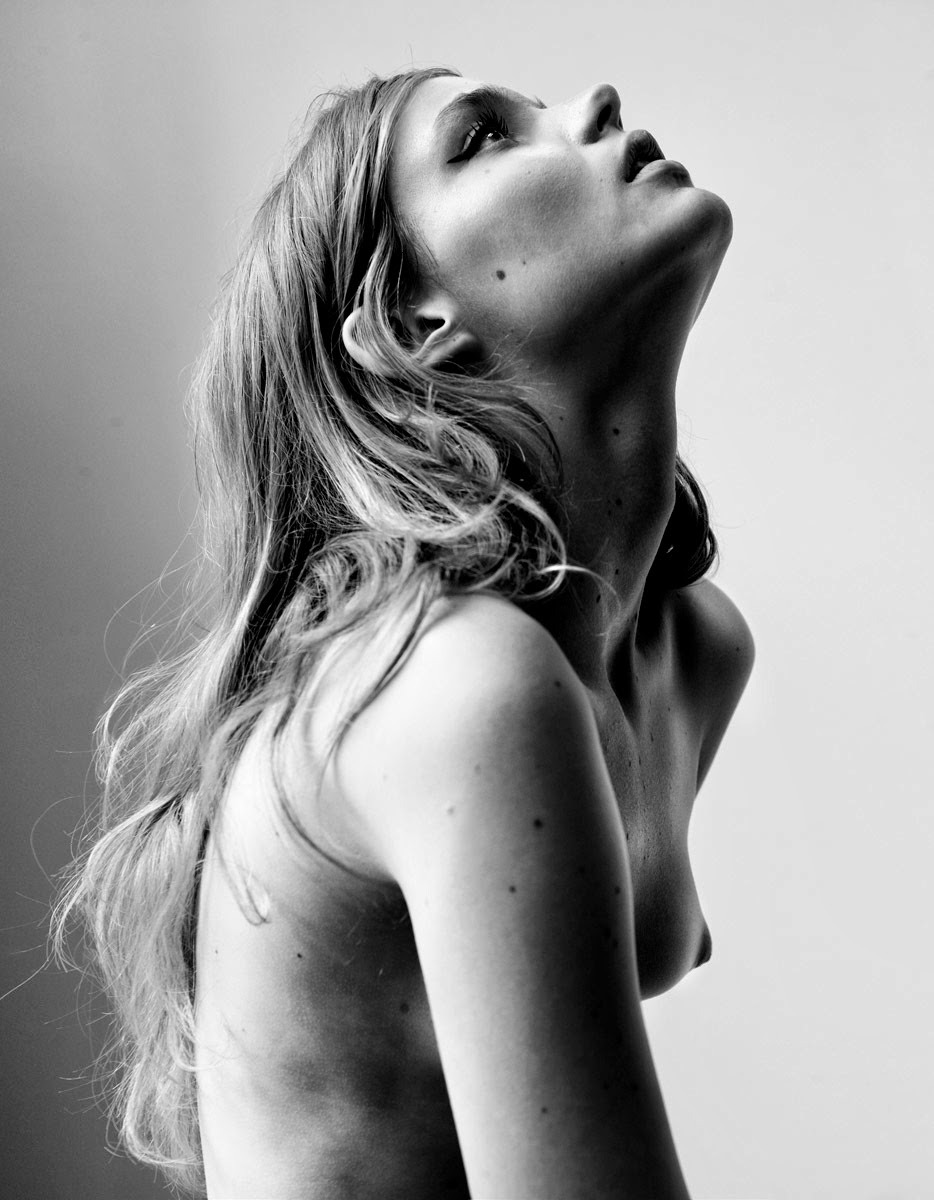
Philippe VogelenzangSvea Kloosterhof (2014)

I admit that I have an outsize bias when it comes to vertical orientation in photography/digital imaging.

It’s partly that image makers tend not to be as rigorous about the logic of their composition when deploying vertical frames; the choice seems to frame the decision as a question of facilitating immediacy, emphasizing of a centered subject or just feeling the vertical more than the horizontal. Individually, those motivations are all factors leading to #skinnyframebullshit.

I know a few folks take issue with the rigidity with which I push this notion. (In fact, I’m pretty sure a few image makers favor such orientations to flout my objections.)

But the reason why I have such an issue with vertical orientation is because even if there’s logical compositional consistency, there’s a tendency to lead to geometrically legible compositions but there’s a lack of dynamism.

In the western world, we read left to right and top to bottom. I’m not sure this is true from a design standpoint but I believe when faced with horizontal compositions, we want to read across the entire frame first. Knowing this allows the image maker to guide the eye.

With vertical compositions, the subject (if it is also vertical) creates a columnar effect: the eye scans the first vertical half of the image before moving to the second.

All too often, this results in the 2nd vertical half of the frame being ignored or only half seen.

And I guess that’s my point, if you are working with a horizontal frame, the primary questions are left vs right. In vertical orientation, the primary questions are up vs down. (A note to those perhaps making vertical images to challenge my assertion: every one of you are making vertical images that insist upon left vs right compositional questions.)

The above is interesting because it answers the up/down question firmly in favor of the former over the latter. The pose and the slight up-tilt of the camera emphasize this.

Additionally the subject is presented off center–unless you’re on a tripod and it’s geometric proof worthy, center your subject in a vertical frame is not going to work for you.

If there’s still any confusion: unless you’re skinny frame has at least the internal and external logical consistency of Caravaggio’s The Inspiration of Saint Matthew, then it’s #skinnyframebullshit.

oan-adn:

The passenger

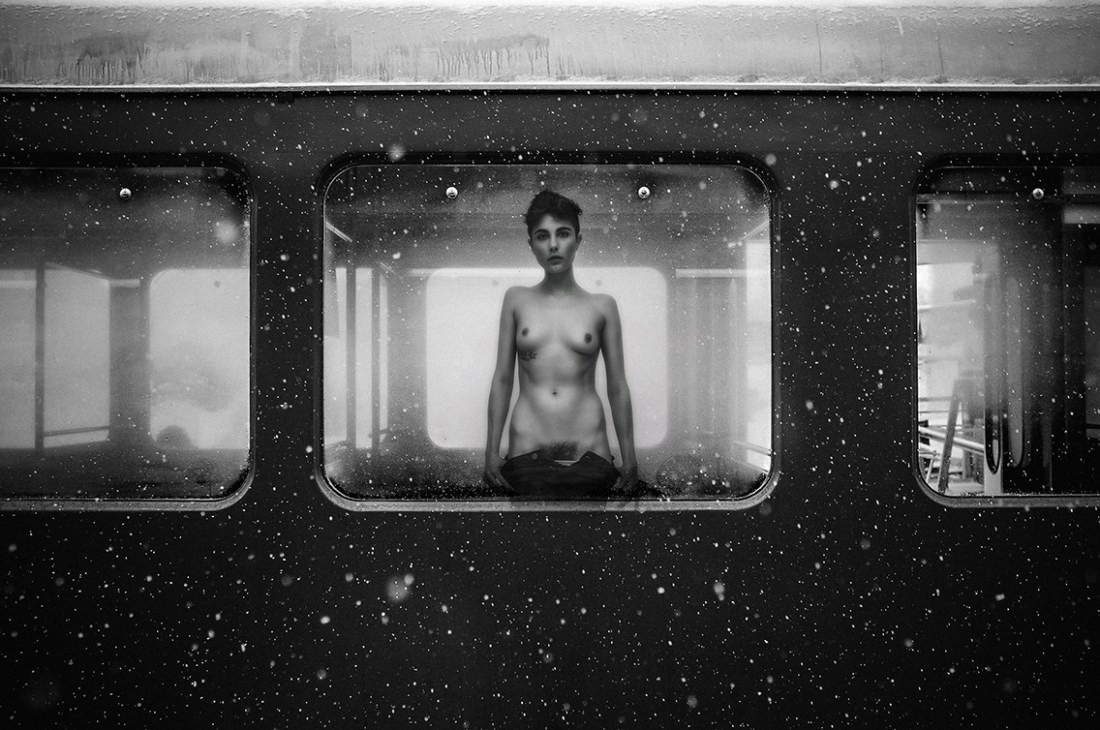
oan-adnThe passenger (2015)

The word ‘surreal’ has been so thoroughly abused as to render it now nearly impotent of meaning.

I hear people use it all the time interchangeably where terms like ‘oneiric’, ‘transcendent’ or ‘fantastic’ might better serve.

To me this image is surreal. Yes: there’s an element of it that is oneiric, i.e. the way text you read in a dream shifts as you read it. Yes: it’s–in some small way–transcendent because upon seeing this I experienced an in rush of breath and for the briefest nano second my subject perceiving an object shattered; yes, it’s also fantasic in that the train and the nude woman staring–ostensibly at me via the conjured space-time magic of a camera lens.

The reason I suggest it’s surreal is it has a feel to it of your mind playing tricks on you. For example: many years ago on what was perhaps my second trip to MoMA, I was walking to Grand Central. Although it wasn’t late, it was already dark–the sort of weather where you can smell the promise of snow in the air and the wind makes you shrink into your own core heat.

There were very few people on the streets and I remember passing a restaurant with tinted windows that looked in on the type of establishment that you’d need reservations in order to be seated and served. I wasn’t even paying attention really but I could’ve sworn there was a woman in a beautiful evening gown sitting across a candlelit table from a man, who wasn’t a man so much as a sunflower dressed in a well-heeled suit. The image stopped me in my tracks and I actually took a step back craned my neck for a second look.

Of course, it had been a trick of light, reflection and imagination. Still though, the oddity of the scene I perceived has stuck with me. It still feels strangely more real to me than the reality.

It’s that feeling I mean to convey when I term this image surreal. I feel like if I look away and look back, I will see the less interesting reality. Yet, due to some strange magic, the initial moment of mistaken perception has been transformed from passing ephemerality into something permanent. Yes, exactly that and beautifully so.