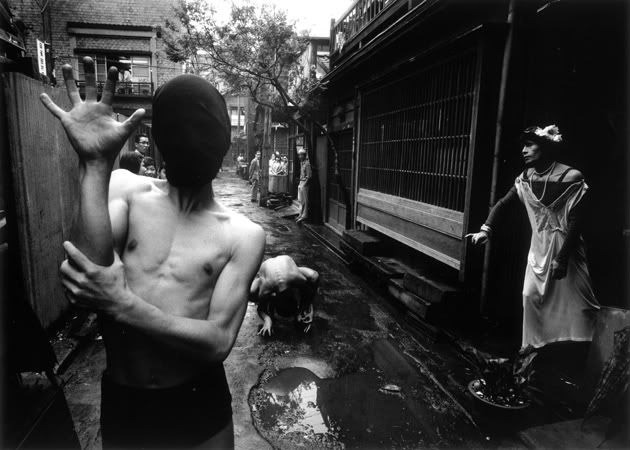
William KleinDanseurs Crabes (Kazuo Ono) (1961)

Apparently, Klein was known in Japan as a Leica shooter. And although I am extremely dubious that the above image was made with a Leica–with a gun to my head I’d say the bokeh in the background trees screams Nikkor lens–I’m going to run with the notion as it allows perhaps the smoothest segue I’ll manage to a tangential topic.

During my time in Berlin, I was able to see the C|O Berlin Eyes Wide Open!: 100 Years of Leica exhibit. (It’s up for another 45 days or thereabouts–so if you are anywhere close, you really should go to the trouble of dropping it; it’s quite extraordinary.)

Honestly, I have mixed feelings about Leica. The craftsmanship that goes into making them is unparalleled. However, my tendency is to choke whenever things get down to check out; I’m always asking myself: is it really worth paying $10K for a camera with one lens. (Plus, in side-by-side comparisons, I tend to prefer the sharpness of a Zeiss lens to the characteristic Leica lens moody contrast.)

Recently, this opinion has shifted. Largely because Trixie, my Fuji TX-1, is a rangefinder–and truthfully although there’s an ultra-steep learning curve when you come from SLRs, I’m actually finding myself more engaged with what I’m shooting.

So it really was the perfect moment for me to encounter this show as it tipped me over from being morally opposed to Leica to starting to think about how one day maybe I’ll be able to afford an MP…

Anyway, the thing I wanted to mention about the show is that the curation was mad on fleek. Seriously impressive. In a nutshell, the exhibit was laid out chronologically so you could see how the compact portability of the camera evolved from it’s inception through roll out, to the golden age of photojournalism.

Yet, the most fascinating thing was the either penultimate or final (I can’t remember which) descriptive plaque that contextualized the entire history of photography within the microcosm of work made with Leica cameras. I’m going to reproduce it here verbatim:

At a time in which none of the remaining magazines can or wants to afford a permanently employed photographer, yet on the other hand museums are showing photographs, galleries are dealing with photos and corporate collections feed very much on photographic images, the author with an interest in art–nolens volens–has become a model of our postmodernist photo culture. Any overview of the terrain shows six different types of photographers as authors, though the boundaries are of course fluid.

Young photographers still stay true to the genre “Reportage”, even though they now travel with self-assigned commissions, often pursue themes over a long period of time and determinedly rely on their own signature, in order to set themselves apart from the fast food of the electronic media (Paolo Pellegrin, Kai Wiedenhöfer). The “Photographic essay”–traditionally the “Travel report”–as a henceforth critical, formally ambitious exploration of a world in upheaval (Bertrand Meuiner, Klavdij Sluban) has remained just as topical as examination of social themes in the sense of approach that has been defined as “Personal documentary” (Jane Evelyn Atwood, Michael von Graffenried, Gaël Turine) of late. Photographers uses their camera to overcome personal trauma or to simply explore their private environment, creating a kind of “Visual diary” (Paula Luttringer, Alberto García-Alix, Tom Wood). They purposely operate their camera in defiance of the dictates of the instruction manual, and in the spirit of Classical Moderism (keyword: “Visualism”) to formally and aesthetically explore the boundaries of their medium (Andreas Müller-Pohle). Or they pose–while photographing–fundamental questions. For example: What do we do with pictures? What do they do with us? How do they influence our way of thinking, our knowledge? In light of this, existing material is lifted, sorted, reactivated. “Approriation art” is the term of the moment, although a line can be traced from anonymous snapshot to the photographic icons through cinema film (François Fontaine).

I feel like the little of Klein’s work I’ve encountered overlaps in many ways with all six proposed categories. It’s also especially odd in a world where street photography–whatever my thoughts of it might be–is increasingly less formal or even active genre, that Klein chose to focus on the unnerving and nightmarish instead of the synchronous, surreal or strange.

Which I guess is the point I’m quite dancing around: no matter how brilliant categories/genres are, they only ever remain truly useful as long as they serve as a point of departure instead of criteria determining arrival.
Source unknown – Title unknown (XXXX)

The feels this image instigates are hell of conflicting.

Technically, it’s rubbish (#skinnyframebullshit-ery, bizzare vignette-ish blurring and the fact that the image maker assumes a shared cis-male heteronormativity from his audience–suggested by not only the depilated vulva but the fact that the camera’s perspective is slightly elevated and looking down on this young woman.)

Further, I do not enjoy anal play–although I admittedly dabble with it on roughly the same schedule as blue moons occur.

Two things about it appeal to me: First, I appreciate how the intensity of her experience undermines the hegemony of the male gaze; in other words, it’s very difficult to read the dildo here as even an implicit ersatz cock; instead, this is very much a document of–what in my limited experience–appears to be an entirely unfeigned response to physical stimulus. Second, this reminds me of the first time I apprehensively explored my self in a similar fashion.

EDIT: an awesome follower steered me in the direction of what is at least a better quality (if not the original) version of this image.

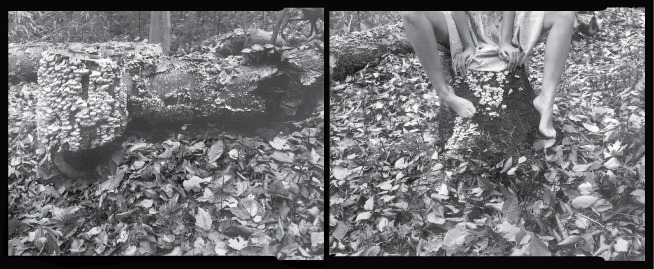
Agnieszka Sosnowska – Nowell, Massachusetts (1991)

If you follow this blog for the artier stuff, then you are probably already familiar with Lens Culture.

They do some rad stuff: serving as the impetus for posts featuring the work of Anna Grzelewska and Kumi Oguro.

Honestly, I was thoroughly underwhelmed by their presentation of Sosnowska. By focusing solely on her work’s ‘coming to terms’ with her families immigration to Iceland, there’s this sort of O Pioneers! vibe to it that registers as coy, sentimental and over-precious.

While I was in Iceland, the boastfully named Ljósmyndasafn Reykjavíkur, or Reykjavík Museum of Photography, had a show up called Traces of Life featuring a smattering of Sosnowska’s work.

I can’t speak to the quality of curation of the show–it seemed to lack an overarching cohesion and although explicitly preoccupied with self-portraiture, a great deal of the work was abstract in a way that beggars the question: how is this self-portraiture? (Not that most of the work on display offered much guidance on how to address such questions.)

Still, I have to qualify it as a success because I walked away with a respect for Sosnowska, I would have otherwise missed. Part of it was realizing that her work is fundamentally rooted in self-portraiture. Second, nothing available online does her images justice. She makes rich, contrasty, 3D baryta prints that are small, make stubborn demands for intimate observation and seethe with the ambiguous intention of a stumbled upon coiled serpent.

Michael Culhane (aka Solus Photography) – Into the Light (2012)

Culhane’s body of work is never (as in not ever) going to be something I’ll celebrate. He does manage some crazy great skin tone on occasion, I will give him that.

The skin tone here isn’t anything to write home about but the picture is damn exquisite–her pose, his pose, the use of space, the way the light falls off all ‘round them.

Plus, I love photos where hetero couples are presented in flagrant delicto and it’s the dude who is fully open laid out for all to see and the woman is strategically positioned so that she remains obscured.

TeknariUntitled (2015)

I think most ‘curated’ Tumblrs are like gifs? Pshaw!

I mean there is something undeniably obnoxious about a grid layout on a infinite scrolling blogs filled with gifs.

However, I think there’s an insane amount of potential for creativity within the format–like Vine’s that don’t suck or something.

I’m super not enamored with all Teknari’s work–too much of it is Jenny-Holzer-joins-a-Burzum-cover-band–but as far as someone who is actively exploring the outer boundaries of what gifs can accomplish, he is pretty much the bleeding edge.

I love the minimalism of this–it’s not one of those where there’s only a factional movement that makes you question whether it’s a still image or not. But scrolling through my dash, the movement is timed in such a way that I scroll back because I wonder if you saw it right.

lesbianartandartists:

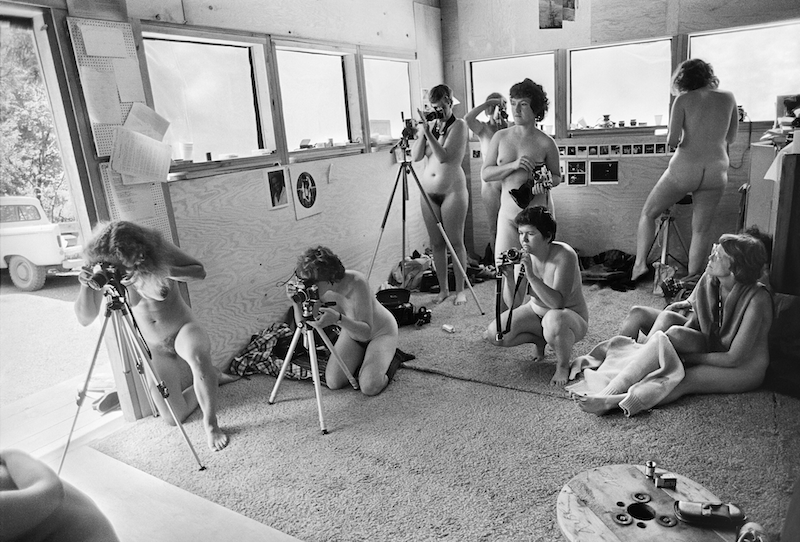
JEB (Joan E. Biren), Photographers at the Ovular, a feminist photography workshop at Rootworks, Wolf Creek, OR, 1980, Printed 2011, Digital silver halide C-type print, 12 x 17 in.

This perfectly illustrates what I hold to be the golden rule for photographing nudes: thou shall not photograph nudes unless thou art willing to be photographed nude.

The first rule when it comes to making pornographic art, never ask anyone to do anything they wouldn’t request of you were roles reversed.

Source Unknown – Title Unknown (19XX)

Although I am not especially into retro/vintage porn thing, I do kind of dig that this image was snapped, printed and published in a magazine that someone held onto long enough to scan and upload it in the Internet age. (Not to mention the way the center fold presents here resembles a similar sort of photo stitching used by someone like Accra Shepp.)

While from an art historical standpoint, it’s enormously problematic to suggest that part of what determines whether something is capital-A Art is survival–how many brilliant works have we already lost because the author wasn’t a white cis man?

Yet, there is something to be said for the test of time. This is an imperfect image–I really can’t overlook the way her legs have been amputated by the frame lines render her legs perpetually spread toward the viewer–not unlike a dead butterfly pinned through the thorax to felt under glass.

There are several allowances that while they certainly don’t mitigate the objectification, they do perhaps soften it: the young woman eschews eye contact with the camera, she’s wearing both a top (ostensibly her own, instead of a wardrobe piece), earrings and a watch; lastly, the three different textures of the back of the couch, the cushions and the carpet are sumptuously rendered in nearly synesthetic detail.

It seems as if the direction she’s been given is that she’s beginning to masturbate. As much as one can accurately judge an expression based on a fraction of a seconds representation of it, she seems very much on board with the notion; however, the contrivance of her pose and self-consciousness directly address the inherent on-your-mark’s-get-set-go! approach that underlies the majority of heteronormative porn.

I feel like if this wasn’t a porn shoot and the goal wasn’t based on a vague erotic notion of depiction of orgasmic paroxysm as narrative denouement, then this image–if it had been content to wait patiently and adopt a wider, less implicitly violent/objectifying frame–could’ve been pornographic art instead of artfully depicted porn.

It strikes me that current international literary cause célèbre Elena Ferrante (and feminist enfant terrible) is addressing something on a similar track when she points out in a recent interview:

Yes,
I hold that male colonization of our imaginations—a calamity while ever
we were unable to give shape to our difference—is, today, a strength.
We know everything about the male symbol system; they, for the most
part, know nothing
about ours, above all about how it has been restructured by the blows
the world has dealt us. What’s more, they are not even curious, indeed
they recognize us only from within their system.

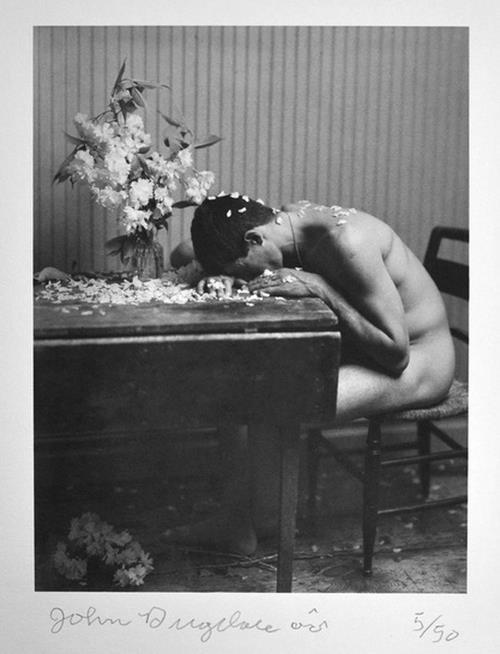
John DugdaleA Turbulent Dream (1996)

I’m forever suspicious of artists who lead with a list of influences. It always feels a bit like an effort to force your work to rub shoulders with the work that initially drove you from passive consumer to active creator. And it frequently comes off as an attempt to predispose the audience to approaching the work in a proscribed fashion.

I’ve learned to be especially dubious of people who lead with exceedingly obvious options. Like I’m not going to talk about the influence of Francesca Woodman or Andrei Tarkovsky on my own work because the debt is so extensive and front-and-center that to draw further attention to it would be rudely redundant.

Dugdale’s portfolio is there double quick with the suggestion of a genealogy shared with Henry Fox Talbot, John Herschel, and Julia Margaret Cameron. Excluding Talbot, they aren’t the usual suspects.

He goes on to mention the American Transcendentalists: Whitman, Dickinson, Thoreau, and Emerson.

I’m always intrigued by the cross-pollination of disciplines in the arts. So a photographer who cites writers as influences, has my attention. (In my own work, although I won’t get into Woodman or Tarkovsky, I will absolutely drone one endlessly about the global impact on my own creativity as a result of the music of Godspeed You! Black Emperor.)

For the benefit of those of you who aren’t necessarily well-versed in the art historical equivalent of card counting, Dugdale is soft shoeing it around a rather obvious exclusion: William Blake.

But wait, you interject, wasn’t Blake all about Red Dragons and The Ancient of Days?

Indeed he was. But, bear in mind that Blake was subversive as fuck. He was re-introducing the fantastic to the familiar–the familiar being prudery surrounding the practice of Xtianity. Or, if you’d prefer: Blake wanted to reappropriate wonder from centuries of lifeless liturgical boredom.

Dugdale’s work seems comparably preoccupied with searching for the transcendent in the mundane.

And now I’ve earned the right to inform you that Dugdale is completely blind and has been for the majority of his photographic career.