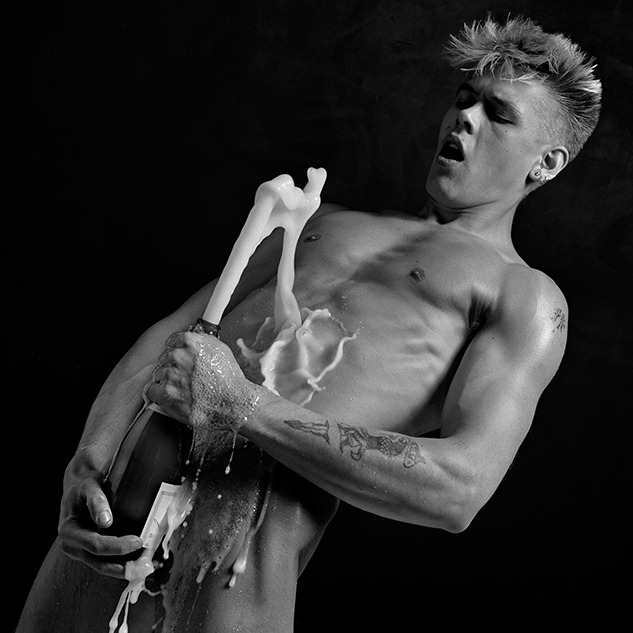
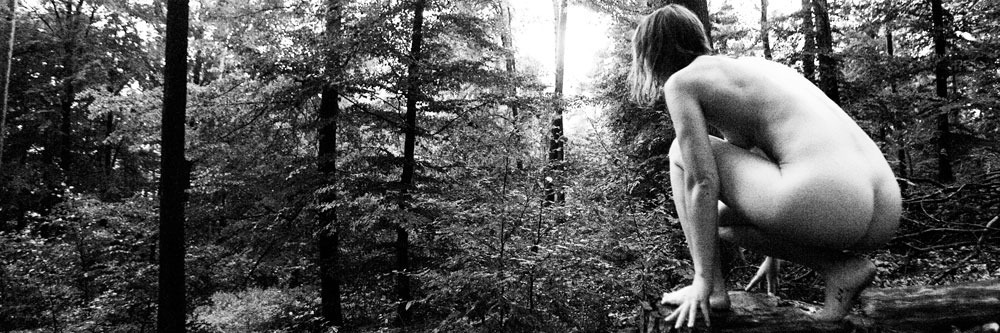
Pierpaolo Morra – Untitled (2015)

If you know a lot of cineastes and they irritate you with their endlessly self-conscious meta-commentary, ask them to name the best example of film noir. Sharks mid-feeding frenzy are a solemn affair by comparison. (I once saw someone successfully defend the Coen Brothers’ Blood Simple as the last true noir–a statement with which I hardly agree but you have to appreciate the audacity of choosing that as a last stand and managing to rout multiple attackers.)

This image gets me thinking about film noir. Particuarly Jules Dassin as the prototypical noir auteur. If you want to understand what noir entails, you could do much worse than studying The Naked City and Riffifi.

Ultimately though, I grudgingly agree with the camp that suggests Out of the Past as the last true noir. (I do understand the desire to attribute a more decisive dividing line a la Touch of Evil where you can pretty much say film noir was B&W and neo-noir is predominantly in color, but I think that glosses over a bunch of nuances–I’d argue Touch of Evil is neither noir nor neo-noir and instead exploited distinctions that subsequently demanded differentiation.)

Back to Dassin though: he’s interesting because he employs the ratcheting of tensions common in noir to a pointedly different effect. (Seriously, if you haven’t seen Riffifi, you’ll never be able to watch that scene in the secure vault in Mission: Impossible without shaking your head in visceral disgust.)

Dassin’s films are quite a bit more formal than your typical noir. They may share a common roster of themes and devices, but even after he was blacklisted and moved to Europe, his films never quiet shook the cast of the Hollywood Three Act structure.

That’s both why his films tend to be so bloody good but it’s also why they’re neo-noir or maybe preferable noir-ish.

In late 30s and 40s Hollywood studio films, if you watch closely you’ll notice that as far as B&W cinematography is concerned, there’s a zone system as applied to motion pictures at work. Things are lit in such a way that there is a pure white and a pure black in every frame and as many interval tones as is provided given the latitude of the film stock, creates a gray scale. It’s crazy. I know people who can’t light green screens as evenly as they lit white walls in studio films.

And yes, Dassin is willing to get muddy and grainy–but it’s usual in service of adding immediacy to the action at hand. Noir just didn’t function like that. It’s not that the DPs weren’t as skilled, it’s just that lighting was used in a far more expressionist fashion than as merely a means of illumination.

That’s why I dig this image. The rest of Morra’s work is (in my opinion) overly mannered. He’s definitely got a solid grasp on controlling tones but working in micro-shifts as he does, his editing needs to be much tighter. This image is underexposed but the underexposure works as a sort of life giving spark.

And I guess that’s really my underlying point. Modern image making gear has made it so you can point a camera in more or less the right direction and without thinking produce a pretty decent image.

But what will make you a better photographer is not what you get right or what you get wrong, it’s what you learn from what you get right and wrong.

So with that in mind, if you really want to become a stronger image maker: ditch shutter priority, aperture priority and matrix metering and embrace full manual everything.

Francesca WoodmanUntitled (1979)

One of the reasons Woodman is such a beloved artist pivots along the axis of her works’ radical accessibly–extensive knowledge of photographic history and/or technique isn’t requisite for immediate, profound appreciation.

The more craft gets under your skin though, the more an appreciation of Woodman’s work pays unexpected dividends.

The time I’ve spent with Woodman’s work lately has been–for the first time–somewhat frustrating. I think it was something that started as an inkling at the back of my brain after I visited the Guggenheim’s retrospective back in 2012.

The exhibit was laid out roughly chronologically and this brings into sharp focus how the themes and motifs with which she was obsessed were always preternaturally lucid and gathered at the fore.

It was fascinating to see the subtle ways she sharpened the work in small, nuanced increments from a Corsican vendetta knife to a blade so sharp that in the act of cutting it cut itself.

But what strikes me as something that has been overlooked is the extent to which Woodman’s view towards craft clearly shifted as she matured.

I’d wager a major factor in why no one has touched this is a result of the panoply of prints out there and the lack of accurate records of whether the print was made by Woodman herself or her estate (which as I understand it means that her father made them).

There is a trend though. Unlike the typical darkroom novice, Woodman’s early work is murky, mired in muddy tones. There’s a sharp divergence marked by the lead up to her arrival at RISD–her prints become more even, flirting with technical perfection. Her time abroad in Rome is when she produced her most visionary printing–embracing a seemingly chaotic (but ultimately studied and rigorously controlled) photographic tenebrism.

Her subsequent struggles with failing to crack into the fashion industry–my only substantive criticism of her work is that her fashion stuff is truly regrettable, and her return to more personal explorations are all marked by a pointed downplaying of stylized print making.

Much hay has been made of her debt to Duane Michals as a result of scrawling cryptic texts on some of her most well known work. But her printing strategy in her later work demonstrates a pathological obsession with replicating Michals interplay of tonality and grain.

So it was fascinating to see this contact print as a comparison with a print of the same image.

The negative is substantively underexposed. Note: how the contrast is decreased and the image is flattened by the crop and the softening of the shadow Woodman is casting on the wall behind her.

I prefer the contact print above; however, if you read the image (and I feel it’s safe to do so given the accompanying date) as an allegory on Woodman’s feelings about her failure as a fashion photographer, pushing the ugliness of the image in printing makes a hell of a lot of sense.

Source unknown – Title unknown (200X)

Netflix’s Sense8 was renewed yesterday–the shared fictional birthdate of the series eight protagonists.

I’m not sure why I gave it a chance. The reviews were middling at best and I already have arguably too full a plate of shows that I follow with something not unlike religious devotion.

And truthfully, I spent the first three episodes frustrated and highly critical of the proceedings. But something shifted right around the 4 Non Blondes full cluster sing-along–I found myself weeping uncontrollably.

It’s not a perfect show but it is in my opinion a great one for all the ways it’s daring to challenge the conventions of what we should expect from entertainment.

One of the things that it manages–one thing which despite some of the notably sexist conventions of say the Matrix–is to push the Wachowskis’ tendency for inclusive diversity in casting to a heretofore never realized extreme. But beyond that, there’s a decidedly queer bias to the program. Virtually all the sex is either group sex or queer sex.

The image above reminds me of one of literally hundreds of scenes that have subsequently become stuck like a splinter in my mind. In it two gay characters, begin to make out. Things escalate rapidly and they forget that there dear female friend is watching them. She slides her hand down her stomach and into her bikini, beginning to masturbate while watching her friends fuck.

Under the direction of less attentive storytellers, it would have easily seemed creepy or inappropriate. But what shines through the scene is a respect for both an honest, unguarded personal expression and respect arising from deep connection and understanding of the boundaries of others.

It’s that feeling that I’m frequently trying to channel through this project. I think I fail more than I succeed. But I do hope that sometimes you feel it, too.

And truthfully, although I know it’s just a silly sci-fi show…Sense8 does make me feel marginally less abandonded and alone. I think that’s one of the reasons I cried when I found out it was renewed. Because I desperately need more Riley, Sun,  Lido, Nomi, Capheus, Kala, Will, and Wolfgang in my life.

More fabulously open and forward thinking depictions of queer sex are just a stellar fringe benefit.

Source unknown – Title unknown (20XX)

This is an interesting picture. I’d have preferred if it were a bit more evening exposed–all the shadow detail in her hair is gone whereas there’s still hints of detail in the cabinet or table to the left of the couch; also, if the camera had been raised perhaps a foot and moved back by a foot, you’ve have gotten both of them more or less fully in frame and enhanced the visual dynamism of the shot.

And as nice as I think the little details are here–i.e. her hand covering his and helping to hold her legs in position, her tongue and clitoral piercing and the books behind her legs on the couch cushion (hell, even the presentation of his erection and testicles is aesthetically pleasing)–what appeals to me about this is the question it perpetuates in my brain: is there a relationship between symmetrical representation and subjectivity?

I’m not at all certain the following applies anywhere outside my own head but I know that there’s always been this rupture or disjunction between the vision in my head and the final print. Generally, the small that rift, the better the photograph.

I think the thing is we tend to look at the world askew. The human brain is amazing at filling in blanks unbidden–sometimes to our detriment (most optical illusions are such because the brain straight up accepts its own grandiloquent assumptions on the regular).

I’ve gotten a bit ahead of myself. I need to backtrack momentarily.

Usually, I’m of a mind that there are two types of people in the world those that separate everything into two arbitrarily ‘oppositional’ extremes of a spectrum and everyone else who isn’t a pretentious douche nozzle. Yet, as blunt tools, things like Szarkowski’s windows vs. mirrors dichotomy do at least provide a set point of departure.

I think there’s another potentially useful distinction–images that are found vs images that are constructed.

It’s easy to just blame street photography as the singularity from which all found images emerge. Even in rigorously constructed studio work, there’s still an element of finding in the eventual edit. Yet, I think the distinction between objective and subjective, has something to do with symmetry.

Constructed work tends to flow outward from a place of symmetry. The trouble with symmetry is… well, it’s mostly an illusion. Spend enough time with a large format camera and you’ll begin to actually see the fruit of the whole Euclidean geometery projected into three-dimensional space. (In simpler terms: try drawing an equilateral triangle on the surface of a sphere. It’s impossible.)

When I’m trying to find an image, I’ll tend to see it but when I lift the viewfinder to my eye–the thing I saw that sparked my interest disappears. I sort of think it’s because what I saw came as a result of my brain projecting a symmetry onto the scene that either wasn’t there or was merely implied by what I saw.

When I experience this discrepancy between what I saw in my mind’s eye and what I see through the lens, I’ve learned to force myself to be patient. To do the heavy lifting, to search for something approximating the symmetry I perceived initially.

On the rare occasion that I succeed in finding it, there’s a sense that the image is less an image and more a window. The image maker steps aside in order to reveal the viewer the objective experience of seeing.

In the above image, there is a literal asymmetry. It’s not so much interested in the ordering of physical space as the conveyance of the moment. Yet, in that it is very clearly subjective. The camera’s focal plane is not a window but instead an approximation of some observer’s perspective.

The thing about symmetry is that we think of it as bilateral–in other words, vertical and horizontal mirroring in one point perspective. But symmetry can exist without centering.

I actually think that is what the brilliant street photographer Paul Graham means when he says:

I have been taking photographs for 30 years now, and it has steadily
become less important to me that the photographs are about something in
the most obvious way. I am interested in more elusive and nebulous
subject matter. The photography I most respect pulls something out of
the ether of nothingness… you can’t sum up the results in a single
line.

His work is full of found images that are more window than mirror and as much as Graham wants to chalk it up to elusive and nebulous subject matter, his work shines because of the way he finds a meta symmetry that doesn’t get in your way, doesn’t distract you from what your seeing but instead functions as a feeling.

The distance between the subjectivity of above image and the window-like objectivity of Graham’s best work is identical to the distance separating artful porn from pornographic Art.

Paul MaffiLa fin featuring Waleska Gorczevski (2015)

Maffi trades in grungy/gritty street wise anti-fashion-as-fashion polemics.

As an aesthetic, there’s no love lost between it and myself because for the most part it seems to pride itself in the sheik, sloppy, ad hoc presentation as a means of conveying an immediacy and/or lack of pretense.

Even though I think of most of this sort of work as trash, Maffi seems to be using the aesthetic as a means to an end. The models he shoot lack the stylized contrivance of pose favored by most editorial minded image makers–you know, the it looks stunning unless you stop and think about and then the underlying physics/mechanics of the pose scream of the inherent unnaturalness.

It would clash horribly with the aesthetic if Maffi veered to the other end of the spectrum and sought to portray models in a state of relaxed, uncontrived naturalism. Instead, he splits the difference and gives this almost stylized but still somehow stunted/interrupted poses that always have at least one foot over the line into awkward self-consciousness.

I find myself wondering frequently who the people he shoots are, where they are and what they were thinking/doing before the intrusion of the image maker and the clacking shutter interferred.

Take the image above for example: there’s no rhyme or reason too it. It’s clearly a cellphone shot of an image on a computer screen. But despite all the things about it that make no goddamn sense, I’m still fascinated by it’s partially uncaring/partially whimsical oddness.

I’d never say it’s an objectively good image but it is interesting. And with the depressing state of eye-bloodying repetition that marks contemporary image making, interesting counts for quite a bit.

Erwin OlafJoy (1985)

I didn’t immediately recognize Olaf’s name when msjanssen reblogged this image (which I have an inkling is a self-portrait) and it  seemed like it sort of wanted to riff on Peter Hujar’s haunting portrait of David Wojnarowicz masturbating and formed an informal point-of-departure for Jeff Wall’s rigorously formal and uncharacterically garish Stereo. (Also, if you want an interesting thought exercise: consider the trajectory from Blade Runner through Olaf to something like say the post-production infusion of underexposed tenebrism in a show like Hannibal while Wall is very painstaking, using a fucking shit ton of light to communicate gloaming.)

But you remember those hideous nudes with the bags from monolithic fashion designers over their heads? It’s called Fashion Victims and well, let’s just say it lacks any sort of subtlety.

Having said that: Olaf’s done some excellent work–though you wouldn’t know it from his website is basically MySpace with Quicktime VR plugin dragged kicking and screaming into some sort of javascript from hell bullshit. (There is no acceptable excuse for an image maker to subject people to such a goddamn awful fucking page.)

The Advocate put together an excellent edit of his work last year;  you should absolutely check it out.

k.flightbrobdingnagian penumbra (2009)

As much as I have a preference for work where the craft is beyond on fleek, I will ALWAYS have a bias for outsider art.

Of course, it’s a very real question as to what that word even means when it pertains to image making–with all the rampant pretense, ego and misdirection that entails.

For the sake of the point I’m trying to make here: I’ll take Lynn Kasztanovics over Stephen Shore any day of the week and twice on Sunday.

The thing that makes k.flight’s images so haunting and yes, wonderful, is that any ambiguities or equivocations/quibbles are removed from the proceedings. It’s clear to the viewer what the images concern–more often than not a sort of sultry sexuality as ontology of existence.

The image maker and I have spoken on several occasions and what I feel is relevant to communicate to you is that for all her seeming assurance in the work, she admits to rarely being certain what to make of any of it.

As lame and knee jerk of a connection as it is to suggest: k.flight’s work reminds me of this commercial I saw back in the late 80s. I think it was for Chevy and it was this skater looking kid walking along a beach maybe talking to the camera about how punk rock functioned as a wake up call to rock and roll, reminded it what had original made it so vital and important.

Not all her work is great, but it is all good–even when it falls flat. I can name hundreds of image makers whose work I rabidly support, but there’s only a few that excites me to the marrow of my bones–k.flight is very near the top of that list. And I sincerely hope that I’m able to collaborate with her at some future point in time.

Christian Schnalzger Untitled (201X)

I’m posting this less as an endorsement of the artist–alright not as an endorsement of the artist at all (I mean he has some okay ideas, but his technique just is not anywhere near where it needs to be)–but more because this isn’t cropped. The image is actually that wide.

I’m verklimt–talk amongst yourselves. Here’s a topic: the Holy Roman Empire was neither ‘holy’, ‘Roman’ or an ‘empire’. Discuss.

Seriously though, I found out about this format on Wednesday. It’s depending on where the camera originated either the Hasselblad Xpan i/ii or the Fuji TX-1. It uses regular 35mm film and fits 21 shots per roll and features an aspect ratio equivalent to Ultra Panavision 70mm. (Think Ben-Hur or Tarantino’s forthcoming The Hateful Eight.)

The cameras are extremely rare and exorbitantly priced. It would also solve a half dozen different problems I’ve been struggling with in my own work for the last three years.

Really, someone out there has to love my blog enough to get me one. You don’t understand. I need this camera like woah…I can’t even.

fpr1Untitled Submission to NN (2015)

A simple, straight forward and pretty image.

I deploy ‘pretty’ with intention–there is something about the pose that suggests androgyny. to me. Yeah, yeah–I know body hair–but I’m increasingly discovering that I really dig the anarchist femme folk with the short shorts and unshaven legs trend. It radiates a zero fucks given mentality that’s super attractive.

Yet, let’s not heap idle praise–there’s some interesting stuff going on ‘under the hood’ so to speak. The lower frame edge hints at the drop off at the bed’s edge. I’m betting the image was originally supposed to only feature the bed. This would’ve worked compositionally since the subject is essentially isolated in the top two-thirds of the frame. The inclusion of the bed’s edge actually unifies the darker ranges of the composition, drawing the eye inward from the outer edges of the frame to the body and further emphasizing the oblique position of the light source.

The impetus behind this image recalls this libidinous offering from the ceaselessly-astonishing-in-her-explicit-evocation-of-female-sexuality Rita Lino. However, in this case, although Lino’s image is bluntly absent with regards to equivocation and as thrilling as that always is to encounter in lens based visual culture, I am convinced the above is ultimately the more enduring record of wrestling with notions laying along a parallel conceptual track.