Source unknown – Title Unknown (20XX)

There’s things I really don’t like about this:

  • I’m not exactly fond of how the vast majority of porn targeting cis dudes fetishizes anal as the pinnacle of the heterosexual experience of intimacy (Queer depictions of anal intercourse get me super hot and bothered, tho, so I’ not kink shaming by a long shot.)
  • What is with the spreading of the labia as a motif in hetero porn featuring anal? Is it a legibility thing? Like the equivalent of look mom no hands except a look it’s in the number two hole not the number one hole?
  • The image has almost certainly been desaturated.
  • The braids and hair tie featuring a bow are clearly designed to add a barely legal lolita vibe to the scene.

That’s quite a bit to not like, I know. But the fact that the image is essentially narrative goes a hell of a long way to bridge the gap between my initial distaste and something like a reluctant interest in the image.

The scene is clearly by the side of a road somewhere–you can see the open care door and the grass in the background.

A blanket was put down first. The stud doesn’t just bend her over the hood of the car. In other words, there’s some concession to comfort.

It’s not hard to imagine how these two ended up here. They were driving and were suddenly both horny. Well, then why not road head? One gets the feeling that this is a pit stop before a weekend spent with one or the others family. They’ve pulled off the road to get one last intense fuck in before arriving.

I like that he’s watching her and dear lord, her expression–which to me reads as one of those responses to a sensation so intense and completely overwhelming that it expands to encompass all of your temporal cognition.

Michael Culhane (aka Solus Photography) – Into the Light (2012)

Culhane’s body of work is never (as in not ever) going to be something I’ll celebrate. He does manage some crazy great skin tone on occasion, I will give him that.

The skin tone here isn’t anything to write home about but the picture is damn exquisite–her pose, his pose, the use of space, the way the light falls off all ‘round them.

Plus, I love photos where hetero couples are presented in flagrant delicto and it’s the dude who is fully open laid out for all to see and the woman is strategically positioned so that she remains obscured.

Source unknown – Title unknown (20XX)

This is an interesting picture. I’d have preferred if it were a bit more evening exposed–all the shadow detail in her hair is gone whereas there’s still hints of detail in the cabinet or table to the left of the couch; also, if the camera had been raised perhaps a foot and moved back by a foot, you’ve have gotten both of them more or less fully in frame and enhanced the visual dynamism of the shot.

And as nice as I think the little details are here–i.e. her hand covering his and helping to hold her legs in position, her tongue and clitoral piercing and the books behind her legs on the couch cushion (hell, even the presentation of his erection and testicles is aesthetically pleasing)–what appeals to me about this is the question it perpetuates in my brain: is there a relationship between symmetrical representation and subjectivity?

I’m not at all certain the following applies anywhere outside my own head but I know that there’s always been this rupture or disjunction between the vision in my head and the final print. Generally, the small that rift, the better the photograph.

I think the thing is we tend to look at the world askew. The human brain is amazing at filling in blanks unbidden–sometimes to our detriment (most optical illusions are such because the brain straight up accepts its own grandiloquent assumptions on the regular).

I’ve gotten a bit ahead of myself. I need to backtrack momentarily.

Usually, I’m of a mind that there are two types of people in the world those that separate everything into two arbitrarily ‘oppositional’ extremes of a spectrum and everyone else who isn’t a pretentious douche nozzle. Yet, as blunt tools, things like Szarkowski’s windows vs. mirrors dichotomy do at least provide a set point of departure.

I think there’s another potentially useful distinction–images that are found vs images that are constructed.

It’s easy to just blame street photography as the singularity from which all found images emerge. Even in rigorously constructed studio work, there’s still an element of finding in the eventual edit. Yet, I think the distinction between objective and subjective, has something to do with symmetry.

Constructed work tends to flow outward from a place of symmetry. The trouble with symmetry is… well, it’s mostly an illusion. Spend enough time with a large format camera and you’ll begin to actually see the fruit of the whole Euclidean geometery projected into three-dimensional space. (In simpler terms: try drawing an equilateral triangle on the surface of a sphere. It’s impossible.)

When I’m trying to find an image, I’ll tend to see it but when I lift the viewfinder to my eye–the thing I saw that sparked my interest disappears. I sort of think it’s because what I saw came as a result of my brain projecting a symmetry onto the scene that either wasn’t there or was merely implied by what I saw.

When I experience this discrepancy between what I saw in my mind’s eye and what I see through the lens, I’ve learned to force myself to be patient. To do the heavy lifting, to search for something approximating the symmetry I perceived initially.

On the rare occasion that I succeed in finding it, there’s a sense that the image is less an image and more a window. The image maker steps aside in order to reveal the viewer the objective experience of seeing.

In the above image, there is a literal asymmetry. It’s not so much interested in the ordering of physical space as the conveyance of the moment. Yet, in that it is very clearly subjective. The camera’s focal plane is not a window but instead an approximation of some observer’s perspective.

The thing about symmetry is that we think of it as bilateral–in other words, vertical and horizontal mirroring in one point perspective. But symmetry can exist without centering.

I actually think that is what the brilliant street photographer Paul Graham means when he says:

I have been taking photographs for 30 years now, and it has steadily
become less important to me that the photographs are about something in
the most obvious way. I am interested in more elusive and nebulous
subject matter. The photography I most respect pulls something out of
the ether of nothingness… you can’t sum up the results in a single
line.

His work is full of found images that are more window than mirror and as much as Graham wants to chalk it up to elusive and nebulous subject matter, his work shines because of the way he finds a meta symmetry that doesn’t get in your way, doesn’t distract you from what your seeing but instead functions as a feeling.

The distance between the subjectivity of above image and the window-like objectivity of Graham’s best work is identical to the distance separating artful porn from pornographic Art.


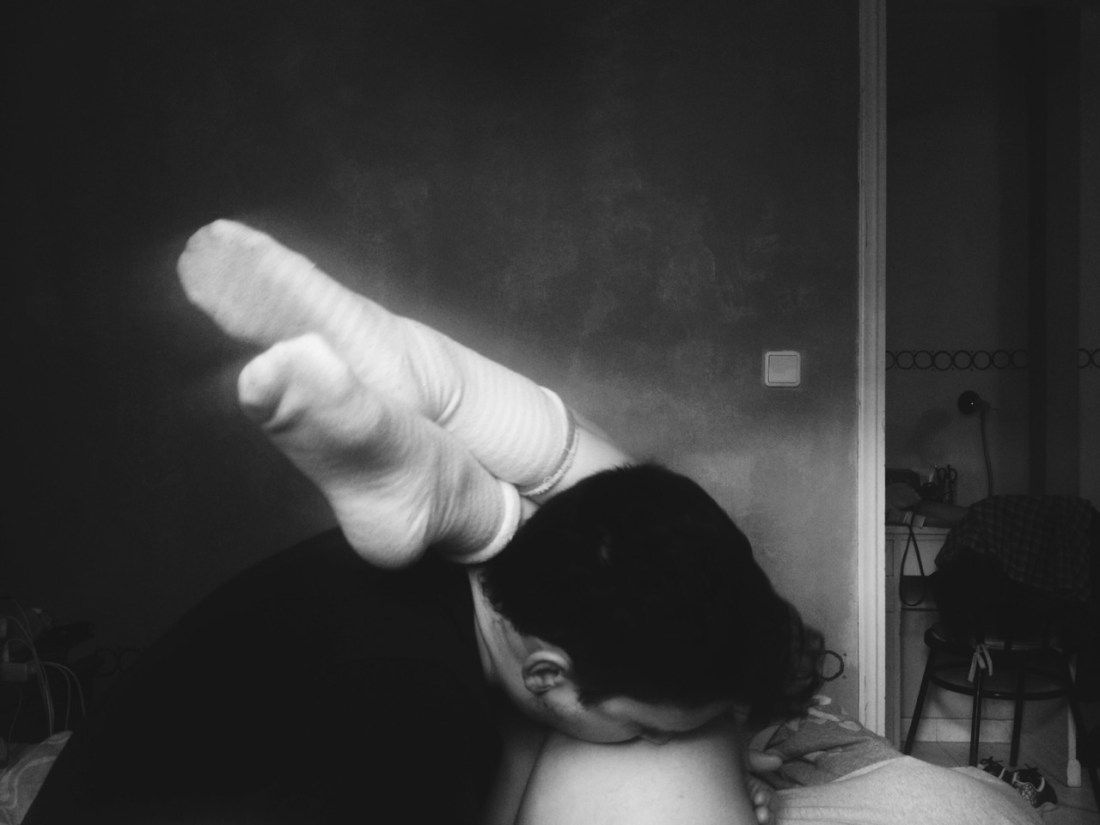
Bo Widerberg – Frame from Love 65 (1965)

I wish I was better able to speak to this image. Specifically it’s composition–which appears like on of those perfectly inspired moments where the resulting photograph reads as devoid of any sort of rehearsal, premeditation or artfulness.

The truth is there is an abundance of all the aforementioned traits (not the alignment of the eyepiece with the angle of the baseboards, the whiteness of the black sweatered arms focusing the lens contrasted with the grey scale of the woman, the angle of the floorboards.

I haven’t seen this film–I’m not sure it’s even available. However, based upon this one frame I would wager that a prevalent theme is the challenge of sharing the world an artist sees through their mind’s eyes with another.

Also, I can’t look at this and not think of the initial sequence in Kieślowski‘s The Double Life of Veronique where Weronika is laying upside down on her bed staring at the expanse of the star filled night sky through a glass orb, which inverts and magnifies everything.

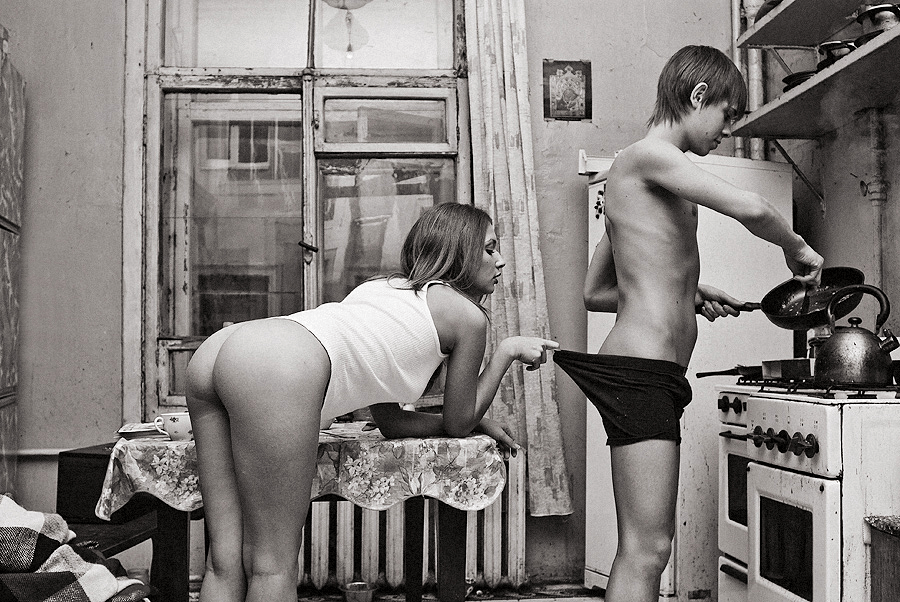
Igor Koshelev – Утро доброго дня (2010)

My Russian was never exactly, how you say: хорошо and the title of this seems untranslatable in an idiomatic sort of way. Best guess, it means something along the lines of the way you might pass a neighbor on the street and as if to indicate the pleasant weather, you were to say: looks like it’s gonna be a wonderful day.

I like the way the title functions here. It doesn’t add anything–only reifies what’s there. It’s the way a narrative image should be titled. Not that this is a narrative image, mind you but it’s at the very least on the right track: you have characters, setting and an inference of what’s happened previous and what will almost certainly follow (i.e. this is a new couple who’ve probably been up late into the night fucking and are about to digress into a diversion that will result in eating their breakfast cold).

There’s too many questions for me to suspend my disbelief enough to accept that this is representative of a narrative. I have no idea if this is her place or his. My suspicion is it’s neither–it feels like a while the parents are away the kids will play sort of scenario; yet there is nothing in the image that speaks to that question. (Also, I’m reasonably willing to bet this image was not taken in the morning. You stare at B&W negs long enough and you start to pick up subtle tones and textures. Gun to my head, I’d swear this was shot on an autumn evening in a decidedly northern latitude.)

This is really the only image of Koshelev that is tolerable. The rest are complete garbage–like truly fucking terrible–which is odd considering despite it’s flaws, this would seem to suggest that this might be the early work of a wonderful photographer.

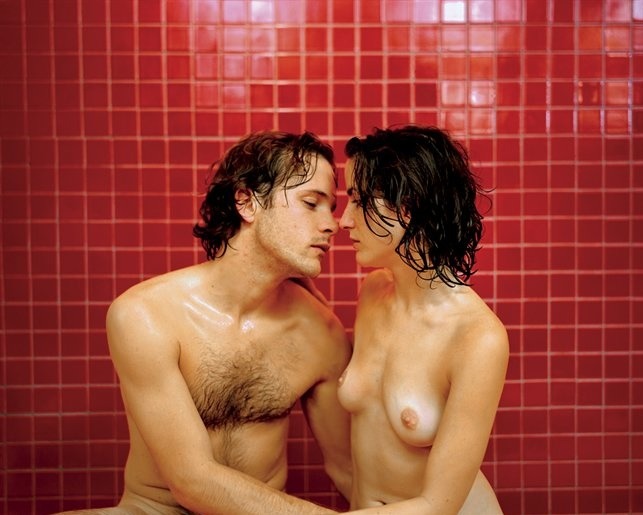
Malerie MarderUntitled (1998-2000)

She explores the psychosexual undertow in close relationships by photographing herself and friends and family in the nude, often in seedy settings such as pay-by-the-hour motels.

Matilda Battersby on Marder’s Carnal Knowledge exhibition

If you only consider her ethos, Marder is exactly the sort of image maker you’d be right to think might motivate me to quit my job, sell all my possessions and become a disciple.

And as much as I love half her work, there’s a prevailing theme of contrite ars gratia artis–as if transgression (or perversity, in the best sense of that word) needs to necessarily be couched in the framework of fine art if it is to be worthy of contemplation.

Marder tends to be less careful in considerations for propriety when it comes to including herself in her work. There is certainly a nobility to that tact, but it does a disservice to her work. Although it’s not a conversation that seems to be percolating, anywhere with her work, I get the feeling Marder has more in common with vextape than Philip-Lorca diCorcia. (There’s zero value judgment in that statement; merely a reflection of the sad fact that our culture has seen fit to lavish praise on a fixation with sexuality that takes a more pathological, apersonal approach while banishing more experiential, personal work preoccupied with graphic depictions of sexuality to the realm of pornography.)

I guess what I am really trying to point to is that with only a few exceptions, the works that move me–and the above is absolutely fucking exquisite–is the work where there’s a greater concern for presenting the underlying truth with brutal, unblinking honesty.

I sort of not-so-secretly wish Marder would set out to make pornography, at least once in her career because I am certain the results would be nothing short of revolutionary.

k.flight – [←] in the back of the bus (2008); [↑] we thank you for the spirits that dwell in us and all things (2008); [→] P1080259 (2011); [↓] good morning (2008)

I don’t know what to say.

I’m just… I mean… fuck me, whoever k.flight is, she has a perfectly, omnivorous eye. I didn’t know it was possible to be in love with images but, well, yeah… learn something new every day.

Not to sound like a twitter tween but this, this right here is fucking everything.

Absolutely perfect.

Go ahead and do whatever you want with what’s left of me. And also, if someone knows who k.flight is I would do anything, and I mean ANYTHING for the opportunity to collaborate with her at some future date.

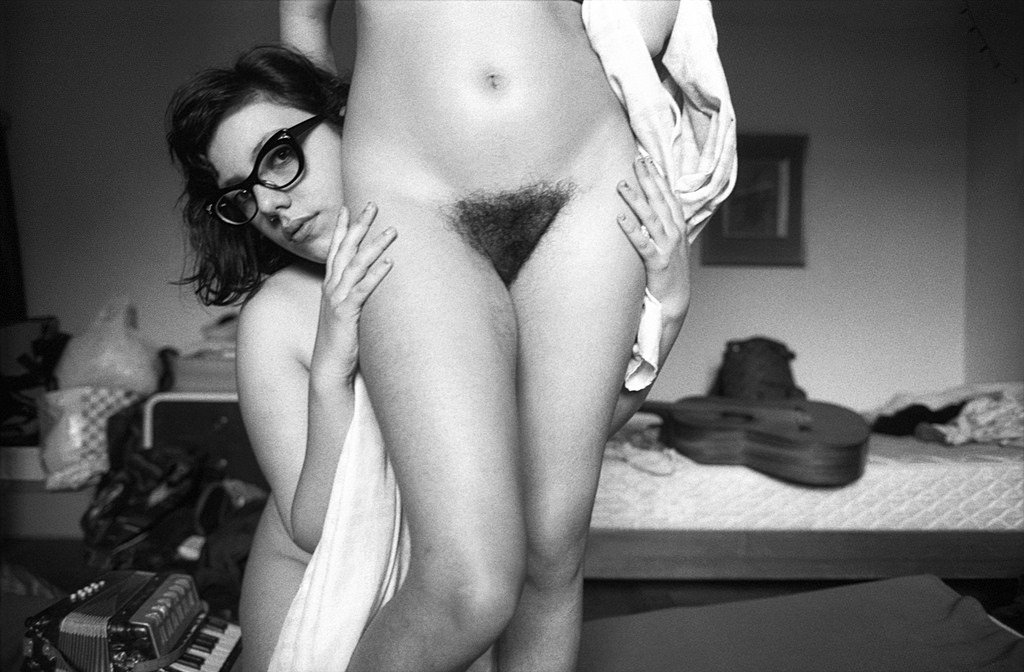
Paula AparicioUntitled (2014)

If there is a single, salient aspect to Aparicio’s work it’s likely the way her photos exude a feeling of post-coital tension between “the waning of ecstatic satiation and the waxing hunger of wanting more.

This tendency is well suited to her style; but, it’s especially noticeable in the way she photographs women.

I’ve lobbed a couple of shots over the bow of the Good Ship Female Gaze previously–namely with regard to Masha Demianova’s claim her work cultivates an equal and opposite response to Berger’s seminal male gaze as presented in Ways of Seeing.

And although I am doubtful, Aparicio would ever invoke the term female gaze to explain her own work, it would almost certainly be more functional applied to her work than anywhere else I’ve witnesses its deployment.

Upon what grounds to a base such an assertion? I am (unfortunately and much to my eternal chagrin) male bodied; therefore what the fuck can I possibly know about a female gaze?

Well, if there is such a thing as the female gaze–unlike the historical male gaze–it’s almost certainly the opposite of monolithic.

I know that growing up seen by others as ostensibly masculine, my experience of attraction, gender identity and sexual desire almost never lined up with my peers.

And I do realize it’s a dangerous assumption to take the braggadocio of hormonal male children as fact based, but I do know that while far ahead of puberty I shared an almost clinical fascination with sexual intercourse and that this fascination was age appropriate within my peer group, it remained a complete abstraction.

Let me try to unpack that a bit more–I feel a very profound need to articulate this correctly. We’d talked about sex, spent hours imagining the mechanics of it and my friends all tended to extend that imagining by connecting it to their sexual response. There was no separation in the expression of attraction and their sexual desire.

What I thought was attraction was actually a need to be understood. The people who listened to me, supported me and shared glimpses of their inner lives were always the people to whom I found myself drawn.

I remember the first time I ever experienced an attraction that linked up with my sexual desire. It was ninth grade. Her name was Michelle. She was my best friend and she’d had a growth spurt over the summer between junior high and high school. She didn’t really notice and I think her family was struggling to make ends meet with private school tuition, so she kept wearing the same clothes she had the previous year. Her favorite pair of pants were these white khakis. They’d been a bit on the tight side the previous year but now they might as well have been skin tight.

I remember walking behind her to class and noticing the visible lines caused by her underwear. I looked away, immediately. Partly because, I felt like I was violating her privacy but also because I found myself stunningly aroused. But my thoughts didn’t proceed from there to a litany of sexual things I’d like to enact with her. Instead, it orbited the notion of wandering if she felt toward me the way I felt towards her in that moment. The thought that there might be a possibility she did was the fantasy I brought myself to orgasm with again and again throughout high school. (Spoiler alert: she didn’t.)

I am hardly so daft as to suggest that what makes me think the notion of a female gaze applies to Aparicio’s work is because I experienced attraction in an unusual fashion. It’s more that the memory of the feeling resonates very strongly with something in her images.