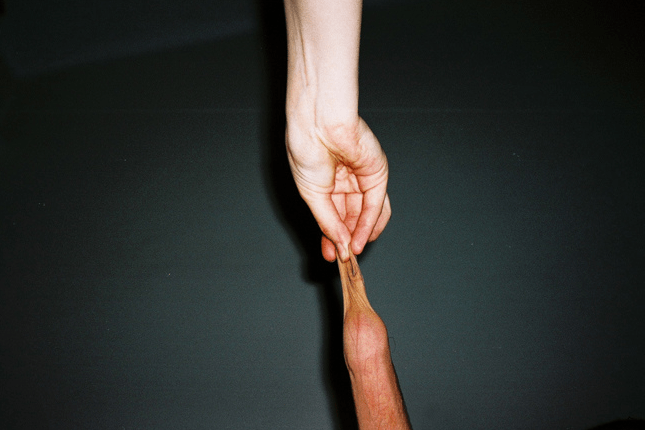
Sasha KurmazUntitled (2010)

Folks are fond of reminding me of Helen Levitt’s notion that the only substantive difference between making work and thinking about making work is whether or not you’re running film through the camera.

I used to object; splitting hairs on the grounds that Levitt was a street photographer and I’m a landscape photographer.

Then I saw this photograph and chugged a big ol’ tallboy of Shutting the Hell Up™.

Great work has this way of transcending the specific confines that contributed to its creation

I’m reasonably sure Levitt would object to mention of her or her work in the context of the image above.

And I’m not sure I’d take issue with her quibble. Kurmaz’s work is largely derivative–borrowing wholesale, in turns from Ren Hang, Maurycy Gomulicki and Igor Mukhin.

As a result, his body of work is distinguished more by its high-gloss, fashion/lifestyle than a distinctive photographic voice.

Still, browsing his Flickr proves Levitt’s point: as long as you are shooting there’s liable to be some perfect storm of mitigating circumstances where good work stumbles through in spite of everything.

This is one such image. (Also, to his credit, Kurmaz seems very aware of this image’s ability both to read as homage and to accomplish something distinct from the work it clearly references–something that functions similarly only using music instead of images consider the Beastie Boys’ monumental Paul’s Boutique.)
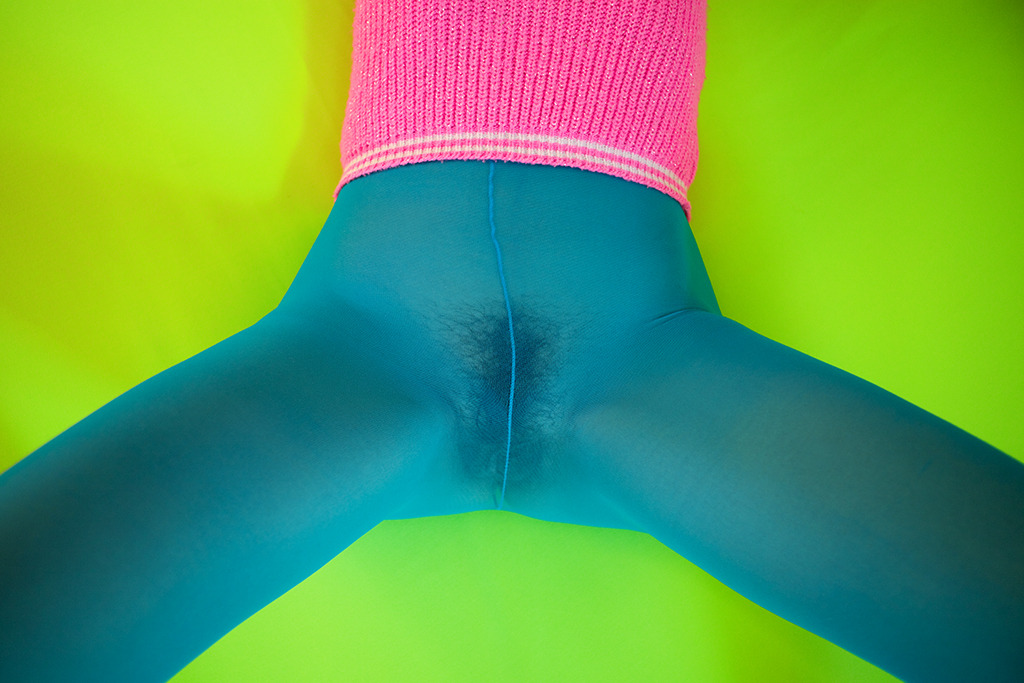
Maurycy GomulickiMINIMAL FETISH_9895 (2010)

This is problematic for the same reasons I took this gorgeous Kodachrome to task.

It’s a teensy bit off balance– the angle of the legs in relation to the lower corners and the uneven grading of the pistachio backdrop; however,  I’m unsure whether it’s a lazy approximation on the part of the artist or an expectation that viewer will get the jist instinctively round it up.

Don’t get me wrong, the interplay of colors is LOVELY. (So much so that when it disappeared from my likes before I could post it, wyoh enacted some of her ‘net wizardry and tracked it down from little more than my muddled recollection of it.)

Gomulicki is trained as a designer and painter. His work is fixated on both documentation and vibrant-to-the-point-of-surreality color palates. And I can’t look at this or any of his images without relating them to amandajas’.

I don’t think it’s difficult to see why: Jasnowski is an image maker preoccupied with image making as a mode of design, after all; and she deploys a strikingly similar palate in her work.

But that connection triggers another question: what is the relationship/where is the boundary between image making & design?

And how does any answer inform the question of the purpose of color in image making practice?

Source: Unknown

Um… so, uh… yeah: LOVE THIS. For you know, reasons and stuff.

At the same time: I hate it, omfg sooo much.

For once my objections have fuck all to do with curmudgeonly hyper-criticality. I object because I am devastated.

I have been trying and failing to make a self-portrait that is alarmingly similar to this; really, this and my idea two might as well be fraternally twinned.

But to top a sundae of injury with rainbow sprinkles of insult: this is just flat-out so, SO much better than any of my fumbled false starts and artless misfires.

And although I have no intention of giving up–I’m exactly the sort of fool for whom the prospect of defying impossibility actually serves as compelling motivation.

Of course, motivation alone doesn’t address the fact that I am not getting any younger and I will never be ripped with six-pack abs.

But my phenomenal lack of physical attraction isn’t even the most profound hurdle. This was almost certainly taken by another person. I only have and will likely only ever have–sadly: recourse to the self-timer.

Mike BrodieUntitled Frame from A Period of Juvenile Prosperity (200X)

Brodie was born in Arizona circa 1985.

Next we hear from him, it’s 2002. He’s 17 and now lives in Pensacola, FL.

He gets it in his head to visit a friend in Mobile and hops a train–as luck would have it–headed in the opposite direction. He ends up in Jacksonville, FL.

After bumming around for a few days, he catches the same train home.

“[The experience] sparked something and Brodie began to wander across the U.S. by any means that were free – walking, hitchhiking and train hopping.”

In 2004, Brodie found a Polaroid camera stuffed behind a car seat. Sans any formal training, Brodie criss-crossed the States using the camera to document his travels. .

In an effort to stay in contact the transient communities he came into with, Brodie shared his images on various websites; becoming known as The Polaroid Kidd.

When Polaroid discontinued the stock his camera used, he switched to a sturdy camera of 1980’s vintage.

On the subject of his process, he’s said:

Sometimes I take a train the wrong way or… whatever happens a photo will come out of it, so it doesn’t really matter where I end up.

Unwilling to be chewed up by the pressures and expectations of the art market, in 2008 Brodie ceased making photographs.

He graduated from the Nashville Auto Diesel College (NADC) in 2012 and now works out of his silver ‘93 Dodge Ram.as a mobile diesel mechanic.

A Period of Juvenile Prosperity was published in early 2013 by Twin Palms.

(Note: there are two biographies for Brodie–his publisher’s version and his personal website’s. Both feature a wealth of information but are bogged down by choppy, artless prose; the versions are riddled with contradictions. The preceding text is not original; All I did was to reconcile the information contained in both versions in order to present it with as few changes to the original language as possible. I repeat: the preceding text is not original.)

Cheyenne Sophiaflint (2013)

Jaw, meet Floor.Floor, Jaw.

You two get to know each other because if Cheyenne Sophia keeps making work this fucking stellar, you both are going to be seeing a lot more of each other.

At first glance this may seem as if it doesn’t belong on this blog. It definitely does but I need to slay some irksome dragons before I get into all that.

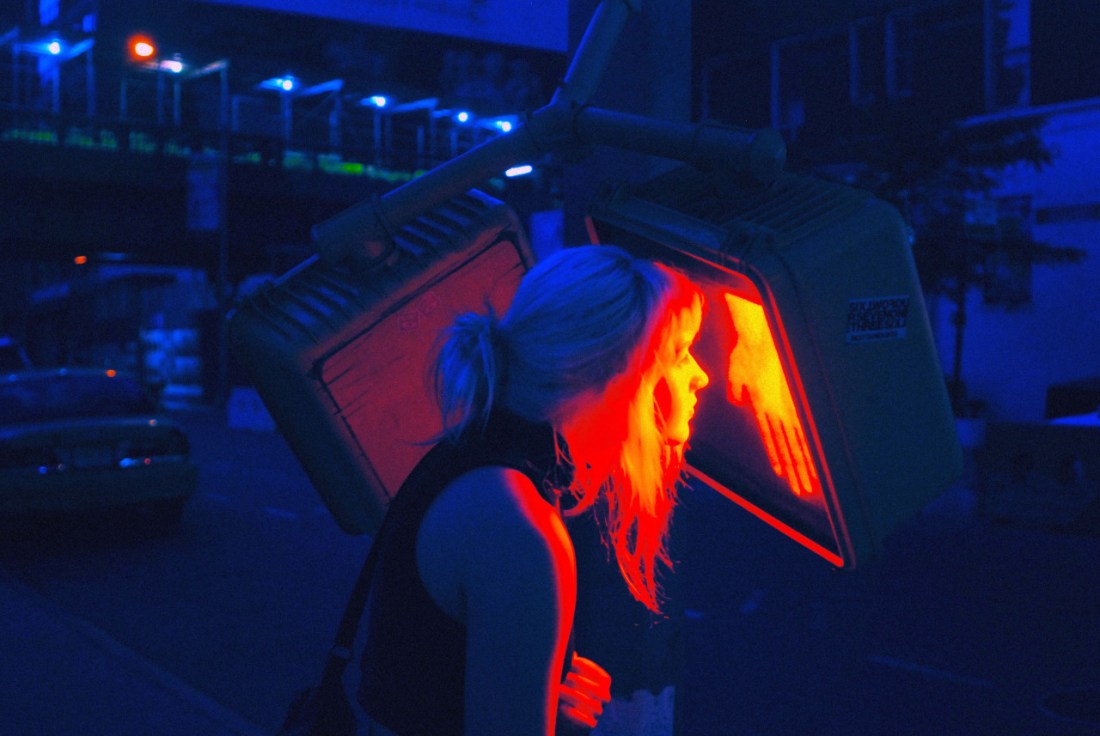
First up, FUCKING STOP drawing lazy ass parallels between the work and Wong Kar-Wai or my arch-nemesis Gasper Noé. Cheyenne admits she isn’t familiar with either beyond their use of super saturated color.

Super-saturated color is a TOOL. Insisting there’s overlap between work due to a single prominent feature considered in isolation is like suggesting there’s a parallel between Henry Gaudier-Greene’s and my own work since both of us favor Pentax 67iis.

Secondly, the look associated with Wong Kar-wai is less his and more Christopher Doyle’s invention. Yes, Doyle lets red bleed out everywhere; so in at least one way there is overlap with Cheyenne. However, the overall effect is ENTIRELY different.

Third, Gasper Noé employs a cacophony of colors that sometimes blur but rarely bleed.

Finally, why compare someone whose work is a great deal more interesting than either of these two artists just by virtue of the fact that they predate her and are part of the art establishment?

Now as to why this belongs here. In an interview with wAsTe magazine Cheyenne speak about the importance of queerness to her work. Her answer is revelatory–not to mention displaying mad strong conceptual game:

Learning about queer culture and feminism has been hugely important in making the work I make and feeling like I have something to stand on. They are both a massive part of my identity and my work is essentially one big self-portrait. Queer work is important because queer people are important.

Whether or not the work she makes fixates on depicting sex there is always an edge to it, an underlying insistence upon “being a feminist artist who is open about sex.”

I CANNOT wait to see more work from this artist. And I am over-the-moon at the prospect of a possible collaboration between Cheyenne & Laurence Philomene.

nymphoninjas:

nymphoninjas:

“And it will be more like a song, and less like its math

If you pull on my hair and bite me like that.” (Bright Eyes)

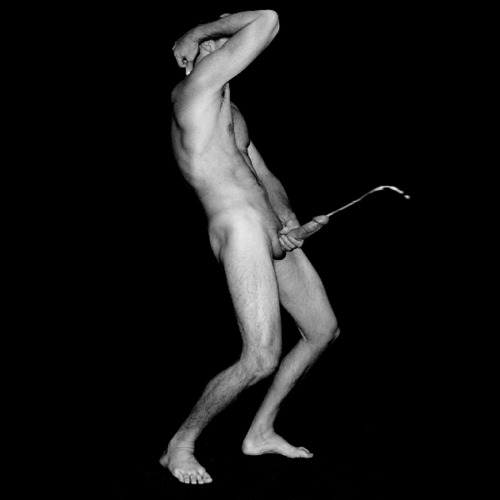
I used to submit my self shots, but now I have few reasons for submitting some I took of my partner.. first of all, there aren’t that many male submissions here usually and I don’t like this difference. this is quite generic view only. most personal is that I enjoy watching my partner playing with himself and it really turns me on. this time I took some pictures of the action..

It was a great Saturday afternoon and we had sex straight after this little shoot and few times later. different places, different intensity but all these were a real pleasure.

Absolutely gorgeous photo, I like everything about it from his sweet purple pants to her knees in the corner. Glad to hear you two are showing off for each other and documenting it, watching your partner get themselves off is pretty much the best way to learn about what they like and how to get them off. Sounds like you two had an amazing day, I’m quite jealous. I hope you two come back to share with us again, thanks again great job A+. 

This and Knitphilia’s Rape isn’t sexy, but being a survivor is are far-and-a-fucking-way my favorite Nympho Ninjas’ Submission Sunday contributions. (An aside: while I am guardedly supportive of the community surrounding NN it does–as an Asian-American–bother me the way ‘ninja’ is so casually appropriated.)

I don’t think this is an objectively good image. Further, pairing it with Conor Oberst’s self-important ravings borders on intolerable.  But, for all its flaws, it has something many more technically adept work lack: truthfulness–the frayed rag rug, messy hair, kick ass pants, beautiful light on the back of his right hand and knees jutting into the frame.

This is the first time in my life I have actually wished a depiction of male-bodied desire was of me–I almost globally identify with female-bodied depictions of desire. Here, I think it’s due to a mistaken notion that if I looked like this there’d might be a slightly better than impossible odds someone would find me attractive.

The Frenzy of the VisibleSelf-Portrait (2013)

The first thing I notice about this is actually the last thing that registers: these are both close-ups.

I’m not averse to close-ups; they allow for focusing on details that might otherwise be missed and when thoughtfully applied can draw attention to the foreign-in-the-familiar.

However, most close-ups exemplify a knee-jerk, voyeuristic fixation: faces and erogenous zones.

It’s sensible enough tactic–glimpse up-close that which is instinctively watched; but there are at least two flaws:

  1. Contextual diminution imposes a representational metonymy wherein a part of the subject (the face) replaces the whole.
  2. Heaping familiarity on top of familiarity in tandem with physical proximity of the imaging device to the subject fosters a false sense of intimacy.

With something like say: portraiture, these are–at worst–critical peccadilloes. When it comes to imagery preoccupied with explicit content, it’s rather another.

This not only shows something beautiful, it shows its work with regard to why what is being shown is being shown in the way it is. (i.e. in close-up)

To see it: take either image independent of the other. Each is strong image in-and-of-itself; each offers an incontrovertible reading of the scene: a male-bodied individual laying on clean, white sheets, masturbating.

Taken together, the artful foreign-in-the-familiar framing in the separate panels merges to form a close-up than in an acharacteristic manner conceals more than it reveals. (Further emphasized by the matting and the orientation as a diptych.)

Truly a first-rate, fucking crackerjack image.

Anastasia Cazabonpart of From the Secret World series (20??)

Artist Statement:

These images are based on my own childhood, specifically the transitional period between the ages of 9-15. This period of liminality, when girls are on the threshold of womanhood, can be one of the most defining and vital stages in a woman’s life. In this stage of life, young women become acutely aware of the world around them and how they are portrayed within the world; physical appearance is suddenly pushed into the spotlight and with that comes insecurity, excitement, jealousy and narcissism.

Relationships with other girls are also critical and these friendships are often fleeting yet intense; feelings of love, envy and rivalry pervade adolescent female companionship. These friendships are also marked by polar swings of emotion – one day encompassing cruelty and the next kindness.

These images revolve around the secret, yet everyday lives of adolescent girls. The power of this transformative time is characterized by the struggle to reconcile one’s girlhood while moving into womanhood – an experience that elicits strong feelings of both fear and longing.