Nate Walton – Alex Papa in Malibu (2014)

Echoes of Nan Goldin’s Kathe in the Tub, Berlin, 1984.

I effing love this image. The way the back lighting creates such stunning separation between the background and Papa’s body–especially her face, neck and torso. The tension between her stillness and the dynamism of spattered droplets frozen in the air–how they convincingly resemble the grain in high speed color negative film.

Claudine DouryLola #2, Tachkent, UZ (2002)

I’m completely head-over-fucking-heels for Doury’s oeurve. She takes the best facets of other renowned image makers (Among them: Nan Goldin,
Sebastião Salgado and Monika Bulaj) and integrates them in a holistic, meditative and frequently hypnotic gaze.

But, someone might astutely inquire, why post them here–there’s no nudity, nothing erotic or seemingly transgressive?

I don’t agree. And the trouble is I don’t know exactly how to fit it to words. I guess it’s not unlike the flashes of awareness that begin as kids approach puberty–those moments of razor sharp awareness that darken faces and features–a febrile yearning for the i’ll know it when I see it future and a palpable fear of one by one putting away those childish things and following blossoming desire like some goddamned pied piper.

Doury’s images radiate with a willingness to stand shoulder-to-shoulder in such a space of betweenness–recognizing and giving thanks for the sacredness of being seen truthfully and without external projection in the one ephemeral and unending moment.

Exquisite to the exponent of transcendent.

Source unknown – Title Unknown (197X)

Although this seems–initially–highly staged/contrived in an effort to balance the composition, there’s also something profoundly compelling about it.

I knew from square one that I fucking adored it. Putting my finger on the why of it took some time. But, last week I stumbled upon an article about a photo snapped during one of the many brawls in the Ukrainian Parliament and how it has garnered a great deal of attention because its composition resembles the Golden Ratio governing composition of Renaissance masterpieces.

It’s really the first time the how of the Rule of Thirds derivation from the Golden Ratio has made sense to me. But it triggered another correlation that’s generally overlooked in most work governed by the rule of thirds–the reliance on an increasingly dense deployment of negative space as thing spirals outward.

This realization reminds me of the wonderful–as per usual–analysis Every Frame a Painting presented of Nicolas Winding Refn’s grossly under-appreciated Drive and it’s use of a so-called Quadrant System of composition.

Granted Refn’s use of quadrants isn’t exactly in line with the Golden Ratio; however, I suspect if one had the time and energy one could demonstrate that the reason some of the unexpected cuts he uses work so well is actually due to an overall respect for the Golden Ratio across connecting scenes… the point is if you overlay quadrants over the rule of thirds and recall that one quadrant needs to be predominantly negative space, then the logic of the rule of thirds suddenly clarifies itself. (At least for me it does.)

I strongly suspect that the above image was originally composed according to the Golden Ratio and subsequently cropped prior to publication. It’s interesting to note that if something is rigorously composed according the Golden Ratio, then any thoughtful crop retains a logical consistency in composition.

Yet, what especially fascinates me  is that although my first thought is stylized contrivance–looking at this now, I view it more as a lie about a lie that manages to tell something not unlike the truth.

I love her introspective expression, the way it conflicts with the obvious catering to the voyeur suggested by her pose and it now strikes me as disarmingly intimate and beautiful.

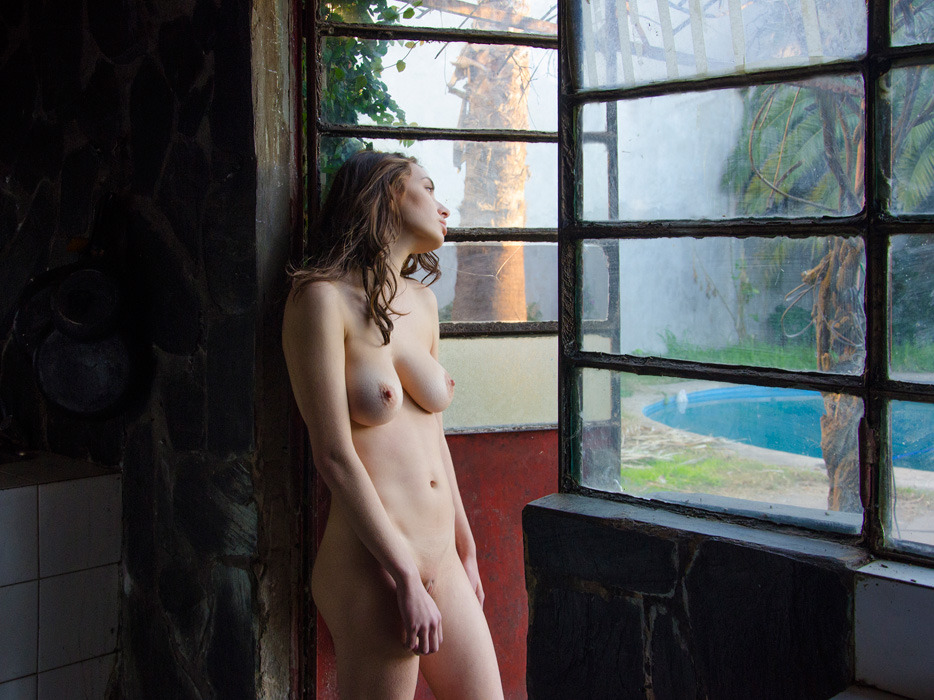
Rodolfo AsinVictoria Bernabei (201X)

There’s probably in excess of a seven (7) stop dynamic range between absence of shadow detail and loss of highlight detail.

In order to accomplish that you really have to know the latitude of your emulsion/sensor and make sure your exposure is dead fucking on.

But what impresses me about this is the fact that you have both a strong blue (the water in the pool), a saturated green (the grass, palm fronds and plants above Bernabei’s head) and a distinct red (the lower panel on the door).

It requires a masterful effort to balance those elements in any image but all that is merely an overture meant to frame both the exquisitely rendered skin tone and morning/evening sun on the palm tree.

All that on top of a thoughtful, balanced composition.

It’s rare for me to encounter work that causes me to pause and independently consider color as anything more than a part contributing to the total sum of the image. Generally, when I think of what I would label masterful use of color it’s work from Eggleston or The Double Life of Veronique–arguably the best example of color cinematography in the western film historical canon. And not to diminish the brilliance of both, what I like about them is they make me think about the role color plays in the reading of an image. Yet, what the demonstrate isn’t easily applicable to my own photographic voice.

I can’t really process it all at the moment, but I feel the stunning color separation in this and the way it is employed in a layered fashion to re-frame the scene from a fine art meditation on the quietness of a moment to a sort of implication of the erotic potential in the physicality of the inter-relationship between being in a body, being caressed by light and therefore seen.

There’s definitely some problems with Asin’s larger body of work and objectification of women’s bodies but the skill of the photographer does manage to sublimate the objectification from time to time–to fucking spectacular effect.

Alena ZhandarovaEvita Goze (2011)

I’m reblogging this from mpdrolet–who if you follow me, you seriously ought to follow; he curates what hands down the best Tumblr blog. (Not to mention: and he’s forgotten more about fine art photography than I’ll ever know.)

It’s odd though because while he’s usually fastidious with sourcing; when he posted this image, he attributed it solely to Goze, linking to modeling work Goze did for Aiga Ozolina.

It’s absolutely worth the time to click through and check out all parties involved. (Especially consider the impact the collaboration with Goze has on the respective image makers codified styles.)

I’m not interested in comment on that, however–mostly because there is something about this image with which I am utterly enamored.

It reminds me of Martin Buber’s I and Thou wherein it’s postulated that their are two modes of relationships in the world–the relationship between a subject and objects (termed I-It) and the experience of transcendent, non-duality (termed I-Thou).

I-It, for example, involves a subject perceiving an object–Molly looking at a painting in a gallery, Dev reading the subway map, etc. I-Thou, on the other hand, like a gust of wind, wrenching open your window and a macaw flying into the room; you are so startled by the sudden and unexpected presence that for a moment you forget to resort to language in the instinctive drive to sort and identify situations; you experience an unmediated fullness of awe in the moment. (This is an example–you can certainly experience I-Thou moments looking at a painting in a gallery. Hell, I wouldn’t be alive if not for that possibility.)

Buber maintains that the spark of the I-Thou moment lies encased–not unlike an insect in amber–within the I-It moment that litter our lives.

* * *

As an off-the-charts introvert, I need a metric fuck ton of solitude in order to even halfway function as a human being. Yet, I do need a modicum of social stimulation–just not in a small talk/how about this weather/interacting with strangers at a loud bar; I need to feel connected to others.

One of my pressing struggles in my life is balancing the need for some sort of connectedness with the fact that I really only have recourse to more casual and frivolous interactions.

Imagine that we are standing on a cliff overlooking the ocean. I am standing facing you and your back is to the sun dipping towards the horizon’s shelf. Something in the color or the vista speaks to me, I enter into an I-Thou moment. All I can do–without slipping out of the moment–is instinctively point. Either you’ll see it and share the moment or you wont. Even if I could explain, the explanation would be a little like explaining a joke–that which was humorous is rendered sterile via translation.

* * *

I want to share the I-Thou spark that flickers just below the surface of this image. Don’t you see it? It’s staggering…

if you don’t the only thing I can suggest is to remind you of the scene in Klimov’s masterpiece Иди и смотри (probably one of my three favorite films of all time) where Florya shakes water from the trees and dances with Glasha in the rain?

Don’t you see it? Look. It’s right there…

Lula HyersUntitled (2014)

Were you to take the current bumper crop of twenty-something lifestyle/fashion image makers, write their names on slips of paper, fold up those slips and place them into a hat, shake the hat about and pull out a name at random, any name would share some obvious parallel with Hyers’ work.

I am certain that Hyers would be at least passingly familiar with the large majority of names in that hat. She probably even considers many of them influences. The thing is: her work is also frequently better than the work of at least ¾ of those names that might emerge from the hat.

A bold statement: yes; but if you stop and look at her work–I mean engage with it–you can’t dispute the assertion. Add to that, Hyer’s still being a teenager and Jesus Harold and Maude Fucking Christ on Christmas her aptitude is freaking unbelievable.

And while I am of a mind that she’s better than the majority of her peers/influences, what she does better than just about anyone is the way she presents bodies and the sometimes related sometimes unrelated sexual expression of bodies as almost an afterthought–allowing her broad latitude in presented the truth of those in her life without misrepresenting the complexity of the moments she captures or relying on knee jerk shock value.

It’s surprisingly mature work for someone so young. And although comparisons to those aforementioned twenty-something lifestyle photographers are astute (along with correlations to Goldin and McGinley), I feel there’s a closer relationship with the frenzied urge to document life exemplified by one of my favorite photographers Igor Mukhin.

What I see matters little next to  than simple truth that this work is breathtaking; I cannot wait to see where it goes from here.

Malinda WasellSlowly, my soul awakes (2015)

Out of every 24 hourrs, I spend two–give or take–perusing the work of various photographers and image makers.

Every day, I find work I like. Work I love is harder to come by–perhaps a couple times a month. Then–in an especially good year–a half dozen image makers completely beguile me.

Wasell’s self-portraits are rarer beast. It’s not so much that her images resonate with any great profundity. It’s more their one masterful aesthetic flourish–the knack of employing absolutely fucking impossible light to devastating effect.

I’ve experienced a comparable reaction before. Four and a half years ago, in fact, as a result of of first stumbling upon Lina Scheynius’ work.

On the one hand I grant that it’s not exactly fair to connect a nineteen year-old with a handful of promising images to one of the quintessential badass Internet famous photographers. But look at the way both manage to coax cooperation from insane lighting situations. So the comparison may not be fair but it’s damn accurate.

These two images in particular are wonderful. They’d almost certainly benefit from a more thorough engagement with questions regarding the boundaries separating selfies from self-portraiture as well as concerns over representation vs. identity. Yet, independent of more intensive conceptual framing, there’s both a raw potential and precociousness that is all but absent in photographers twice her age.

Lastly, I would be woefully remiss in my duties were I not to mention Wasell’s Tumblr curation. Yeah, super beyond on point.

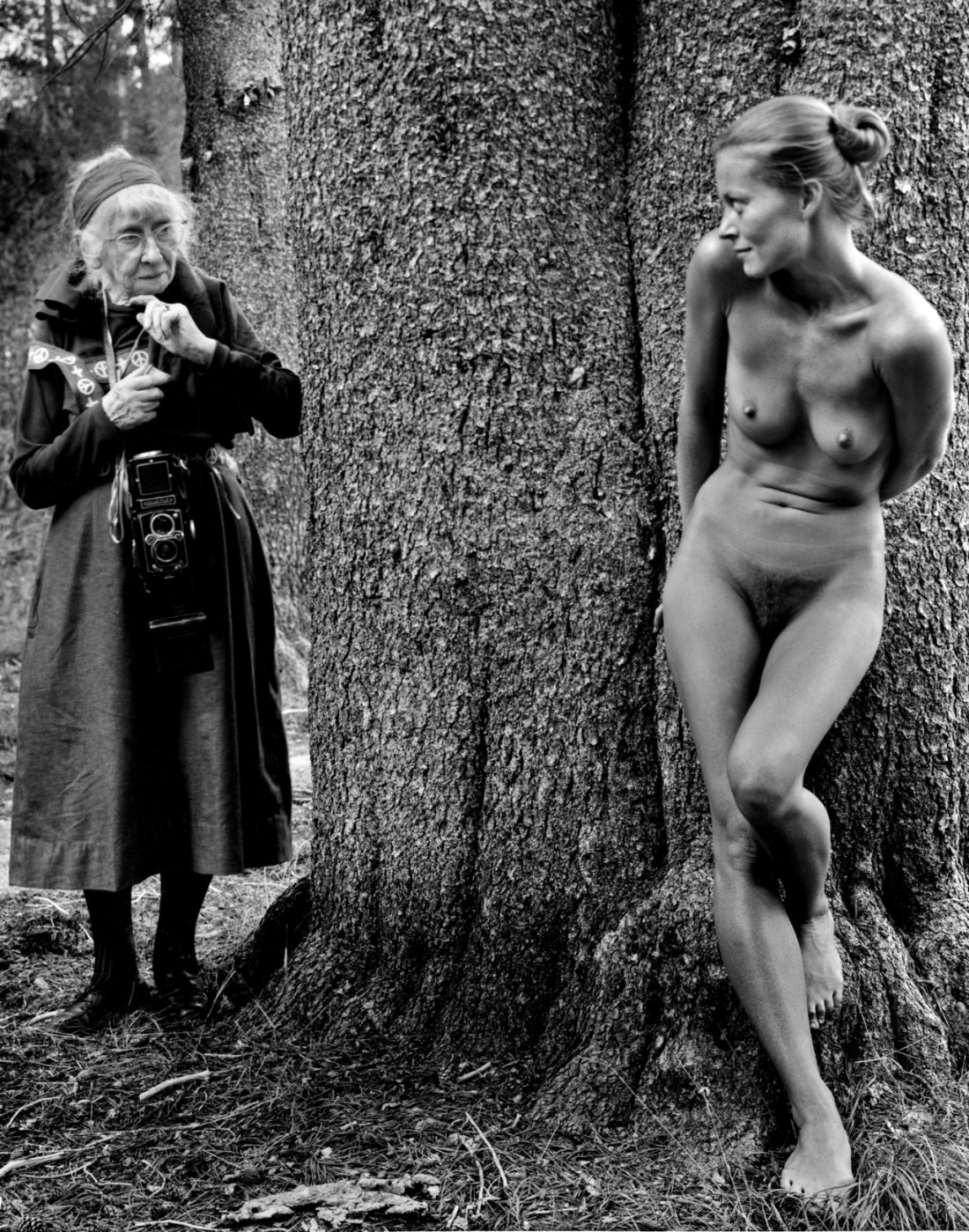
Judy DaterImogen and Twinka at Yosemite (1974)

I was completely unfamiliar with this image prior to this morning. And now that I know about it, I am sort of going crazy over it.

Long story short: I came to photography via cinematography and ever since I’ve been trying to figure out how to convey a narrative within a single, static frame.

There’s a lot of folks who are similarly fixated. Fewer succeed and some (looking at you, Crewdson) don’t even come close but continue to tout their work publicly as narrative despite a colossal misunderstanding of what narrativity entails.

This image is narrative as fuck. What we are seeing is indisputable. A woman with a camera has walked around a tree and to her surprise, encountered a nude woman eying her coyly.

Given only the image, we can surmise both what led up to this event and what will follow from it: respectively, a photographer was wondering through the woods looking for a scene to shoot and now having found it she will take a picture.

But… but… (sorry, totally v. emotional ova here) that framework suggests a number of questions: who is the photographer and why is this woman just leaning up against a tree naked?

And unlike so many images that rely on the inclusion of accompanying text or a title to activate the narrative, the title here–hallelujah!!–directly addresses those questions: the photographer is Imogen Cunningham, one of the first American female photographers; and the nude woman leaning against the tree is Twinka Thiebaud.

Further the mention of Yosemite serves the dual purpose of connecting this to the American photographic tradition–Eadweard Muybridge and Ansel Adams writ all the way into the fucking margins–and grounding it in the fact that this image came out of workshop (organized by Adams) entitled “The Nude in the Landscape.”

Apparently, Twinka character was conceptualized as a woodland nymph after Thomas Hart Benton’s Persephone. (Note how this intricately compliments the fantastical undercurrent of the initial narrative interpretation as well as presents a critical and conceptual weight to the mention of Yosemite in the title–i.e. the American west and it’s relationship to the nascent medium of photograph as a new mythology.)

I’m overcome by how incomparably perfect this is. This is the model for the work I want to make as a photographer.

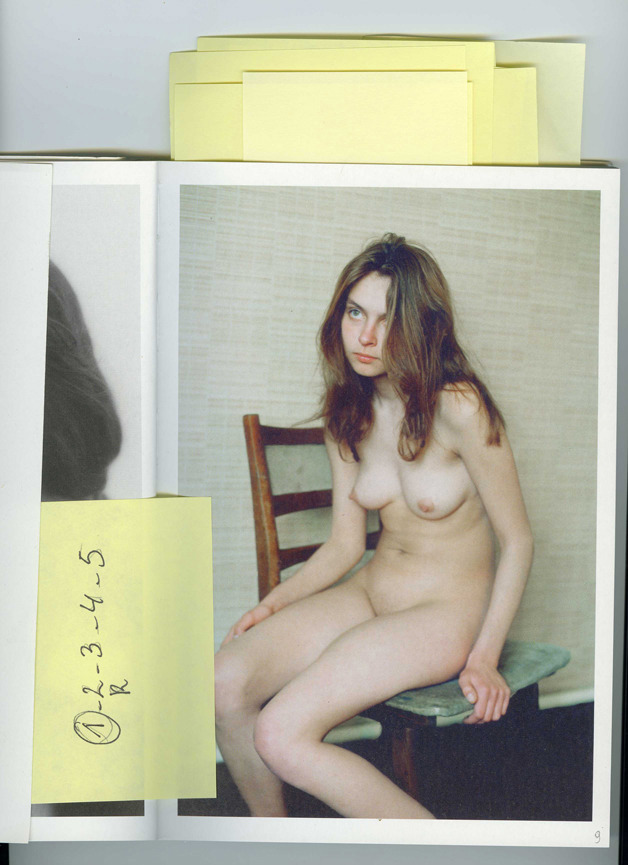
Arno NollenUntitled (20XX)

Although I can’t make heads or tails of Nollen’s work–it’s too scattered and profuse for me to know how in the Sam Hell I’m supposed to fucking approach it–this image walked in my brain like it was a cat that owned the joint and my brain had a front door I’d accidentally left open.

I can’t explain why I like it. It’s #skinnyframebullshit and the way her right ankle gets cut off is more than a little awkward. Yet, there’s something about her expression in combination with the self-conscious placement of her hands and her slouching posture that manages to reach in and completely short circuit my brain so that my only thought is Jesus Harold and Maude Fucking Christ on Christmas she is Helen of Troy beautiful, people would wages wars over her.

But I think–despite how off putting I find Nollen’s typical presentation–that in this case it enhances the effect of the image. The post-it notes recall a certain studious academic fervor that I suppose is an effort to undercut the sexualization and objectification that come to bear on the image. It’s half good first step and half cop-out but that it’s there at all feels reassuring in a way that it will probably take me another two years to even begin to articulate.