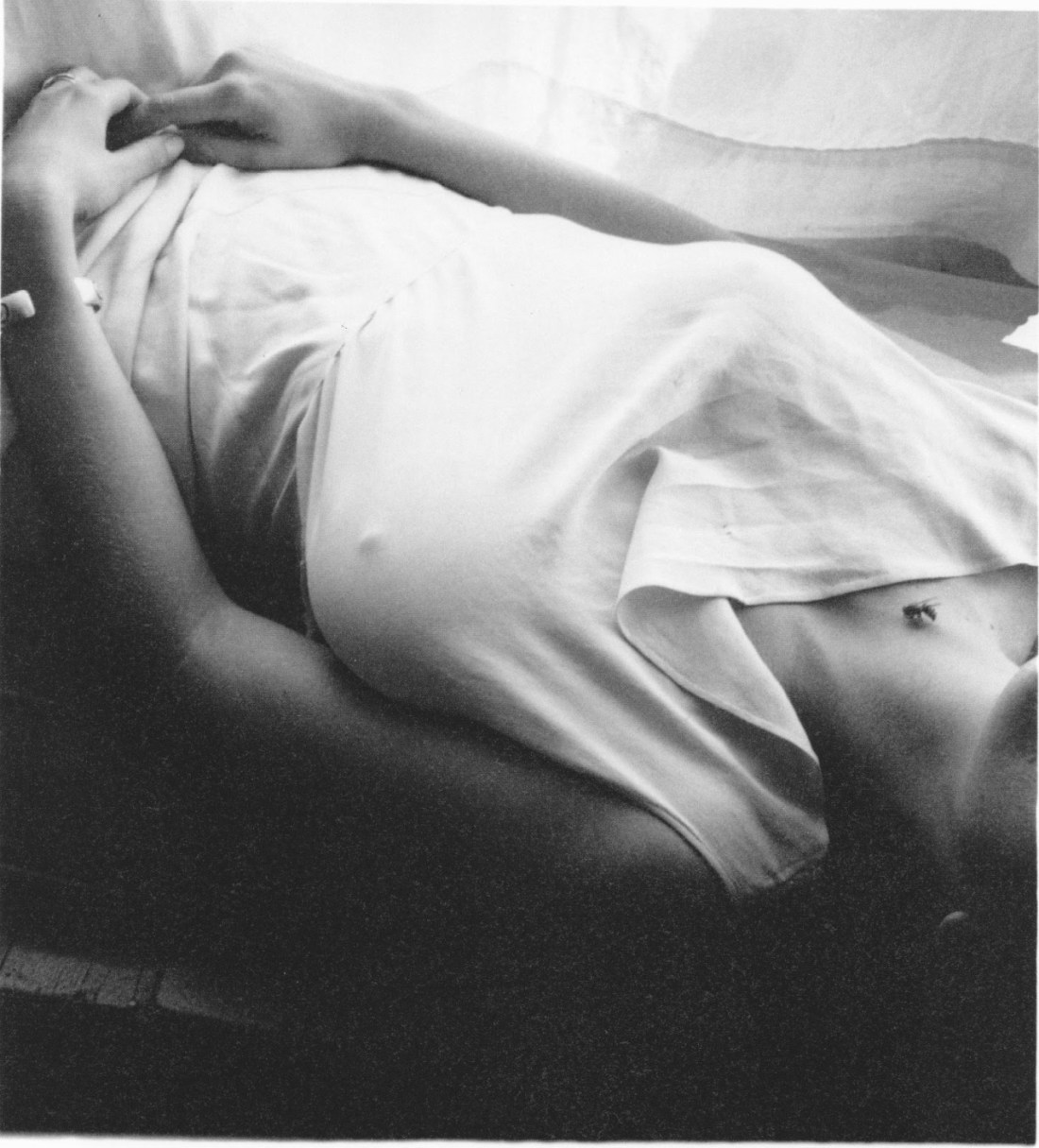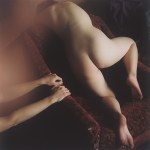
Francesca WoodmanUntitled, New York (1979-80)

My Life had stood – a Loaded Gun –
In Corners – till a Day
The Owner passed – identified –
And carried Me away –

And now We roam in Sovreign Woods –
And now We hunt the Doe –
And every time I speak for Him
The Mountains straight reply –

And do I smile, such cordial light
Opon the Valley glow –
It is as a Vesuvian face
Had let it’s pleasure through –

And when at Night – Our good Day done –
I guard My Master’s Head –
’Tis better than the Eider Duck’s
Deep Pillow – to have shared –

To foe of His – I’m deadly foe –
None stir the second time –
On whom I lay a Yellow Eye –
Or an emphatic Thumb –

Though I than He – may longer live
He longer must – than I –
For I have but the power to kill,
Without – the power to die –
                     -Emily Dickinson

Source unknown – Title unknown (XXXX)

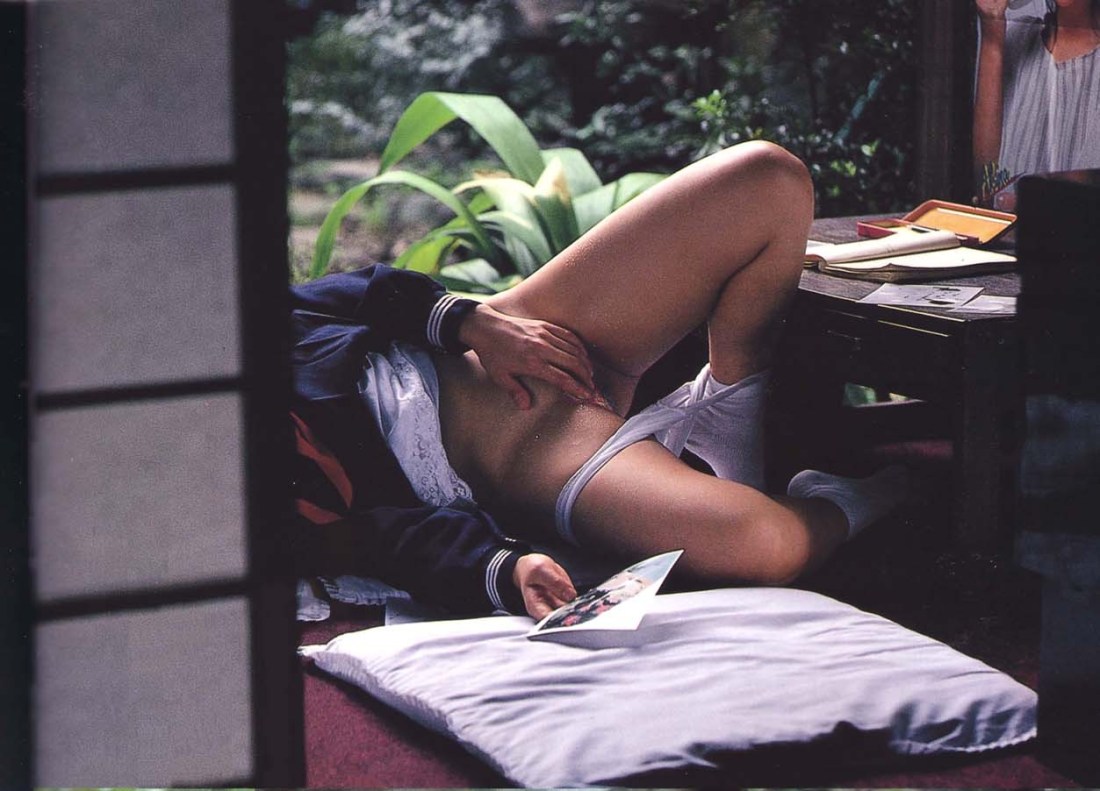
In general, I’m not especially forgiving of tacky composition in erotic imagery.

At first glance–with the young woman’s left index finger and genitals positioned dead center–my gut reaction is to scream BULLSHIT.

That I’m not only willing to give it a pass but to actively engage it has less to do with my profound preoccupation with the politics of depicting masturbation and more to do with the fact that unlike the claims by Gregory Crewdson about his own work– the above is a narrative image (albeit a crude one).

Note: the active workspace, school uniform and skin pricked with sweat. I think we all can remember a time when the heat makes focusing on work impossible and high on hormones, the ache of lust is more than one can endure; so in assumed privacy, one pushes aside various clothing blocking unfettered sensual touch–oh but what that twist in her knickers inside her left ankle doesn’t make me shiver– and sets off in search of release (however temporary).

Things run a little deeper than that though. The room in which this occurs is–in the Japanese style–open to a courtyard which not only contributes a lush and verdant green to the proceedings it also insinuates questions of public vs. private that perhaps not completely but at least tangentially implies a cast aside explanation of the ridiculous framing: someone of whom the young woman is unaware is watching her. (This does raise questions w/r/t consent–invariably experiences in life where we can watch others unbeknownst to them occur and how one responds speaks to personal integrity; however, this is too posed, the lighting orchestrated for me to believe the young woman is entirely unaware of her audience.

What the image does exceedingly well is presenting a carefully manicured fiction that invites suspension of disbelief. Two things I notice is that their is a picture of what appears to be a pop star pinned over her desk. You can’t see enough to determine who that pop star might be. In my mind–always hungry to fill in the blanks–it’s a female pop star on whom she has a crush.

Also, the picture in her hand is tilted at an angle that reduces the glare for the camera but not for the young woman. I’d like to think it’s a picture of her and a girlfriend and that the angle is explained by the fact that she’s already orgasmed–the beaded sweat on her legs (which almost certainly is water from a spray mister)–and is exploring the mostly sated, hyper-sensitive perhaps a little horny again already ecstatic afterglow body high that comes with being young, alive and tragically longing for life, as it were, to begin.

The thing this does best is to show that using the frame edges to decapitate a body for the sake for the sake of preserving anonymity is the worst thing you can do. There is almost always a way to preserve anonymity in such a fashion so as not to disembody the subject.

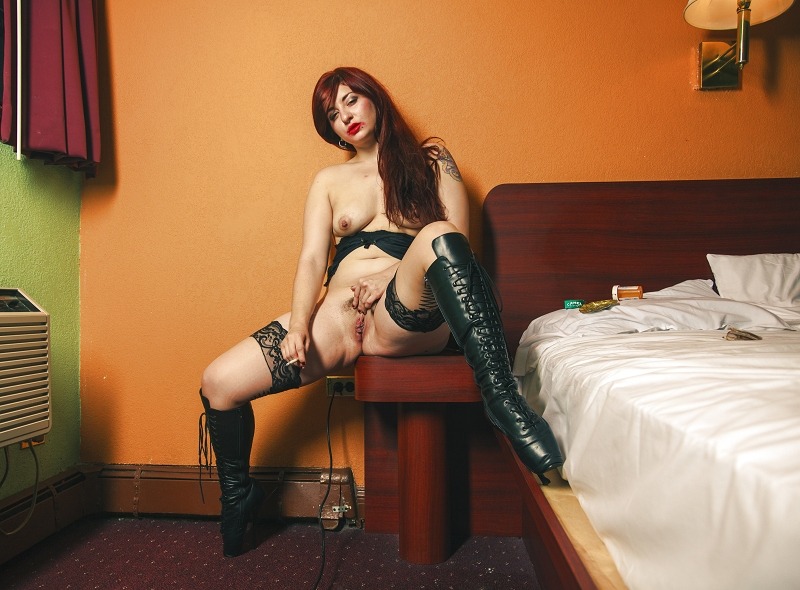
vk-photographyFreshie Juice (2014)

The use of color in this is masterful. The avocado side-wall juxtaposed with the clementine skin back wall! The way the mulberry of the drapes and burgundy stain of the bed seem as if they are different phases of the same continuous spectrum. (This allows coaxes a flattering accent from the otherwise ugly brown heating fixture.)

Then there is the skin tone. Seriously, I encourage you to stop reading now and enlarge this. (See: how the mattress is pushed slightly to the side to reveal particle board that is sort of a control tone distinct from the skin tone range that actually causes the skin tone to pop even more–that’s some Mike Portnoy level show boating, right there.)

Other little details are just too exquisite to pass over unnoticed: the precision with which the drape pull is aligned with the left vertical frame edge. The corner and the light fixture above the bed are skewed slightly but even once you notice it, it’s hard to actually see it. I also adore that there’s a cord plugged into the socket directly underneath and behind Ms. Juice that then stretches back toward the camera.

Really, all the above would play like a super technical jerk off session, if it were for Freshie’s perhaps slightly stoned, vaguely judging expression taken together with the provocative coyness of her pose is fatherfucking perfect.

This is one of those rare images that I am going to beat myself up for the next year for not having been one of the geniuses involved in making it.

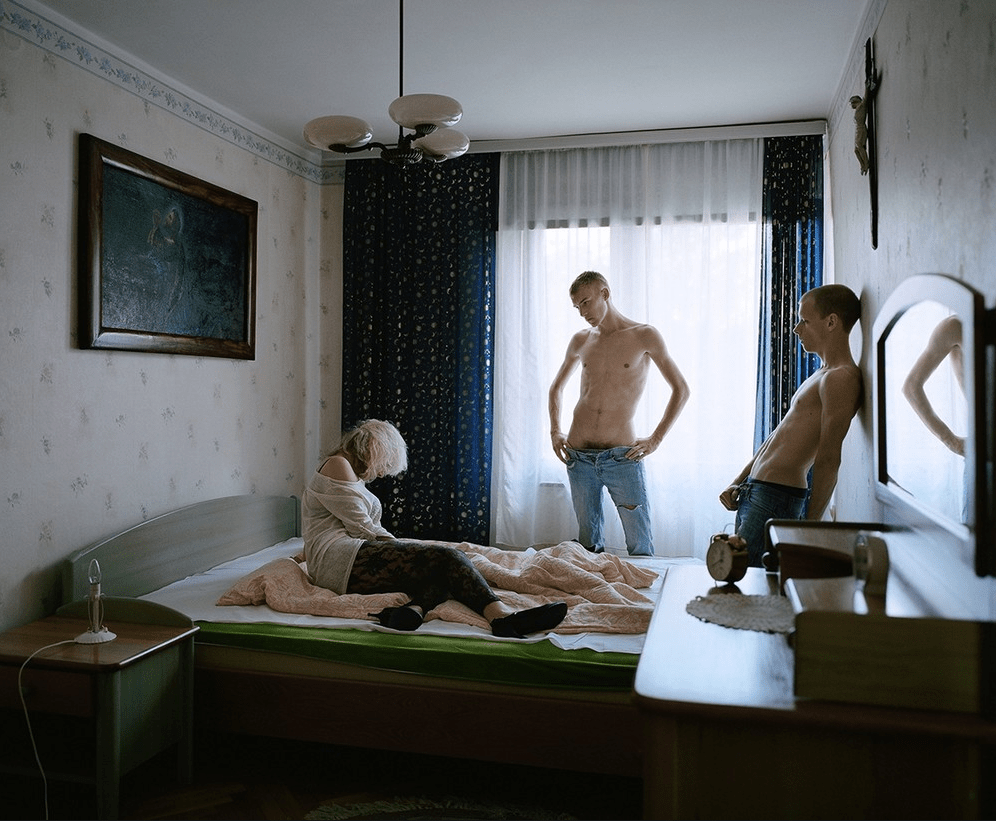
Michal Solarski and Tomasz LiboskaUntitled #98 from Cut It Short series (2013)

Pursuing this blog I’ve encountered exactly four (4) photographers whose work destroys me: Igor Mukhin, Amy Montali, Allison Barnes and Prue Stent.

Michal Solarski needs to join them.

I don’t even know where to start here. I’m Stendahl-ing all over myself.

The religious iconography alone–Jesus praying in the Garden of Gethsemane on the left, a crucifix on the right, i.e the span of Christ’s final mortal night framing the scene–speaks volumes. Add the triangulated tension–personal, sexual, dramatic and fuck me but if this isn’t utterly compelling.

What would be a throw away subtitle [a]fter first sexual encounter instead puts the rest the electrical charged question of have they or haven’t they.

But this is one of those times when I need to shut up and trust the work to speak for itself. Here are Michal on Tomasz on Cut It Short:

We come from a little town of more or less four thousand people, in the southern edge of Poland. This is the place where twenty years ago, both of us were coming of age. It was nothing unusual, growing up is a process everyone goes through and there are certain things we all must encounter and discover at some point or another, and people of a certain generation find themselves going through the same fads and trends as fashion, attitudes and politics enter our awareness, well, at least that’s what we think.
It was the early 90’s, and if you really wanted to be cool, there was only one way – to declare war on your hairdresser, wear anything stripy and dive into the very depth of the Grunge revolution.
All that counted was our friendship and our dreams. And always, while listening to another new CD, somewhere in between the first and second bottle of cheap wine, that absolute certainty of having our lives under control was coming back. Time had stopped. But, before we learned the rules of the game, it was already over. Fate pushed to the front row unannounced. It wasn’t the first time fate had played unfairly. We happened to choose different schools, we started to eat burgers and to visit hairdressers from time to time. Both of us went to find our own happiness far from the little town we once used to call ‘home’.
Today we return to the familiar place with Dominik and Marek. With their help we are trying to reconstruct past events of our lives.
Slowly, we are back in the game. Sneaky fate – you better play your cards carefully this time!

The title ‘Cut it Short’ refers to the old tradition in Slavic cultures called ‘Postrzyzyny’. Young boys have their hair cut in order for them to enter society, a ‘coming of age’ of sorts.The custom is still being practiced in some circles as a kind of symbol of obeying the rules.
It’s an autobiographical story about transition between boyhood and adulthood, about friendship, and the passing of time.

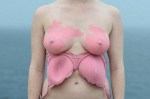
Prue Stentselections from Pink series (201X)

choomathy:

soulsandfishbowls:

7knotwind:

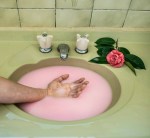
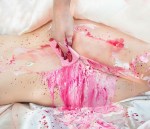
Prue Stent is a 20 year old photo student from Melbourne. The themes of her photography center around femininity and the struggle of identity in women. The color pink is used to represent femininity either physically or emotionally throughout her work.

Her Pink series explores feminine beauty. Stent uses the element of color to raise questions about society’s standard of beauty; breasts, buttocks, and lips are slathered with pink paint to illustrate these commodities are a woman’s own.

found via: http://www.ignant.de/

love it

If this is the future of fine art photography, then Bring. It. On.

Prue Stent = Pure Genius.

Source unknown – Title unknown (201X)

I really, really wish I knew where this is from because it is quite possibly perfect.

Let’s start with the color: the walls are an eggshell that go white in the daylight key lighting, peachy in the spill splashed behind his left hand and hazes towards blue gray as it nears the edges of the frame. His pants and her skirt (?) are black; her top is white and his top is grey. These muted colors punch up the skin tone rendering a spectacular range in both parties skin tone.

That alone would be enough to make me swoon but there’s more: the way his shoulders are cantilevered against the wall as she pulls his center towards her is almost certainly a visual rhyme with one of the most exquisite studies of figuration motion in the western art historical canon–Bernini’s Daphne and Apollo.

Vladimir Nechiporenko – [above] *** (2011); [↖] *** (2013); [↑] *** (2014); [↗] *** (2014); [↙] *** (2014); [↘] *** (2014); [below] *** (2014)

“Before I take my last breath, before my last flower withers, I wish to live, I wish to make love, I wish to be in this world close to those who need me, those who I need, in order to learn, comprehend and rediscover that I can be and I want to be better at every moment.”

                     –Ahmad Shamloo

[↑] Igor MukhinUntitled (2010); [←] rule of thirds (overlay); [→] rule of thirds + 18° (overlay); [↓] grain density & depth of field (magnification sampling)

I talk to much and say too little. I decided to show as opposed to telling you the genius-tier visual math shit going on here.

Igor Mukhin has forgotten more about the photographic craft than most of us will ever hope to know.

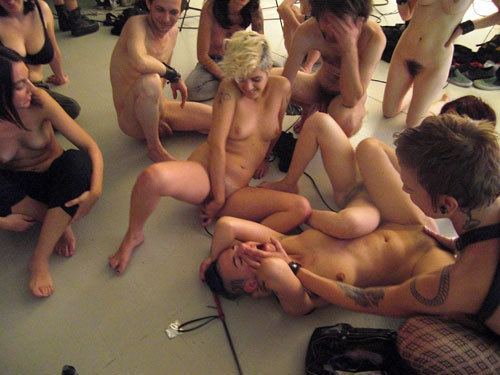
FeminismoPornoPunk – Documentary still from Public domain porn version (2008)

Catalan Theater Directory Roger Bernat staged Public Domain in 2007. The underlying notion being to eliminate the audience/actor distinction.

[Public Domain] is (like) a life-size board game in which the spectator is more than just a pawn. Theatre-maker Roger Bernat assembles a group of people – the audience – on a square. Who are they, where do they come from and what is their relationship to each other? They walk across the square while listening to a series of questions and instructions on their headphones. Some are more innocent than others. The same can’t be said for the result; through the participants’ simple movements, small groups start to form in the audience. These micro communities expose underlying social patterns and tell a tale that Bernat carefully orchestrates. While [Public Domain] starts off looking like a 3D poll brought to life, the project ends up transforming into a bizarre fiction.

Maria Llopis reimagined Bernat’s concept as DIY porn for the Beatriz Preciado curated Arteleku in Donostia, Spain one year later.

I’m an extremely sexual person. However, I’m also aware that as someone who passes for straight, white and cismale–although I would never claim any of those terms in self-identification–I experience a degree of privilege.

As someone who passes, it’s assumed that I fit squarely into the cismale heteronormative default. I don’t though. I care very much for others’ autonomy in self-identification but the truth is I’ve never found label words especially useful. About the only label I don’t dispute is the distinct of being a ‘switch’ on the D/s spectrum.

It’s difficult to lack a readily available means of expression. On the one hand I want to distinguish myself from what I may be perceived as being by others. But how do I do that in a way that isn’t appropriative at the same time as also not being entirely fucked up and entitle?

I can’t say I’ve discovered anything that works. But I have definitely learned the importance of safe spaces–and not just safe spaces for me but spaces that are safe for myself and inclusive and safe for others, too.

At present this fits the form of a tweak to the ubiquitous Golden Rule: do unto others only as the would of their own free will and volition do unto you. (Being that I am on the autism spectrum, this isn’t the most effective coping mechanism…)

The above image suggests several things:

  1. I can’t look at this and not flashback to that scene in The East where the anarchist kids are playing spin the bottle. It strikes me that there’s huge overlap between that space in the one above; an emphasis on  intimacy, connection and using consent and negotiation/re-negations to test/push through largely arbitrary boundaries. (It’s also enormously helpful–not to mention fucking wonderful–that The East includes a queer perspective!)
  2. It also reminds me of Stranger by the Lake (a great film for it’s artfully graphic depictions of gay sex and is currently streaming via Netflix). With the world growing increasingly compartmentalized, sex is everywhere but unless you are a multinational corporation or resemble the board of said multinational corporation–whether or not you have access to similar mountains of cash in your private life–there is increasingly no viable venue for safely and consensually engaging with sex on a non-conceptual, tangible level. I think the idea of creating such space is important. But it’s hardly new. The LGBTQAAI community has fought tooth and nail to create such spaces.

This relates to the above image insofar as it is very clearly a safe space, concerned with sexual expression that insists on equal space for queerness.

It also doesn’t feel as if it’s about exhibitionism. That’s a huge thing for me. I am hardly shy. Truth told, there’s like maybe three things I would never consider doing in front of a camera. But I am not an exhibitionist. I don’t have any sort of problem with exhibitionists. But I am not happy with my body. However, for better or worse, my sexuality is tied to the body I have. (I regret very little in life but I wish that I’d done something like appear on I Feel Myself–although they probably wouldn’t take me and I’d have to do something more in line with Gentleman Handling, unfortunately… stupid biologically male body.)

I wish I knew where I could find spaces like the ones this image points toward. I would love to be able to express my sexuality more openly in a fashion that was neither intrusive or entitled.I wish there were more spaces like this–focused on rejecting mass marketed fantasies and instead projecting DIY ethos and creating for ourselves the truthful and open spaces for complicated expression we most want to see in the world.

Interesting, the lack of such space is perhaps the biggest obstacle I face in my own creative work. i patently object to the myth of the rock star photographer. I think the vast majority of Tumblr photographers (good or bad) use fine art nude photographer as a pretext to appropriately channel sexual energy. I have an immense problem with that–not in and of itself but if that’s really your goal then at least be up front about it.

I love looking at naked bodies just as much as the next person. But I am more interested in the correlation between you and your body–with particular emphasis on your negotiation of your own sexuality. I want to ask what turns you on–not as any kind of prelude so much as I find it endlessly, almost transcendentally intriguing to understand how someone else experiences something that profoundly moves them. I’m curious as to what their experience of puberty was like, how they masturbate, whether or not they’d be comfortable with showing me? Is it okay if I show them?

I can’t approach photography except as collaboration between equals. The subject has just as much of a stake in things as does the photographer. And as far as my own work goes, what affects me is conveying something of the highs and lows, the narrative of what it is to be a being with a carefully considered inner life, hopes dreams and aspirations but who is also tied to an inconvenient simultaneously autonomous and desiring body.

It seems simple enough but it goes back to the question of would the person I am asking realistically ask the same in return from me. So far my life so far has demonstrated the answer is a resounding no.