Scott MorganIMG_0283 [1] (2012)

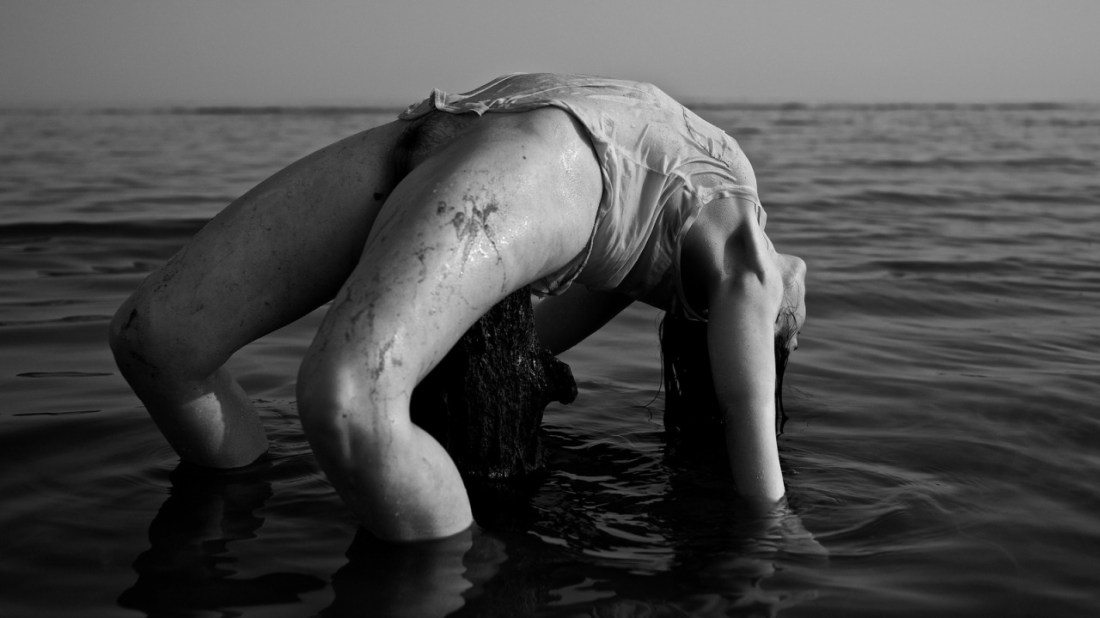
On dry land, even in a studio under canned lighting, this would be a dynamic as fuck pose but orchastrating it so that the pose occurs in approximately a foot of water is inspired.

The problem is that you can’t really appreciate how completely mesmerizing the surface of water can appear when rendered in B&W given this angle.

The better angle would’ve been at roughly the same height as this image, only with the camera angled to see the woman’s face.

Unfortunately that wouldn’t work–since part of what makes this composition work is that the figure is presented off-center and the slanting light capturing glistening skin and taut musculature serves to balance it. Shifting into the better position would black light and in so doing interrupt the carefully positioned horizon (which contributes an oneiric tone) by necessarily including the intersection of water and shoreline from the alternate angle.

Instead, the best course of action would probably have been for the woman to shift 90 degrees clockwise and then to have the camera line up with her face. This would further emphasize the surface of the water and diminish the degree to which the shadows consume her hair, arms and legs.

Although, props to the image maker for having the sense not to make this a full on crotch shot. I know about two hundred lesser image makers who would’ve done exactly that given this pose.

Garry WinograndPhoto night at the Ivar Theater (1982)

Call me an iconoclast if you must but I really detest fucking Monet.

I won’t argue his technical accomplishment as far as applying paint to canvas–at that he was an indisputable master. And Woman with a Parasol is exquisite.

However–by and large–I find his paintings intolerably cloying and consider the impetuses for his stylistic affectation specious at best, at worst: entirely contrived.

At the same time, I would never challenge his art historical import.

I feel similarly about Winogrand–except there maybe merit in the conversation about whether or not he deserves to be as lauded as he has been and in some circles continues to be.

He made some great photos. I adore New York, 1969. And Mark Steinmetz has repeatedly referenced Utah (Wyoming), 1964 as one of the first photographs that truly captivated him completely.

In a painfully overlong, overwrought, overwritten and sparsely edited essay entitled Standing on the Corner – Reflections Upon Garry Winogrand’s Photographic Gaze – Mirror of Self or World?, Carl Chiarenza manages (despite these significant faults) to provide valuable observations and insights; namely: Winogrand produced far more shit than shine and he was godawful when it came to sexualizing/objectifying women.

Yet, with an image such as the one above, anyone with any sort of partially developed critical facilities should take issue here. There is nothing particularly studied about the frame. In fact, it appears like a crap snapshot any idiot with a basic understanding of how their camera works could have produced.

That we look at it today independent of the context of vintage pornography is solely due to the name of the reputation of the person who made it.

But that shouldn’t be where an analysis stops. Frankly, I find this image disturbing. Chiarenze addresses this better than I will but was entirely preoccupied with photographing the world around him in such a way that it allowed others to see the world the way Winogrand himself assumed it ‘really’ was.

The above image is unequivocally about photography. At least three men are taking pictures–the two we see and the third who created the record that allows the viewer to witness the other two.

I get messages all the time from people who think I’m a raging dickhole when it comes to critiquing framing. But take this as an example of two things I’m always going on about–whether or not the image space given suggests a continuity or discontinuity with the space/reality surrounding it and the issue of decapitations/amputations w/r/t frame edges to preserve anonymity or for any other reason.

The frame here is analogous to a peephole where the aim is not the setting but the occasion–a naked women. Thus, there is no suggestion of space beyond the frame edge.

As such, the decapitation is a calculated act of violence. And I can’t help but see a similar act of violence in the patrons–who are equally absent feet and legs which would allow them to get up and leave. The implication of this image is because those who are sexually desired cannot think since they are presented sans heads (minds, facial identities) are essentially interchangeable.

The sex object merely is a sex object, in other words; there is no recursive abilities. But the men–who are presented with head’s–are rendered impotent by their sexual attraction. They couldn’t leave where they are to walk away because they are presented without feet and legs to do so.

Whether Winogrand meant to or not, this image clearly blames the stripper for the existence of this purgatorial tableau–an implication I find fucking repugnant.

Unfortunately, once you begin to see this less-than-subtle misogyny in Winogrand’s work, you can’t help but to begin to see it in everything he ever did.

While in Berlin several months ago, I got up early one morning. Unlike in Brooklyn, where one can get a decent cup of coffee at any hour. Coffee places generally do not open until 9am. I decided that since the sun was coming up and the light was golden and lovely, that I would walk around with my camera for an hour or so.

In truth, although I started out walking around looking for interesting things to make pictures of, increasingly–despite the fact that I am technically a landscape photographer (for better or worse)–I don’t know what to do without people in the frame. I tried a POV shot of myself throwing away a beer bottle in one of those strange brown glass recycling mounds. I tried to treat an abandoned lot as if it were a landscape.

I tried several angles but was increasingly aware that a rough looking forty-something was making a B-line for me. I mean, it had to be me, since there was no one else around.

He queried me in German. Then Dutch before I got out that I only spoke English. He demanded to know what I was taking pictures of. I tried to explain the light was nice and I was looking for shots but he wasn’t interested. He said that I had better not be taking pictures of people; that to do so was illegal and I should know better and if he caught me pointing my camera at him or anyone else he was beat the piss out of me.

I was quite taken aback but he’d already continued on past me, looking occasionally over his shoulder as he moved away.

It turns out that he wasn’t entirely wrong. The legality of street photography in Germany is very much in question at present.

Of course, my initial response was that’s absurd. Street photography is a respected fine art tradition. Making that illegal is detrimental to capital-A Art.

I’ve subsequently come to question that response, however.

These days we are quick to decry invasions of privacy. We rally around Edward Snowden for allowing the world a peak behind the curtain. Yes, that was mostly regarding data accessed from within the privacy of our homes. But in the same breath we fault Apple for tracking our every move and lament the growing security (theater) state, we still defend the virtue of street photography–the whole point of which is to surreptitiously invade personal privacy.

It occurs to me that maybe this isn’t okay. That perhaps my defense of street photography is–ultimately–a defense of the patriarchal straight, cisgendered heterosexual status quo. Since so much of street photography has traditionally hinged on an absence of consent.

Which is not to say all of it. Helen Levitt, doesn’t make me feel creepy. Alternately, some of Vivian Maier work is ethically super suspect from a standpoint of consent.

I don’t know the answer but I know that a great deal of what is considered technical mastery in photography and image making emerges from photojournalism and subsequently street photography. Given the inherent potential for the transformation of photographic documentation into voyeuristic experience and considering the predominance of patriarchy and institutionalized sexism (misogyny, rape culture, et al.), I’m pretty sure street photography doesn’t deserve a pass. In fact, I think it should be aggressively interrogated with regards to this considerations going forward.

Christoph Boecken – Claudia (2015)

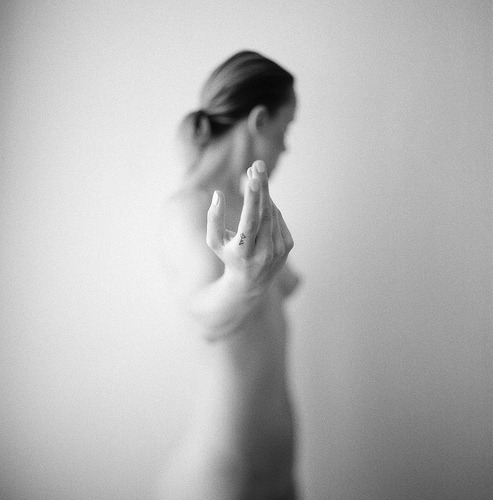
Maybe I look at too much porn but initially I thought this gesture was something more along the lines of this than hey, show me your tattoo.

Either way, it’s nice to see bokeh used as something more than just a means of highlighting a subject in a frame.

Also, check out that creamy medium format film super fine grain tonality–always shiver inducing.

thepureskin:

Hey TPS! I don’t often post pictures of my flower because it attracts the kind of creepy sexual attention that I don’t want. I really loved the movement in this photo. I think women are sexualized so quickly especially when it comes to showing breasts and flowers. So today I’m celebrating how pretty my flower is without feeling sexualized. Kisses! Willow

I completely agree with you, thewillowrae, I’m glad you shared and hope that everyone will see your body simply as the beautiful work of art that it is

This image is just effing awesome.

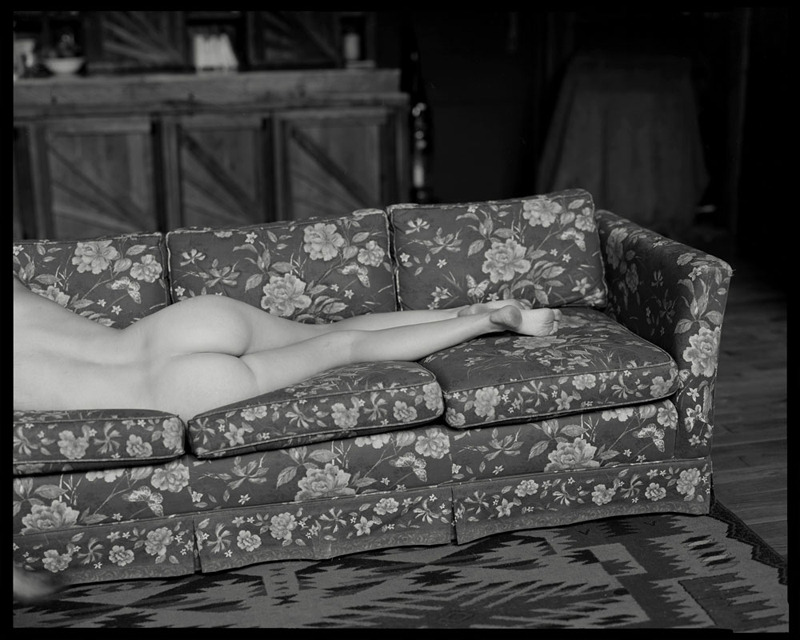
It’s absolutely not #skinnyframebullshit–the viewers eye is intended to move from bottom to top. The angles of the stitching on the duvet emphasize this motion as well as drawing attention to the way the light intersects (from right to left) that trajectory at a complimentary angle.

Further, I am always lambasting compositions that cut off the subjects head since there are literally thousands of ways to present an undecapitated body while maintaining anonymity; this is one of the most creative and just damn ingenious as fuck I’ve seen in ages.

Also, love the nailpolish juxtaposed against the light and shadows on the skin.

Excellent work.

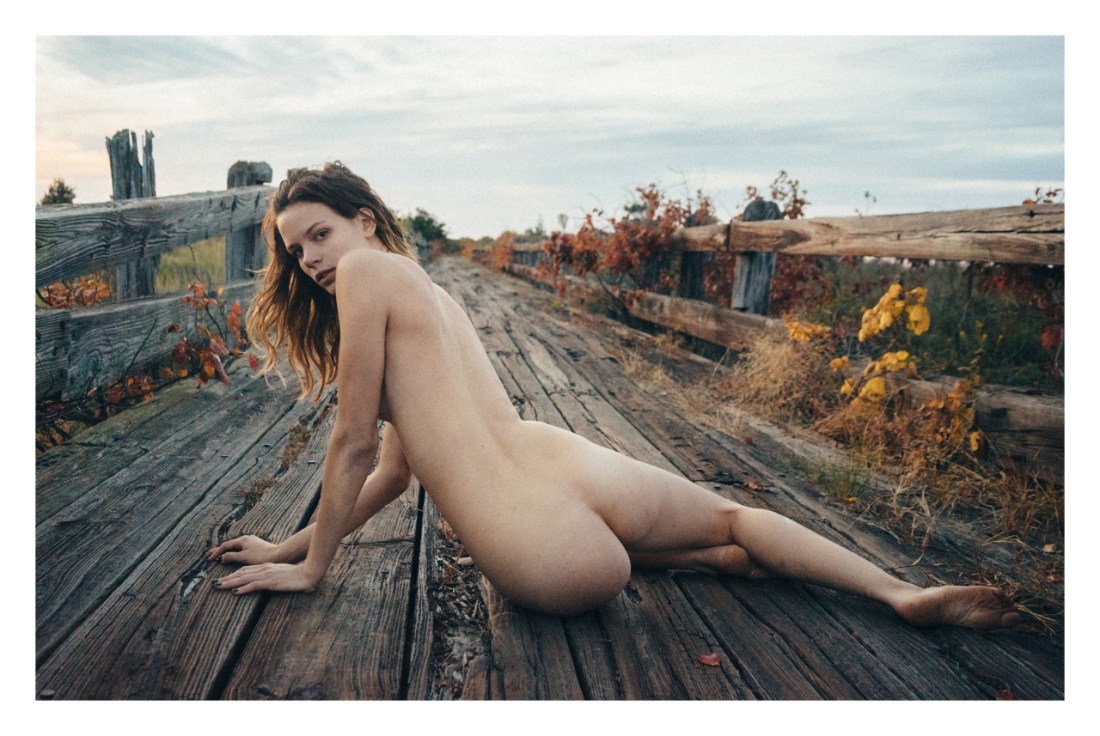
Sam LivmUntitled (2015)

While it’s possible and certainly important to quibble about several problematic considerations given the art historical problem of the male gaze, this is an absolutely fantastic exercise in perceiving color.

Theories on color are a dime a dozen. Color theory with regard to light is different than color theory related to pigments; digital color representation (RGB) is different than the parameters for printing work (CMYK).

I’ll be the first to admit that my (admittedly limited) theoretical understanding of color vastly surpasses my practical know-how. For example: if you consider this work as build on a foundation of Red, Green and Blue, then what becomes immediately clear is the dominance of Red and Blue.

The red highlights in the young woman’s hair, the red-brown of the foilage, skin and wood, the clump of golden leaves in the right third of the frame, the muted nectarine of the more pale skin on her back and shoulder and the more yellow cast of the weathered wood.

There’s the steely blue in the sky, gunmetal blue in the wood, even hints of it in the highlight details outlining her shoulders and hips.

It reminds me of Josef Albers. And yes, that’s a bit of a well-duh! jump to make. But I feel that it’s even more Albers-esque because this doesn’t fixated on only two colors–it uses a hierarchy that enriches the composition by unifying the elements of the image and also prioritizing what is most important about the frame (subject, setting, time of day–in descending order of importance). In the absence of the green, the image would’ve been flatter, wouldn’t have been so visually compelling.

And ultimately that’s what reminds me of Albers–the sort of feeling that rules are limiting and foolish and that when it comes to color, practice should inform theory not the other way around.

I’m not 100% on board with Livm’s work but the one thing I will say without reservation is that he is doing some righteous work with color–and is definitely worth checking out.

Laura KampmanUntitled (2015)

I’d post this just based on the exquisite tonal range and use of the depth of field–the mid-ground is soft while the background (both actual and reflected are sharp).

But really this deserves to be celebrated as a testament to discipline.

Anyone who’s ever tried to take a Traci Matlock-esque mirror self-portrait without looking through the viewfinder, knows it’s nowhere as easy as it looks.

But here Kampman is using a TLR–so she doesn’t even have the benefit of a  straight forward view as I’m reasonably certain that Rolleis mirror left to right in the waist level finder.

And she’s set things up with very thin margins as far as composition, so this is emblematic of a degree of mastery I’ll admit I lack the patience necessary to cultivate.

Allison BarnesBlooming Sofa from Neither For Me Honey Nor The Honey Bee (2014)

While I was traveling in Europe several months back, a gallerist inquired as to who I held to be the single contemporary American photographer making the most important work.

Without so much as a pause, I suggested Allison Barnes.

That probably surprises a few of you with how much I am perpetually singing @ericashires praises…

But while Shires’ polyglotism w/r/t various, disparate image making processes along with the way the tone of her work seems to invoke a similar force as when a dream unexpected develops a malevolent undertone and you wonder if you should pinch yourself, appeal to me on an almost preternatural level, there’s a still small voice that questions whether an image maker can be a viable consideration for the gate keepers of culture without at least some degree of academnification.

With the possible exception of digital collage and the definite exception of cinema, photography is an adolescent art–what with Joseph Nicéphore Niépce’s first image being 1826ish, photography hasn’t even reached it’s bicentennial.

Further there’s a lag between the introduction of the work and it’s adoption by the academie. How long had color photography been around before it was considered a viable fine art medium? How long after Robert Frank’s release of The Americans, the subsequent backlash and the eventual promotion of it to the yard stick by which the art-worthiness of American photography is measured? Who’s the most recent photographer to achieve fine art canonization–Alec Soth?

During the two years I studied photography in an academic setting, I ran into–again and again–this antipathy to work not accepted as ensuing from the framework of fine art photography.

As someone who does a lot of work with nudes in ruins and landscapes, I was concerned about potential overlap with someone like Miru Kim (whom I fucking detest). However, she wasn’t considered to be making work under the fine art umbrella.

I object to this rigid demarcation for at least a hundred different reasons but mostly I hold that without an aggressive cross-pollination of practices, perspectives and methodologies, that which is good becomes less good. In other words, shit stagnates.

No, you shouldn’t include Miru Kim just because she gave an awkward TED talk. But if you step back and look at things with a wider lens, you can see how Miru Kim’s relationship to fine art photography vs. pop photography is the exact inverse of what Noah Kalina’s relationship to those respective categories.

So why Allison Barnes?

Well, to grossly over generalize, it has to do with that adage about a picture being worth 1,000 words. And they question–whether conscious or not–is what do we do with those words? We can explore, document, tell a story, seek out the foreign in the familiar, etc.

I don’t believe it’s an accident that the series from which the above image emerges is taken from one of Sappho’s most famous poem fragments.

There’s that great line by one of the greatest poets–whom I consider an honorary photographer–William Carlos Williams:

It is difficult

to get the news from poems

yet men die miserably every day


for lack

of what is found there.

By using her 1,000 words toward the end of poetry, Barnes does more to unify the rigid parameters of fine art photography with the impetus driving the creation of so much self-confessional pop photography than anyone else with whom I am familiar.

Verbose – Upskirt on Road (2013)

Upskirt as a motif in porn makes me wary. There are so many scumbags with zero concern for basic consent who surreptitiously film women: submariners, Bostonian and this guy in Kobe, Japan.

At the same time, the women I’ve dated have although categorically being only loosely pro-porn, they have all been super into material featuring upskirt shots as a ‘plot’ point. (I’ll never forget the day my ex I and I watched a video with a women hiding under an open stairway in a shitty desert motel to try to peek up women’s skirts while she masturbated. (Of course, this led to another woman catching her.

I won’t argue that it wasn’t a hot clip. I was very into it–if only the actresses seemed really into each other.

Yet, I do think that ETHICAL upskirt is probably a sorely under explored vein of erotic photography.

For example this picture isn’t bad–it’s not compositionally excellent but it’s roughly balanced. Her not looking at the camera and instead futzing about with her shoe–distract from the contrivance of the framing. She isn’t positioned so the view up her skirt is dead center in the frame, either. There’s some subtlety operating. (Although given the composition, a wider frame would’ve be preferable to this narrow frame. I’m only not calling it #skinnyframebullshit because I have a strong sense that it was shot horizontally and subsequently cropped.)

David G. Donnelly (aka oberonfoto)  – Fiona – Nipples Clamped (2010)

Vladamir Nabokov famously experienced what’s called grapheme-color synesthesia.

And every time I listen to a record with great production and some THC in my system, I start to believe that I experience sound as shape. But it turns out anyone who gives a fuck about music and enjoys pot seems to have a similar experience.

I do occasionally have this odd experience of the sight of a particular texture making me think that I can feel it. B&W images of twill patterns exposed just-so they seem to have a 3D pop to them always do it. Looking at them it’s as if I’m actually stroking the fabric with my fingertips.

It can be more subtle. But it can also be much, much more intense.

Take this image:

image

I can’t explain what it is about it but looking at it feels like my facial muscles are similarly contracted and I can almost taste it. But, strangely, I simultaneously feel lips pressing against me and the ever so slight suction. It makes me feel all weird and adlepated in my tummy.

But, with the top picture I can actually explain why it is that looking at it makes me feel like my nipples are clamped. It’s all in the color–the inflamed red against the peach-pink of the areola.

So I’m posting it for that. But it also reminds me of this post guest curated by my best friend. I get the feeling she’d really dig this image.