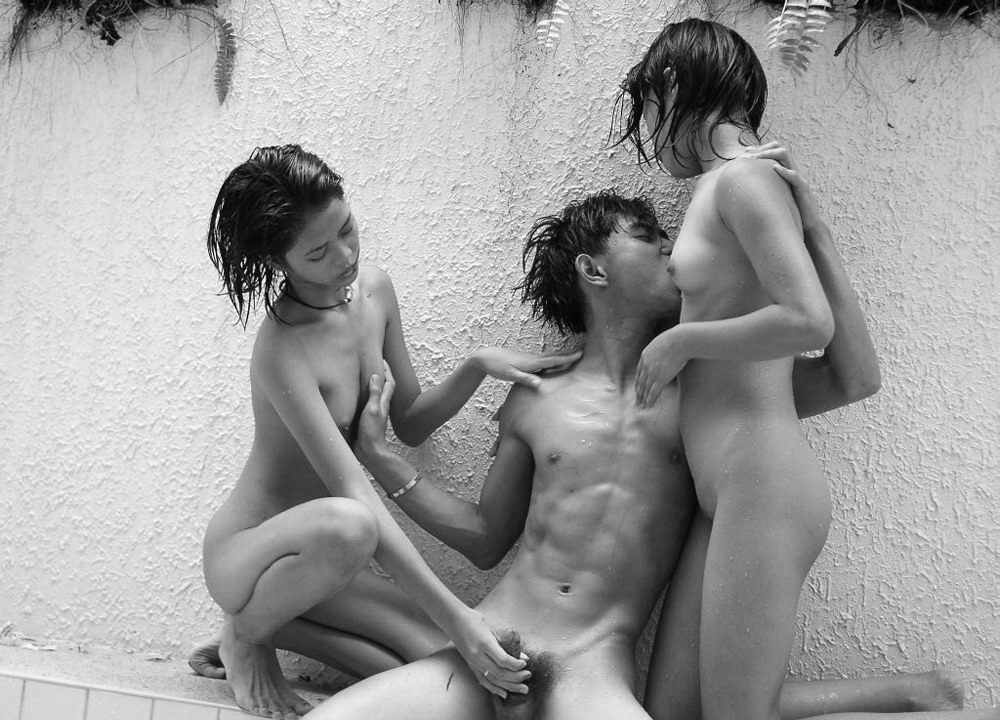
Source unknown – Ace, Joy and Erica (2008)

As a general rule: I don’t post images shot in color and subsequently desaturated. I’m making an exception with this because it’s literally a thousand times better than the low contrast, optically flat and unappealing original image.

Also, I really try not to post excerpts from shitty corporate porn often. I’ve noted the source here as unknown simply because this image has been licensed and relicensed so often, I really have no idea who the original author even is.

So with two strikes against it and the fact that even if the desaturation restores some desparately needed depth and contrast, it is still a compositional shit show–why the hell am I posting this?

Well, not unlike labeling oneself an anarchist unfairly welcomes correlation with Caucasian crust punk wannabe layabouts who smoke too much weed and have a less than nuanced appreciation for Bob Marley, I feel that the credo sex, drugs and rock n roll gets a similar bad rap by association.

That such a ready-made comparison exists is politically expedient. Thoughtful practice of anarchism is a threat to power structures in a way that few other -isms manage and sex, drugs and rock n roll as a baseline system of belief/motivating factor is similarly if not more dangerous because all three independently or amplified in combination have a proven track record of demonstrating to the individual the extent and degree to which learned limitations are bullshit.

I guess my point is that there is only so much you can to to push your own limitations. It’s like tickling–I can’t tickle myself, someone else is required for that.I know in my own experience that although best orgasm I’ve achieved through masturbation is only slightly better than the worst orgasm I’ve ever experienced during sex. You know what you’re going to do before you do it and you know what you like… there’s nothing unexpected about it. Whereas someone else can tease, cajole, surprise and push your body towards amazing experiences you never knew were possible.

And something with which I am preoccupied is the limitation of how much is too much, is too sensitive really a thing? In my experience, the answers are nothing and no, respectively. But I feel like I haven’t considered all the options and when I die, I don’t want to wonder if I was wrong I want to know with certainty that I was wrong or that as I suspect, I was right.

I think at the root of it that encapsulates my fascination with group sex in the face of the fact that I am a misanthrope with pronounced anti-social tendencies.

Lux Aeterna Girl – Untitled (2014)

(I’m not 100% on the source for this. The original post appears to be a now defunct Tumblr named luxaeternagirl; thus I have credited it as such. If that’s incorrect, please let me know and I will edit the attribution.)

This isn’t a good image–not even close. The camera is off-center a foot and panned right about 15 degrees to attempt to compensate. I understand that after cars, bathrooms are some of the most difficult places to shoot due to them almost always being small and cramped but the two shadows in the upper left and right alone with the angle of the tub edge in the lower right corner is really effing distracting.

What I will say is that given what is probably a single incandescent overhead fixture, the skin tone here is very much on point. It has that natural peach tonality that you get from remembering the rule of thumb w/r/t skin tone: Red > Blue > Green.

The rendering of the skin is super important here–by getting it right, it makes the fact that both participants skin is flushed red more discernible. The edge of the left partner is obvious along the outside of the ears; while the partner on the right has reddening ears, faces and neck. It might almost be sunburn but with the pale complexion in tandem with body language, it seems more likely that she’s just extremely aroused.

And that is what distinguishes these images: chemistry. There is no questioning the primacy of their physical desire for one another. The partner on the right in the top image is doing the hesitant if-I-so-much-as-feel-your-skin-I-will-lose-any-trace-of-self-control; the way the partner on the left is leaning in, in an effort to draw the other out. The response in the second image doesn’t give in so much as beg for defenses to be laid to waste, to earn the victory by no other means except total surrender.

To me–chemistry like this is what is missing from 95% of erotic work. And it’s a shame, really… because were effort expended on facilitating it–less artful work (much like this) would shine in spite of it’s technical shortcomings because it would present a record of physical desire it would also simultaneously illustrate something true about the psychology of physical desire.

Besos RobadosY en la neblina de una tarde de lluvia… te espero en donde pocas personas te esperarían (2014)

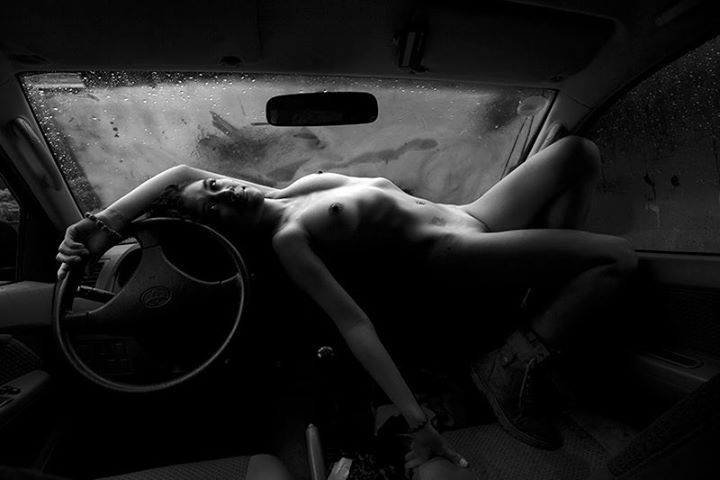
I’ve been thinking a lot about music videos lately…

Partly because I’ve been commissioned to direct a music video for a Boston band. Although to say it like that is a bit disingenuous since the band has a zero budget; they’ve hired me because the singer appeared in three of my five student films and she knows me as a filmmaker who bends over backwards and spits wooden nickels to deliver a product that looks it was produced for roughly ten times what was actually spent on it.

But the other part of why I’ve been fixated on this topic is that music videos played a huge part in paving the path that led me to become a film making kid which led to photography which led to this blog…

As far as informing my basic, initial visual vocabulary, there’s one name that towers head and shoulders above the rest: Mark Romanek.  It’s pretty much unarguable that he made the best music video ever–the issue is whether one points to Jay-Z’s 99 Problems or the Johnny Cash cover of // | /‘s Hurt. (I can’t choose between them mainly because I’ve seen the now all but impossible to find original cut of 99 Problems and that’s just as good as Hurt; but I have always been especially partial to the production design of // | /’s The Perfect Drug and the sleazy post-coital, 70′s porn grunge of Fiona Apple’s Criminal.)

I was aware of Jonathan Glazer‘s work. I was clued in to his work on UNKLE’s Rabbit in Your Headlights while it was still an underground thing–I initially detested but now consider it one of the best narrative videos ever made. (Shows how wrong snotty 19 year old’s can be…)

But it’s Glazer’s take on Radiohead’s Karma Police that applies to above image.

Some context on Karma Police: the video is just shy of four and a half minutes long. It features a total of 13 cuts, rendering in average shot length of 20.7 seconds. (Definitely an enormous anomaly in the mid-90s.)

I don’t know if it’s the extra time we get to dwell on the composition of a camera staring out the front window of a car but this video has–for me at least–become so iconic that I can’t see a shot like the one above without comparing it with Glazer’s image. (As I write this I am in NOLA fresh from seeing the devastating Mark Steinmetz: South exhibit at the Ogden–best photography exhibit I’ve ever seen and there’s an image taken through a car window of a lightning strike in the distance that doesn’t remind me of Glazer and I think that’s because you don’t see the window so much as the out of focus edge of the dash which provides context but is decidedly not a frame within a frame like Glazer.)

The odd thing about Glazer is that while his music videos are far more narrative than Romanek’s and while he continues to explode the boundaries of what is visually possible, his film work–though always beautiful–always flirts with complete incomprehensibility. Whereas, Romanek and David Fincher have proven much better at crafting cinematic narratives.

Alexey Malyshev *** (2014)

The lighting in this is just fucking fantastic.

Honey hued and evenly suffused–providing something like a four stop range between skin tone highlight (closer to the window) and shadow detail (further from the window). Combined with the somewhat shallow depth of field, the young woman is isolated within the frame.

This is the kind of light anyone who knows fuck all about operating a camera lusts after–great when you can find it but not always easy to find.

That’s why as much as the light is what makes this image work, the same light would’ve made just about anything work. (Good light is fucking magic like that.)

What interests me increasingly is work which transforms disadvantageous, even ugly lighting situations into something that motivates the image just as much as if the light had been exquisite.

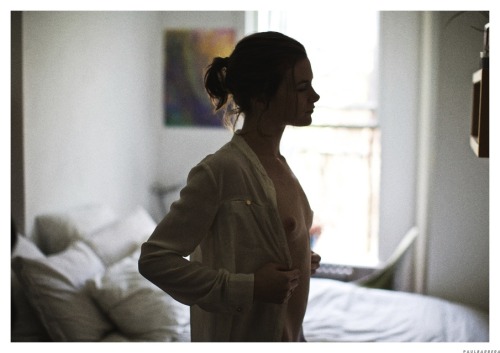
Now I’m not especially fond of Paul Barbara but credit where it’s due: his work is more aware of light than most.

This frame from Barbara’s Love Lost project demonstrates an even more astute use of light than Malyshev–because it manages to employ a stark, bright white backlighting with a compelling composition, that manages enough shadow detail to balance against presenting the young woman in silhouette.

In other words, objectively displeasing light is suddenly rendered not only an interesting factor in an image but a big part of why the image works.

After all if we sit around and wait for the perfect light, we’ll spend more time waiting than we ever spending creating.

Harry CallahanEleanor and Barbara (1954)

onlyoldphotography:

Muses throughout his career, Callahan’s wife and daughter played, posed, and aged before his lens. With their attention to the physicality of light, however, Callahan’s photographs transcend mere family portraiture by calling attention to the simple beauty of life’s fleeting moments. “He just liked to take the pictures of me,” Eleanor recalled in her nineties. “In every pose. Rain or shine. And whatever I was doing. If I was doing the dishes or if I was half asleep. And he knew that I never, never said no. I was always there for him. Because I knew that Harry would only do the right thing.”
Eleanor Callahan died in February 2012 at the age of ninety-five.

Michael Grieve – Porn shoot, Cuffey, UK from No Love Lost series (2006)
This reminds me of a dream I had a little over two months ago.

Really? You remember a two-month old dream?

Well, I’m fairly sure I dream most nights but it is a truly rare thing that I remember my dreams upon waking. On the rare occasion when I do–it’s like water to a man dying of thirst in a desert. As such a make a point of jotting them down in my dream journal.

In this dream, Carin* was in my room. It wasn’t really my room but an amalgam of my current room, the second apartment I had after graduating from college and the room I lived in from 1998-2000.

I can’t remember why she was there but it had that sort of seamless dream logic to it. There was a reason she was there and I had at one point known what that was and as such it had ceased to matter.

[A little contextual background on non-dream Carin: she worked for me for like seven months. She was hand’s down the worst employee I’ve ever had–not because she was incapable of doing the things asked of her (if anything she was overqualified); she just had a piss poor attitude and constantly complained about everything. In hindsight, I realize that her performance reflects worse on my ability to motivate her than her ability to be motivated. Now that she doesn’t work for me, we get on famously.]

Also, I have no idea what color her natural hair color is. In the dream it was blue with bleached streaks.

She was in the middle of the floor seated in a frog like position (Diagram 1) with her pleated skirt in a perfect circle around her. For some reason, this didn’t strike me as the least bit odd even though Carin wouldn’t ever be caught dead in such an outfit.

She was doing her usual simpering bravado routine–which is charming when you aren’t her supervisor. She informed me she’d hidden something somewhere in my room and I needed to find it.

I looked around half-heartedly at first and then began tearing my room apart.

The BB gun I used to have but have long since disposed of (I have an outsize problems with guns) was buried in my closet wrapped up in a towel. I asked her if that was the thing she’d hidden. It wasn’t. She thought it was dumb and even dumber that I had it but that she gave me credit because at least it wasn’t tacky looking.

I realized that she’d clearly gone through my stuff. I thought about all the things I was mortified she’d certainly seen. Only I wasn’t mortified. I asked her if she thought I was a pervert. She said she’d always expected as much but now had the goods and wasn’t disappointed.

I turned around and saw that she was holding her skirt up with one hand and was applying lube to the head and shaft of a truly dauntingly sized white marble strap-on. Taking a step closer, I noticed she was wearing powder blue boyshorts and that she’d wedged a small purple vibrator between herself and the floorboards.

There was an expectant pause accompanied to the buzz of the vibrator resonating against the wood.

This is okay, right?

Before I could whisper yes, I woke up.

*Close to but not identical to her real name

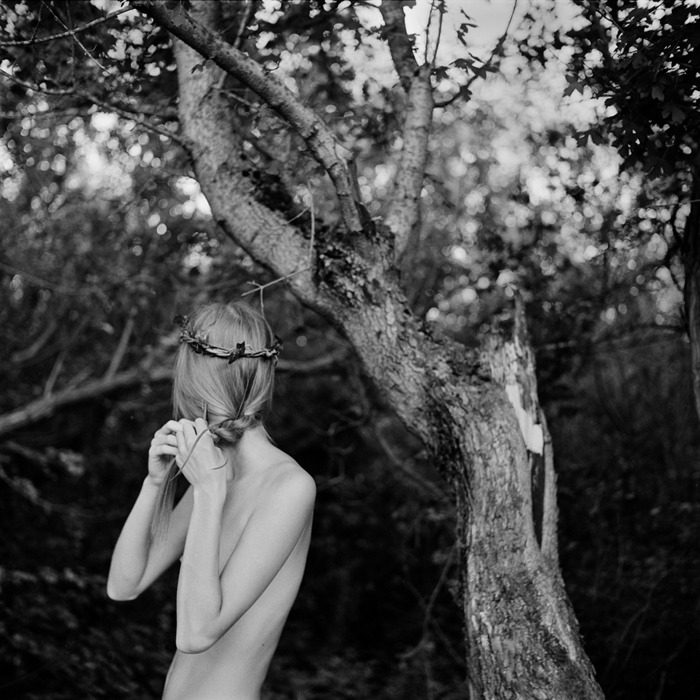
Mariya Kozhanova Untitled from Prussian Brides series (201X)

There are so many things this does well–the tree trunk twists up and stretches away  into the background, the young woman leans every so slightly toward the camera to counterbalance this retreat (it’s rare to see such shallow depth of field used to interesting, thoughtful effect); not to mention the effing lovely cinematic bokeh…

I don’t have any quarrel with this photograph in and of itself. In fact, I’m rather fond of it. The thing that baffles me is the rest of Kozhanova’s Prussian Brides series. I don’t understand the use of eye contact with the camera, POV shots, not to mention her homage to Jock Sturges and startling similar ways her shooting windows is reminiscent of Michelle Arcila.

The statement of purpose accompanying this body of work–contributed by Russian curator Irina Cmyreva– (unfortunately) further muddies the matter. After localizing the work in the history and tradition of Prussia (now Kaliningrad), she connects to work with the ‘original Prussian legend’ where:

[A] dead bride in ancient times whose tomb was opened and it was discovered that she had disappeared. The Prussian Bride is a kind of
film or literary narrative about a girl’s dream of an old house within
an ancient estate in the forests. The month of May is the time when
nature awakes again and is reborn. It is the time of the ancient legends
and the folk celebrations of the “May Bride”. In her re-telling of the
legend of the May Bride, Kozhanova incorporates Prussian culture in the
blond beauty of the girls, the old style of the dresses they wear and
the architecture of the house itself.

It speaks to how much better the above photograph is than the rest of the project that verbal diarrhea such as this actually serves the work. But it detracts a great deal from the rest of the images in the series.

The images are not a stand-in for ‘a kind of film’ or a literary narrative. They might be a bit of a dream–that would alleviate some of my more pressing concerns. However, in point of fact, it’s not. The work is precocious portraiture, edgy editorial or oneiric look book. By trying to be all those things at once, it ends up being none of them.

Kozhanova is still a teenager–a clearly clever and talented teenage. So I’m willing to give her some credit. There’s a chance a 6×6 camera is all she has and another chance that it was less her notion to tie her work together with a pat mythological reference. And even if she was directly responsible for both decisions, her work is sharper than a great bit of what’s out there.

thebodyasconduit [Traci Matlock‘s Tumblr] – Ruby Slipper (2015)

As much as I carry on about composition as a facet of qualitatively ‘good’ photography and image making, truth told: I always favor work which presents the singular immediacy of The Moment.

For example: this depiction of a threesome is indelibly imprinted on my psyche. Is it a qualitatively good image? I’d argue it’s no more and no less important than a broad swatch of Nan Goldin’s photos. The difference is the former is fixated on the immediacy of documenting a moment, whereas Goldin is more interested in photography as an act of memorializing.

Admittedly, both are two shadows cast by the same motivation; but, in Goldin’s case there’s an implicit questioning of how perception works. Given that it’s a hop skip and a jump to an assumption that the work must function as some sort of implicit eye training–exists at least in some part as a means of instruction in or illumination of How We See ™.

And to bring it back to the actual image I’m posting: Traci has been posting a lot of work she made last month with Ruby Slipper. Really, their recent collaboration is just the cat’s fucking meow–you really should check it out.

In looking at this work, I am starting to notice the ways Matlock has matured as a photographer. As long as I’ve known of her work, she’s been better than just about anyone at tapping into the objectless transcendence of The Moment. Her compositions have similarly always been on point. Yet, what is emerging in her work is a sort of hybrid between Stephen Shore’s ability to compose a perfectly balanced frame that appears as if he snapped it off hand as a casual afterthought; or, Garry Winogrand‘s seeming accidental–but in truth, anything but–perspectives.

The work also has something to say about the role color should play in photography. I think I’ve always seen Matlock as a follower of Eggleston; this making it even more clear–afterall, Eggleston pretty much single-handedly legitimated the Art value of color.

But seeing that it makes me question such an assumption. There’s really something here interrogating the boundaries between pigment on canvas and painting with light itself. The above image reminds me of a painting–which, of course, since I’m hung over as the queen in Maida Vale, I can’t recall the painter but it’s like van Gogh and Klimt collaborated.

I’ve put this all badly but my point is simply this: good work shows you something new; great work shows you something you’ve already seen in a new and different light.

Given that metric: Matlock’s work is probably whatever comes after good merges with great.

Silja MaggUntitled (201X)

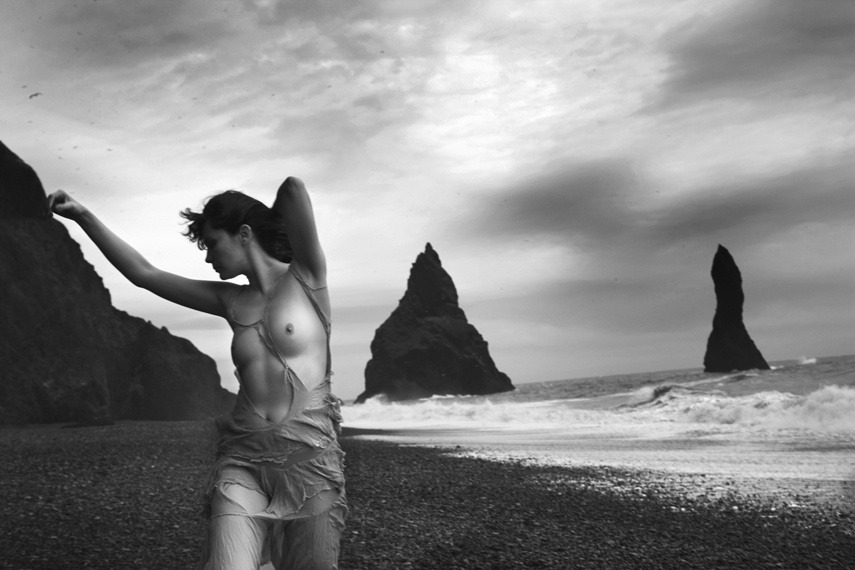
Despite the fact that this sacrifices proper exposure for pushed contrast, I’d post it on the strength of the interplay between the tattered outfit and the gorgeous skin tone highlights.

But, I’m mostly posting it because it was taken on the volcanic black sands of Vík beach in Ísland, or as you’re probably more familiar with seeing it: Iceland.

The way that many of the misogynist literary giants write about how Africa gets under your skin is the way I feel about Iceland.

I’ve dreamed about it on a recurring basis since I was approximately eight. Initially, in these dreams I’d find myself in the middle of a vast expanse of arctic terrain. In the way dream logic works, I just felt that this was Iceland. It was a number of years before someone informed me of the epigraph: Iceland is green and Greenland is ice.

The dreams continued but shifted: I’d be on my way to the airport to fly to Iceland. But there’d be traffic or I’d have forgotten my passport.

Finally, two years ago, despite being unemployed, I through caution into the wind and spent a week there.

I’m not yet to a point where I can articulate the impact of this trip. All I can say is that I’ve booked tickets to visit again at the end of the summer.

I could never live in Iceland. Being as I suffer from severe Season Affective Disorder, the paltry 3 daylight (3 hours in Reykjavik at Solstice) would quite literally kill me. But it’s a place where I feel strangely not at home but in my element.

All that is merely to introduce the fact that as Iceland becomes an increasingly popular vacation destination and more and more photographers tap into the alien beauty of the land, there are sadly fewer and fewer images like this that so effectively encapsulate the feeling of being there that they make my soul ache with the most profound longing.

Bronte Sommerfeld – Untitled (2015)

A recurring thought I have about image making is the extent to which image makers are largely motivated by tangential compulsions. Pictures are taken to ensure that moments are remembered, to give voices to experiences which would otherwise pass silently into darkness, etc–it’s not so much about the image as what the image represents.

Whereas, I tend to think of ‘pure’ image makers as those who employ pictures as a sort of map for how they see the world around them.

Those with the former impetus are generally astute practitioners of the latter–but the lesson in seeing is secondary to that which the image bears witness.

I believe it’s easier for an image maker of the former stripe to achieve critical recognition and stature within their lifetime. And although I can’t in good conscience favor one at the expense of the other–the work of the latter strikes me as the path of most resistance.

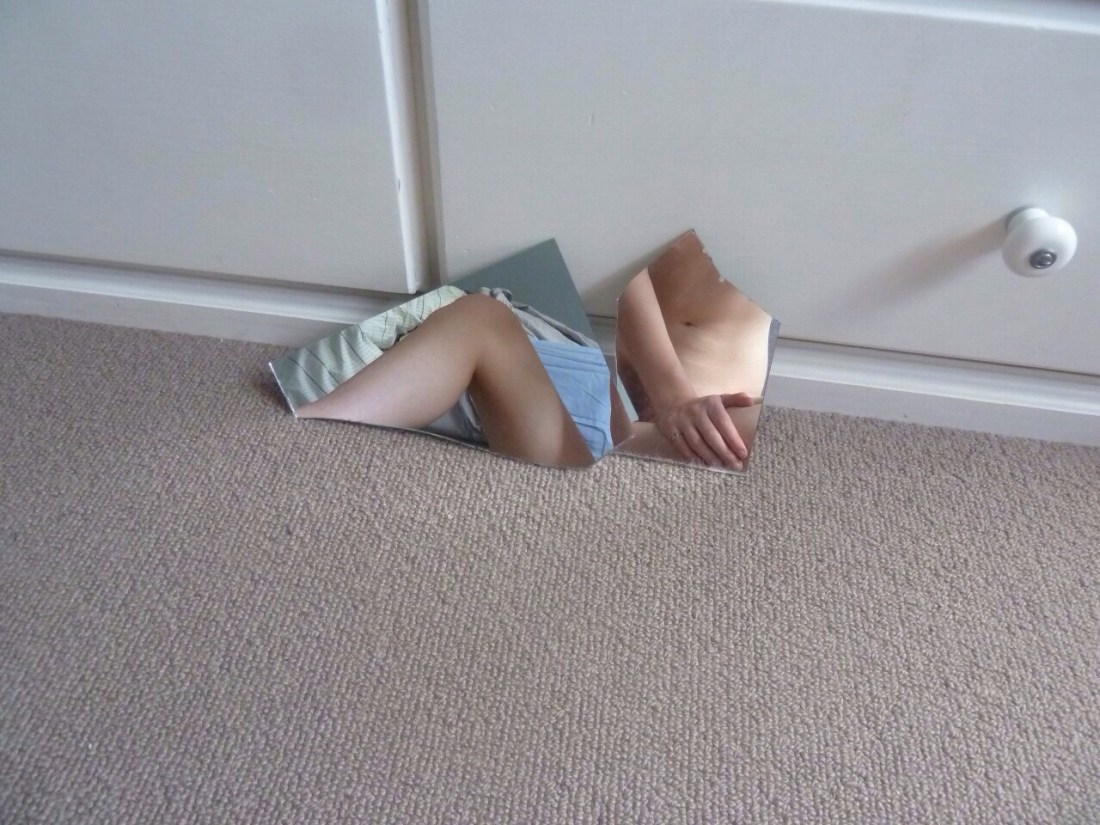
Sommerfeld’s work seems to be of the latter variety. This image feels as if the image maker saw something in a moment and raised her camera to her eye guided by nothing more than precocious instinct.

And what’s captured is fucking fascinating. The texture of the carpet, the suffused light with soft shadow stretching from the drawer knob insinuating a broader world outside of the frame, the mirror fragments presenting ostensibly naked bodies in a seemingly impossible configuration; the synesthetic texture of the carpet.

The trouble is: with the disembodied reflections presented at the center of frame, the angle of the baseboard, although flattering, sets up an imbalance that is in point of fact too strong to be resolved by the drawer’s vertical line or the drawer’s horizontal in the upper right corner. (Lining the drawer’s veritcal with the frame’s left vertical third would have resolved this but created the problem of losing the knob–something that I think would detract from the image. Thus, the real question is more or less carpet. My instinct screams more–I am and will forever remain a texture whore; but I suspect Sommerfeld would veer in the opposite direction; either way the difficulty of the diagonal baseboard becomes the sole compositional stumbling block in the image and can therefore be summarily addressed.)

Lastly: Sommerfeld is a truly interesting young woman. And if you consider that she made this video as a 16 year old high school student, I’m fairly certain you’ll understand why I would be completely remiss as a curator if I didn’t nudge you, my dear followers, in the direction of her endeavors.