Sanders McNewFinancial Services, Minnesota (2009)

If you wish to shoot deliberately, to front only the essential facts of image making, and see if you can learn what it has to teach then go out into the landscape, I say. Take your square format, studio portraits and milky white backgrounds and shove them up your ass.

Except… well, sometimes I’m wrong and it’s a rare image that can not only make me admit I’m wrong but that makes me completely rethink my objections.

The focus here is on Brooke Lynne–she’s either trying on a new pair of glasses or nervously adjusting the pair she’s worn for months. There’s something both hyper posed and yet off-balance to it.

A milky white background typical decontextualizes the model emphasizing physicality. But although the backdrop certainly accentuates the shape of her body, the lighting and the simultaneous stylization and awkwardness of her posture emphasize shift attention to her gesture.

In most portraiture work in this style, I always feel as if the decontextualization is an effort to isolate the model; an invitation to objectify her.

This feels quite the opposite. LEss that there is no background than any background complicates matters unnecessarily.

In fact, browsing McNew’s Flickr leaves my head spinning at just how diverse a body of work given reasonably limited operating parameters.

[↖] Mark VelasquezUntitled (2013); [↗] Vlad Kenner [aka VK Photography] – Lady Sensuality (2014); [↙] Tomi KnoxLight the way (2013); [↘] asp photossecret beach (2014)

I distinctly remember my first encounter with the top right image. Few and far between are the images which command my attention like woah, got damn that’s bad ass!
It wasn’t the explicit nature of the image so much as the way that undercurrent seemed so inextricably entwined with an unapologetic–even confrontational–sense of self.
 
There was also enough playfulness to thoroughly unbalance–her expression of over-the-top offense that might be feigned but is maybe legitimate; indicating a seismic threat lurking just beneath the surface.
 
I noted her pseudonym–Lady Sensuality–and have actively followed her work ever since.
Despite having only worked as a model for a year and a half now–getting her start working with Mark Velasquez–she’s crafted a portfolio featuring collaborations with a veritable Who’s-Who of Tumblr image makers and is also beginning to shoot her own work.
After the unexpected success of my shot-in-the-dark that turned into an interview with french indie image maker Chill, I decide what-the-hell and reached out to Lady Sensuality about whether or not she’d be amenable to being interviewed.
She graciously agreed to answer a handful of questions.

Acetylene Eyes:It feels to me as if at least some of your work is preoccupied with pushing your own personal boundaries. How do you ensure those shoots happen in a safe space for you?
 
Lady Sensuality:If I decide to test my boundaries at a photo shoot, it is always either discussed prior to shooting and with someone of high credibility or photographed by someone who is close to me in my personal life. There are certain photographers who have become very dear to me who I will do more explicit work with. Erotic modeling boundaries are not always about what you are comfortable with sharing on the internet. Sometimes I would be comfortable with a photo of a certain pose or act being online, but not comfortable with a stranger photographing it.
 
AE:    Being a model and an image maker, do you have any advice image makers could employ to make a model’s job easier?

LS:      Firstly, be open with me. It makes it easier for me to help the photographer get the shot they are looking for when they communicate their vision with me. Secondly, letting me know what you are photographing. I like when photographers let me sneak a [peek] at the images during shooting so that I’m aware of the mood the lighting is creating, so that I can pose accordingly. Or if you are only photographing my face, or my shoulders and up, or my thighs and up, let me know! Then, I can give full attention to that instead of all little things that collectively make a big difference on the ease of the experience and how the photos turn out.
AE:     Who is your favorite artist?
LS:Deciding on a favorite artist would be impossible for me. I’m going to keep it relevant by listing a few models and photographers that I’m currently very interested in. Models include Echo Nittolitto, Jacs Fishburne, and Katlyn Lacoste. Photographers include Sebastian Rut (who I am very excited to work with in October of this year), David Miller, and Aeric Meredith-Goujon. There are at least a dozen other people I wish I could add to this list.

AE:Speaking of Ms. Fishburne, maybe two months ago she posted an impassioned declamation of signing model release forms prior to the end of a shoot. Even though he’s a fucking terrible photographer, I remember reading once about how Jock Sturges avoids model releases in favor of an implicit policy where the model has a degree of agency in when, where and how the subsequent images are used. It’s maybe not the best system but model releases strike me as inherently non-collaborative. Do you have any thoughts on a way the de facto model release position might be modified to be more egalitarian?

LS:      I have no problem with signing a model release. Because I am paid during the time of shooting, I have no issue with giving up my rights to sell the images at a later point. That is the photographers [sic] opportunity to make money off of the collaboration. Occasionally, you run into a situation where you are giving your time to a photographer for free (trade for print) and they still have you sign a model release. This, I do not agree with. It doesn’t seem fair to me that both the photographer and model are giving equal time and effort to a collaboration, but only the photographer is able to benefit from it financially. But again, in most cases (where I am being compensated at the time of shooting), I have no quarrels with signing a release.
 
5.     Frank Ocean did this interesting exercise earlier in the year where he explained his current situation to himself five years ago offering wisdom, advice and perspective. What, if anything, would you want impart on yourself of five years ago given the chance.
 
Honestly, I am so perfectly happy with my life right now, I wouldn’t want my 5 years younger self saying anything to put me off track. I feel as if I’m exactly where I need to be at this point in my life and that is a beautiful feeling.

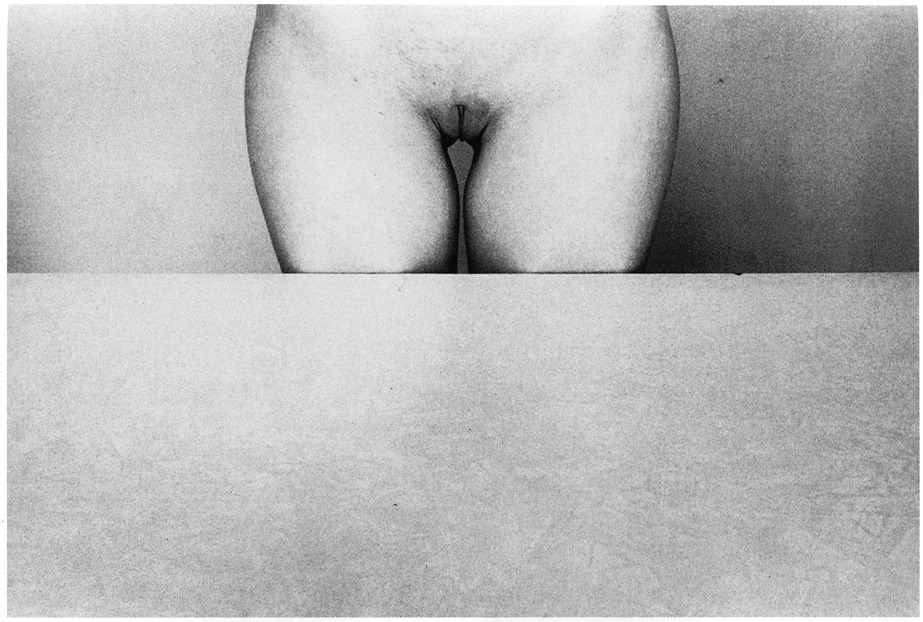
Duane Michals – Naked Nude (1982)

While the title is a riff on John Berger’s distinction between ‘naked’ (i.e. the natural state of the body) and ‘nude’ (i.e. the conventionally stylized art historical objectification of nakedness) in the seminal Ways of Seeing, I’m always suspicious when someone like Michals telegraphs that he’s aiming for the broadside of the barn.

Despite the simple elegance of the image, I feel like there’s an underlying middle finger being given to the notion that photography as an art is fundamentally more prone to essentialist objectification due the the inclusion/exclusion parameters of the frame edges.

Upon first seeing this I immediately flashed back to a college discussion on Piaget vs Vygotsky–specifically: the supposed necessity of object permanence in order for a child to learn language.

I never grasped the salient tenants of their disagreement but the general principle of object permanence applies here. At a certain point in our development–I believe Piaget would say it happened at one particular point, whereas Vygostsky insisted it was a recurring evolving process of increasingly sophisticated awareness–we learn that the toy our mom is hiding behind her back still exists even though we are unable to see it.

It seems Michals–who to my mind is a metaphysician first and a photographer second–is pointing out that we’ll allow that this woman’s legs continue below the table and even extend beyond the lower frame edge but politics insist we acknowledge that she is severed at the waist by the upper frame edge.

Using the table to create a frame-within-the-frame creates a tableau that it’s easy to dismiss as essentialist–reducing the female body to symbolic genitalia.

That this image doesn’t come off like that is a result of the clever composition, but I think contrary to Michals’ assertion–I’m pretty sure he’s a card carrying Cartesian–it’s the context of the image which dispels any trace of a sexist agenda. First, it is of an especially high quality, it’s self-consciously aware of the relationship between an out gay photographer, a nude model and an audience with the expectant male gaze default setting that will respond either salaciously, with disappointment or with critical censure.

The rightness or wrongness of thesis is irrelevant due to the masterful grasp of the totality of context.

Allison Barnes –  [↑] July 30: Incision (2012); [←] July 23 (2012); [→] Bruised Vein from Neither For Me Honey Nor the Honey Bee (2014); [↓] July 24 (2012)

Little else drops me down a k-hole faster than stumbling upon a photographer whose work thoroughly engages me.

I spent a good part of yesterday pouring over Allison Barnes’ work. Given her proclivity for shooting analog large format almost exclusively, this shouldn’t be a surprise.

What surprised the fucking shit out of me was how far off base my initial impressions were.

For better or worse, I think everyone tends to start from what they know based on their experience. Barnes initially struck me as a photographer preoccupied with Francesca Woodman, Sally Mann and Ana Mendieta.

Following those markers leads down lush verdant path passing interesting scenic overlooks; but sooner or later each dead ends, leaving you to retrace your steps and then begin again from the beginning.

What’s strange is it almost feels like these false trails are supposed to be followed–as if in following them to their end the work is teaching the viewer how to see it, as if initial misunderstanding is somehow integral to any sort of eventual understanding…

It’s this that dismisses perfunctory correlations with Woodman and Mann–both being more caught up in aesthetic interrogations of the trilateral relationship between author, subject and audience, how that relationship manipulates objectivity.

The Mendieta trail does stretch further than the others but in the end Barnes veers away from carefully manicured feral confrontation for something not exactly patient or even contemplative so much as the expectant stillness of someone willing to wait for you to get the ever-so-clever joke in the otherwise grave conversation.

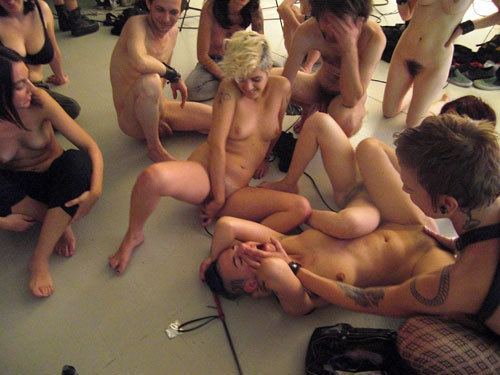
FeminismoPornoPunk – Documentary still from Public domain porn version (2008)

Catalan Theater Directory Roger Bernat staged Public Domain in 2007. The underlying notion being to eliminate the audience/actor distinction.

[Public Domain] is (like) a life-size board game in which the spectator is more than just a pawn. Theatre-maker Roger Bernat assembles a group of people – the audience – on a square. Who are they, where do they come from and what is their relationship to each other? They walk across the square while listening to a series of questions and instructions on their headphones. Some are more innocent than others. The same can’t be said for the result; through the participants’ simple movements, small groups start to form in the audience. These micro communities expose underlying social patterns and tell a tale that Bernat carefully orchestrates. While [Public Domain] starts off looking like a 3D poll brought to life, the project ends up transforming into a bizarre fiction.

Maria Llopis reimagined Bernat’s concept as DIY porn for the Beatriz Preciado curated Arteleku in Donostia, Spain one year later.

I’m an extremely sexual person. However, I’m also aware that as someone who passes for straight, white and cismale–although I would never claim any of those terms in self-identification–I experience a degree of privilege.

As someone who passes, it’s assumed that I fit squarely into the cismale heteronormative default. I don’t though. I care very much for others’ autonomy in self-identification but the truth is I’ve never found label words especially useful. About the only label I don’t dispute is the distinct of being a ‘switch’ on the D/s spectrum.

It’s difficult to lack a readily available means of expression. On the one hand I want to distinguish myself from what I may be perceived as being by others. But how do I do that in a way that isn’t appropriative at the same time as also not being entirely fucked up and entitle?

I can’t say I’ve discovered anything that works. But I have definitely learned the importance of safe spaces–and not just safe spaces for me but spaces that are safe for myself and inclusive and safe for others, too.

At present this fits the form of a tweak to the ubiquitous Golden Rule: do unto others only as the would of their own free will and volition do unto you. (Being that I am on the autism spectrum, this isn’t the most effective coping mechanism…)

The above image suggests several things:

  1. I can’t look at this and not flashback to that scene in The East where the anarchist kids are playing spin the bottle. It strikes me that there’s huge overlap between that space in the one above; an emphasis on  intimacy, connection and using consent and negotiation/re-negations to test/push through largely arbitrary boundaries. (It’s also enormously helpful–not to mention fucking wonderful–that The East includes a queer perspective!)
  2. It also reminds me of Stranger by the Lake (a great film for it’s artfully graphic depictions of gay sex and is currently streaming via Netflix). With the world growing increasingly compartmentalized, sex is everywhere but unless you are a multinational corporation or resemble the board of said multinational corporation–whether or not you have access to similar mountains of cash in your private life–there is increasingly no viable venue for safely and consensually engaging with sex on a non-conceptual, tangible level. I think the idea of creating such space is important. But it’s hardly new. The LGBTQAAI community has fought tooth and nail to create such spaces.

This relates to the above image insofar as it is very clearly a safe space, concerned with sexual expression that insists on equal space for queerness.

It also doesn’t feel as if it’s about exhibitionism. That’s a huge thing for me. I am hardly shy. Truth told, there’s like maybe three things I would never consider doing in front of a camera. But I am not an exhibitionist. I don’t have any sort of problem with exhibitionists. But I am not happy with my body. However, for better or worse, my sexuality is tied to the body I have. (I regret very little in life but I wish that I’d done something like appear on I Feel Myself–although they probably wouldn’t take me and I’d have to do something more in line with Gentleman Handling, unfortunately… stupid biologically male body.)

I wish I knew where I could find spaces like the ones this image points toward. I would love to be able to express my sexuality more openly in a fashion that was neither intrusive or entitled.I wish there were more spaces like this–focused on rejecting mass marketed fantasies and instead projecting DIY ethos and creating for ourselves the truthful and open spaces for complicated expression we most want to see in the world.

Interesting, the lack of such space is perhaps the biggest obstacle I face in my own creative work. i patently object to the myth of the rock star photographer. I think the vast majority of Tumblr photographers (good or bad) use fine art nude photographer as a pretext to appropriately channel sexual energy. I have an immense problem with that–not in and of itself but if that’s really your goal then at least be up front about it.

I love looking at naked bodies just as much as the next person. But I am more interested in the correlation between you and your body–with particular emphasis on your negotiation of your own sexuality. I want to ask what turns you on–not as any kind of prelude so much as I find it endlessly, almost transcendentally intriguing to understand how someone else experiences something that profoundly moves them. I’m curious as to what their experience of puberty was like, how they masturbate, whether or not they’d be comfortable with showing me? Is it okay if I show them?

I can’t approach photography except as collaboration between equals. The subject has just as much of a stake in things as does the photographer. And as far as my own work goes, what affects me is conveying something of the highs and lows, the narrative of what it is to be a being with a carefully considered inner life, hopes dreams and aspirations but who is also tied to an inconvenient simultaneously autonomous and desiring body.

It seems simple enough but it goes back to the question of would the person I am asking realistically ask the same in return from me. So far my life so far has demonstrated the answer is a resounding no.

Petra DolezovaUntitled (2011)

Have you ever come awake too soon from a beautiful dream? I’m talking one where you immediately roll over, screw your eyes shut and focus every bit of energy on descending bacl into it again?

If you can recover it, it’s never quite as vivid as it was the first time around. like a dream seen through gauze, in a mirror.

It’s a feeling not unlike the thread that runs through Slovakian-born, Dutch educated Petra Dolezova’s stunning work.

I’d very much like to share some of my impressions but her work truly deserves at least initial contemplation. So please, do the internet equivalent of closing the text around your finger and go through her entire Flickr photostream. Treat each image the way you would a savory mouthful of food, chew slowly, twenty times, before swallow. (I’ll still be here when you get back.

Oh and may I suggest a sonic pairing, this 1997 vintage Labradford enhances the oneiric grace notes rather well.

I keep fighting a strong urge to term Dolezova’s work ‘minimalist’; except as much as I’ve studied both art history and critical theory, my understanding of minimalism is a bit like those words that are their own opposites.

On the one hand–and I think this constitutes more of the general denotation: minimalism suggests a diminution of ornaments (necessarily entails additional, implicit emphasis of form). One declare Philip Glass and architecture with clean lines to be ‘minimal’.

On the other hand, there’s a tendency to think of minimalism as something additive. I add this line or that curve to negative space–the relationship of the line or curve to such space is minimal. However, if you invert it and consider empty space as the locus of meaning, the what appears maximal is actual razor sharp in its subtly and nuance. (Silence is a sound; melody is sometimes what is excluded.)

And that’s glossing over questions of conceptualization, concerns over execution.

I think my instinct to label them minimalist has to do with the way the presence of each image all but extends to the viewer the key to its own undoing. As if the image is less witnessing document and more kataphasis/apophasis perpetual motion machine.

As if there is no author [praxis] in which theory and practice are fused; as if there is no sayer to impose two words when one will do–all that is unnecessary or extraneous has been removed; there is only the image.

P.S. PH Magazine did an interview with Dolezova a few years back. The questions are underwhelming but it’s difficult not to admire her straightforward and meticulous responses.

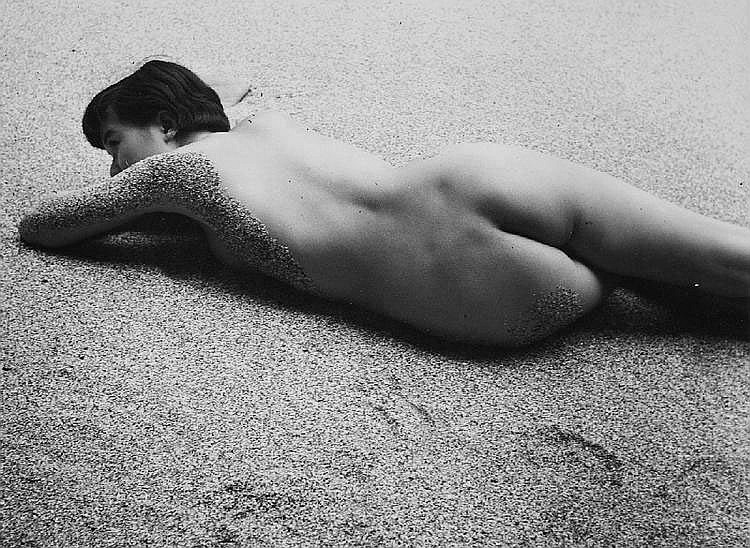
Iwase Yoshiyuki – Untitled (1966)

Yoshiyuki, it seems, was a sake magnate who upon being gifted a Kodak camera set out to document the so-called ama girls who harvested seaweed, shells, oysters and abalone from the cold waters off Japan’s Pacific coast.

This photograph is atypical of his work which frequently featured candid shots of topless divers, water, sand and nets.

It was likely produced as part of one of his ill-advised forays into the fine art nudes. Unlike those awkward, overly self-conscious dalliances re-staging previous scenes in an effort to transform immediacy into technical rigor, this manages to encapsulate Yoshiyuki preoccupations in a manner which transcends the context of its creation and becomes at once somehow both timeless and deeply resonant in its uncomplicated humanness.

Jesús Llaríano head (2014)

As in tune as I can be with logging my own process of reading images, this short circuits everything.

I’m not sure I can explain it without getting a little TMI but it reminds me of being fifteen. (Not that I saw anything like this in the flesh until almost a decade later…)

It reminds me of random, mundane things that would inexplicably trigger arousal so extreme it was actually painful.

I had already been chasing the same oxytocin/prolactin buzz for seven years as a way of smoothing out the jagged edges of my abusive adolescent existence and suddenly it was also effecting some sort of vaguely imagined autonomy over my own body.

As a friend puts it: it’s a real wonder all the masturbation didn’t inflict permanent nerve damage.

So yes: initially seeing this image resulted in me having to release some sexual tension.

Afterwards, I found myself enchanted by the way the image works. Although I’m not sure it’s ever justifiable to employ a frame as a means of dismembering a woman’s body, I can’t technically refute the decision as Llaría observes the dictum of amputating between joints instead of at them.

And there is a notable compositional logic supporting his choice. Note the repeated angle of the elbow which is not the model’s, the line of the lower half of the dresses’ buttons, the way the seam to the left of the lower button line softens the angel to echo that of the model’s right thigh only to have the same angle emerge again in the cocked angle of her right leg.

There’s also the matter of palate: excluding her bush, the image consists of three hues. The rust colored earth figures at the darker end of a spectrum that would include the more magenta tones in her skin; while the white in her slipper and dress are virtually identical. The blue of the dress makes everything else pop.

Let’s not forget texture, either–something about which I am often preoccupied. The skin doesn’t really have texture in this image; except juxtaposed between the dirt and the fabric of the dress the absence of texture becomes a null field. Unlike the ground or the dress you can’t imagine touching the model’s legs but you can recall what it was like to have touched such legs. The visual synesthesia suggests an insistent anti-objectification that subtly reminds that this is no less or no more than what you have always known.

I would be dreadfully remiss for also not mentioning that even though I am not female bodied and if I were I would not be comfortable wearing a dress, I’m more than a little obsessed with the dress.