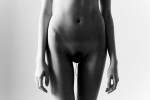
Brooke LaBrieBlack Tape 1 (2013)

I’ve said it before and it bears repeating: if you aren’t following Cam, you’re doing Tumblr wrong.

Without question, Cam is one of the preeminent models in the Tumblr-verse. She’s extremely intelligent, has a nice voice, is six feet tall, has really cool tattoos; and when fuckwits antagonize her she spouts incredible, tongue-in-cheek mythological backstories, is socially awkward and a consummate bad ass. (I don’t feel the three things I haven’t linked require additional documentation.)

I have mixed feelings about this image. It was made with a Hasselblad 500C/M and I am all about analog photographic processes. And I don’t think I’ve ever seen Cam presented squared to the camera. (She really is beautiful.)

I am not quite sure how I feel about the tape is being used to cover her tattoos, though. I mean Cam has some AWESOME ink work.

But looking at this what stands out to me is the compositional logic to the placement of her tattoos. I mean if you suggest the body as a canvas for art, there is more than just a passing reminiscence in the lines suggested by the tape to Piet Mondrian paintings or the De Stilj aesthetic.

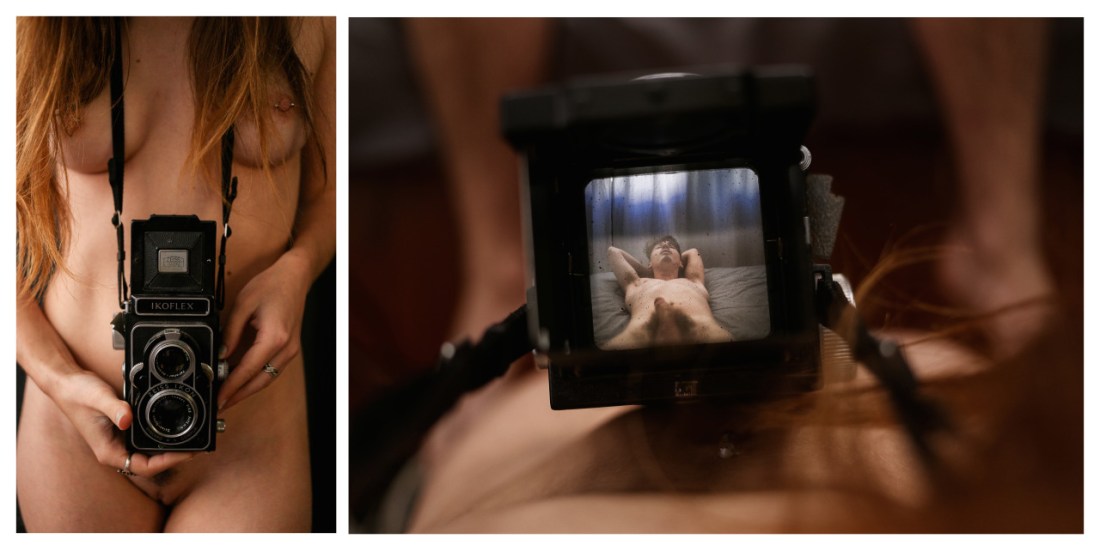
A & N – Nympho Ninjas Submission (2014)

Diptych ought to be read seamlessly.

The trouble–which in the end isn’t really trouble at all since it allows a far more benevolent interpretation–is that I initially see these images discontinuously.

There’s the obvious discrepancy in visual langague. The first frame being one of the most infuriatingly egregious examples of #skinnyframebullshit I’ve posted.

Plus, it is oblivious to the politics of frame edge dismemberment. (To anticipate the counterargument: preserving anonymity is a downright lazy justification. There are literally a thousand ways to obscure identifying features that don’t require decapitation. Yes, it just takes a bit more effort on the part of the image maker…

Pairing the first image with the second presents an interesting dichotomy. (It maybe even alleviates the tiniest fraction of the goddamn piss poor decision to opt for portrait orientation in the first image since it allows both images to fit together more intimately within the viewer’s visual field.)

The second image is very nearly perfect. Yes, I have a bias to frame-within-frames and viewfinder peaks but although the second image is great on its own, I think the interplay between it and the previous image are fascinating.

This interplay–as I read it–is a studied subversion of the male gaze.

The leftmost image presents a sample of said gaze; the right explicitly presents the viewer with a female POV.

All sorts of tangents and rabbit trails emerge. But what’s most important is to note that the male gaze is in-built, assumed. It sees the female bodied subject regardless of whether or not she sees–here she literally cannot see as she has no eyes.

Because the initial image informs the following image the female gaze sees but it is seen in its seeing.

(Whether intended or not, the fact that the male bodied subject does not acknowledge the camera is a sophisticated bit of conceptual reflexivity.)

The first frame contextualizes the second. Were one to draw a parallel with art historical tradition and subsequent influence in practice, one would go straight to the head of the class.

In the context of the first frame, the second frame’s richness diminishes the first; underscoring the glaring impoverishment–not to mention bias–of the male gaze..

This is as thoroughly subversive. And it occurs to me that unlike most -isms that take on definition by prioritizing this above that; feminism is a rare ideology wherein the criticism is also a performance of a suggested solution. The act of saying: voice like mine have been silence for centuries, what I have to say is as important as any thing anyone else has to say: therefore I will speak.

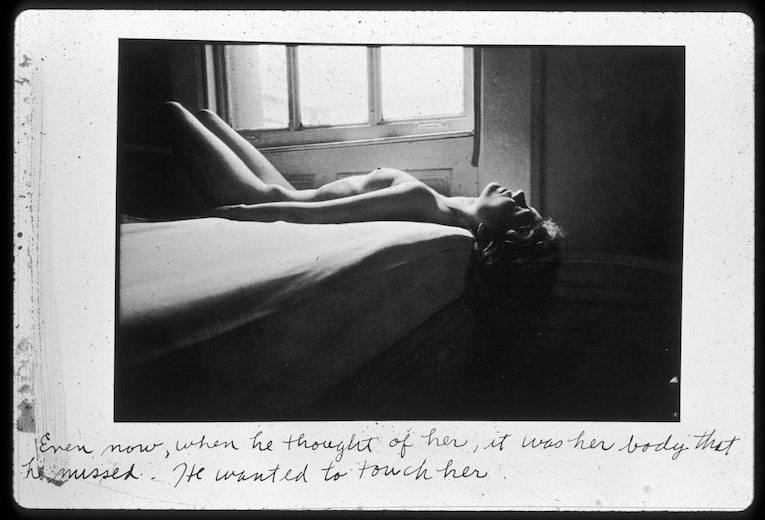
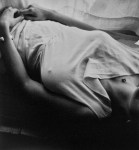
Duane MichalsEven now, when he thought of her, it was her body that he missed. He wanted to touch her. from Person to Person
 (1974)

Quite frankly, Michals’ frustrates the piss out of me. His work is always so goddamn in-fucking-scrutable.

Take this. As with many of his prints, it’s unrefined, sloppy. But it works. And the reason it works had to do with the presentation.

Michals’ tends to present his photographs as a series. He also frequently imposes inscriptions on the image which tend to hijack mere archetypal readings. The inscriptions read like crib notes to the artists more than the audience. Their hurried, seemingly off-the-cuff character enact a strange sort of alchemy wherein the weary, ailing aspects of the image become assets instead of liabilities. 

For example:

This photograph is one of 15 photographs in a series entitled Person to Person which invokes Lynchian account of a relationship’s dissolution. (It’s a little Lost Highway (in structure), a little Mulholland Dr. (in content).

The image I’ve featured is beautiful–in spite of not being on speaking terms with mid-tones. Yet, what’ s interesting is the way the text colors the image with a wistful resignation.

Without seeing another image: the words re-contectualize the photo so that the audience understands that they are envisioning the lover for which the ‘he’ pines. He misses her and wants to touch his lover’s body but cannot. Something happened and they are no longer together.

As you browse through the series, the basic narrative is clearly presented in each frame. And with each additional frame, the story is implicitly re-stated and more details are sussed out.

In the end, although I really don’t want to, I can’t help but like Michals. He’s the type that prefers the prospect of two marshmallows later to one now. But unlike the rest of us, he somehow always manages to have one now and two later.

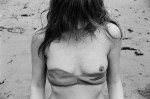
[↑] Peter Kaaden – for C-Heads (2013)
[→] Unknown – Edit of Billy Kidd’s Cora Keegan (2011)
[↓] Lina Scheynius – Bandeau by Yves Saint Laurent (2010)

As far as curation-and/or-criticism-as-art, I am in the same boat as Thora Birch in Ghost World’s art class scenes.

The juxtaposition of the these three found images is an exception that proves the rule.

It’s one thing to re-purpose objects, materials and imagery. It is another entirely to effectively ground them in a new, full-functioning context.

Yes, there is a similarity in style and gaze informing the three independent of each other. And yes, they do sit side-by-side like well-behaved children at the dinner table.

What makes them work together is the Photoshop intervention–the addition of the dangling tampon string which does not feature in the original image.

Simple but startlingly affecting.

Bryce Louw – [↑] Skin | [→] Hold | [↓] Pull (201X)

Despite being graphite drawings, the first thing I notice here are the colors.

In fact, I am fighting the urge to create the sort of palate swatch sidebars that seem to be de rigueur–a la this and more insidiously ingenious this. (Note: I lifted both links from popotum; who has a murderously precise eye for immaculate graphic arts ephemera.)

Beyond color, I am not really sure what to do with these. There seems to be a stylistic disconnect between the more minimal blitz sketch (what I prefer when faced with drawings) in the left half of Pull and the more overwrought shading in the fully rendered work.

It’s not that I don’t dig the full renders–there’s a sense of gorging on carnality to beat back an all-consuming visceral desperation which I find appealing.

But, at the same time, I am not comfortable with the amputation of 2 out of 3 female bodied figures left arm by the fourth wall. And, I find it odd that all the left hands/arms are dismembered. Could this have something to do with the factoid about Classical Latin: the adjective ‘left’ (sinister/sinistra/sinistrum) also meaning ‘evil’ or ‘unlucky’?

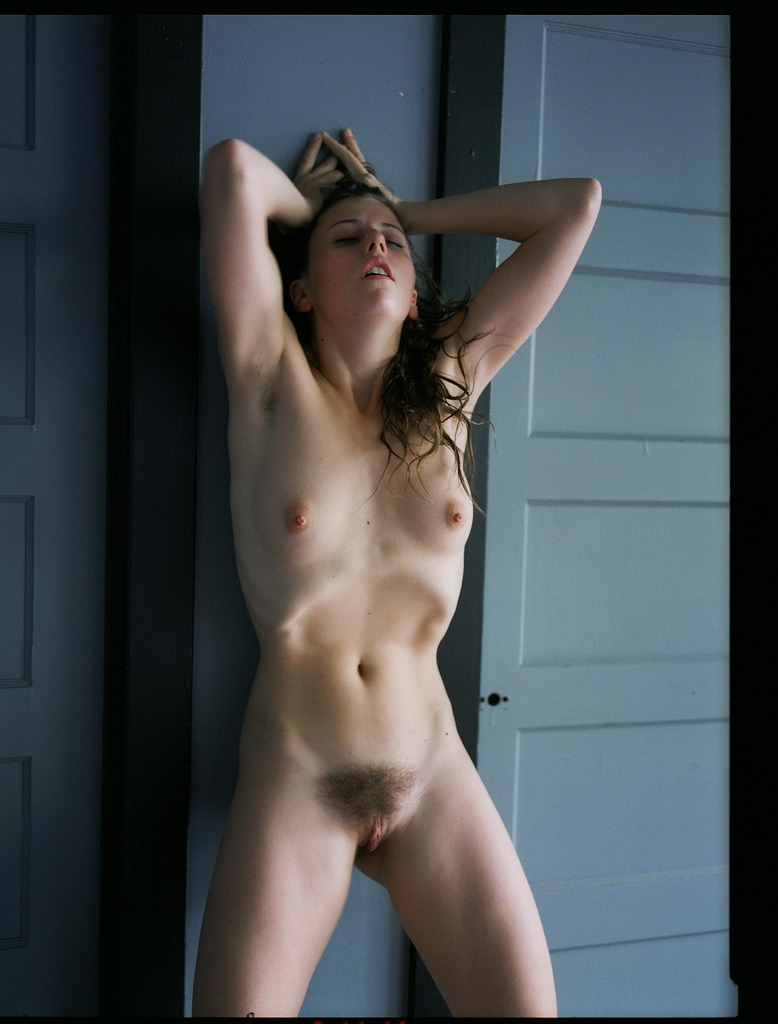
asp photosKatlyn Lacoste (2014)

It seems a rite of passage for young artists: an over-enthusiastic, searching response to a query or a giddy, unedited experiment is published bereft of context and so begins the circling of wolves.

Those who limp away learn the necessity of reducing the truth of process–often counter-intuitive and confusing–to simple, easily digested soundbites.

Dismissing the messy trappings of Being for a precisely manicured media-digestible facade has always seemed inherently self-hating to me.

It’s great to make work, to release it into the world. It’s awesome to speak in tongues which disallow all misconstrual. Still what never fails to give me chills are creators who struggle not only to birth work but to shape the conversations and contexts surrounding the work, how the work is approached and understood.

I think Katlyn Lacoste is actually enacting this sort of meta-context shaping in her modeling work. Yes, I am probably biased as a result of this bad ass  missive against assholes who exploit the vulnerability of nude models she penned being my introduction to her work.

Also, her images make me vaguely uncomfortable. Not in any bad way, they just fuck with my notions of where the line between voyeurism, eroticism, sexuality, identity, pornography and art might lie.

It’s as if the image has the effect of someone standing too close to me in a loud over-crowded room whispering: fuck you, fuck your frames and double fuck your preconceived notions: I am perfectly imperfect as I am. This is not for you, about you, concerned with fuck all to do with you or will ever be concerned with fuck all to do about you. See me–really see me–or go right ahead and fuck off and die.

Alec DawsonUntitled from Nocturna series (201X)

Any convesration about Dawson’s work will prove a fool’s errand unless one first addresses the elephant in the room: Gregory Crewdson pernicious influence.(Sidebar: whenever someone says elephant in the room, I look around for a split second hoping there’s actually an elephant in the room so maybe I can hug it. I ❤ elephants like whoa.)

Now, I know I mostly come across as a crotchety, you-kids-get-off-my-lawn, over-critical contrarian but I do make a very concerted effort to stay constructive.

However, there are several photographers for whose work I can only muster abject revulsion; Crewdson is one.

I would never dispute his technical acumen–even if questions as to whether his process precludes him from consideration as a photographer are interesting thought experiment.

And his finely tuning, orchestrated lighting masterfully facilitate a consistent, oneiric aesthetic.

My objection is to the manner whereby the elaborate conception/execution and presentation insist upon itself and is excused as being in service of conveying a decisive moment-esque impetus; bullshit given simply asking of the image what led up to this moment and subsequently what leads away from it remains indecipherable.

If Crewdson would shut the fuck up about his work as being narrative–a concept he woefully misunderstands–then I might give his work a pass.

But as goes Gregory Crewdson, so goes a raft of fuckwit MFA students as well as Reverend Bobby Anger and Alec Dawson.

Not to malign the latter two by association but with such a pervasive debt of influence in their work, they both get snared by their similar reliance on aesthetic as means of compensating for flimsy narrative conceptualization.

That being said, I hardly want to piss all over Dawson’s work. He has a profound knack for making a scene appear cluttered without detracting from the composition and though I do worry about the implication of some of Frances Blanc dead and crumpled poses in Nocturna; the series would arguably prove more compelling than Crewdson if Dawson could cull a very much needed, tighter edit.

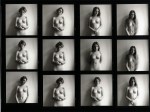
Stephan BrigidiFrancesca Woodman contact sheets (1978)

Despite the absence of her characteristic compositional asymmetry and murky mid-tones, these are frequently attributed to Woodman instead of Brigidi.

(I only sourced them because it seemed odd–given my familiarity with Woodman’s oeuvre–that I had no recollection whatsoever of these contacts.)

If nothing, the instinct to impose false attribution is not entirely misguided. After all, the prevailing art historical framing holds Woodman as the progenitor of the current surfeit of confessional self-portraiture.

This conceit has always frustrated me. First, Self portrait at thirteen demonstrates a more comprehensive grasp of photography as Art than 95% of the legacy claimers.

Second, the rule every seventh grade literature student leans the writer and the narrator aren’t necessarily the same individual is ignored.

To my mind, there’s a reason only one of her images explicitly bears the ‘self-portrait’ designation: Woodman only documented herself in the strictest sense. Really, it was more that hue was playing a character in a single frame film.

This is made clearest with her flirtation with an alter ego, Sloan, resemblances to Lewis Carroll’s Alice and her On Becoming an Angel series.

My feeling has always been that Woodman’s images are much closer to a sort of alchemical fiction–being by way of photography a means of becoming. As if all the identities in the world are dresses hung in a wardrobe and image making offered a mode of trying them all on one-by-one to see which ones fit, which ones pinched and which ones did little more than hang like limp sails in horse latitude doldrums.

On top of that, there is a sort of underlying menace to her experiments. Whenever I look at her images, I have a feeling similar to someone I care about showing me scars from self-harm. To an extent, I think photography served as an externalizing stand in for cutting–at least initially, at least through her arrival in Rome; at which point her flirtations with magical realism shifting toward a darker obsession with potential to harness the interplay of light, shadows and skin in the conjuring of malevolent maledictions.

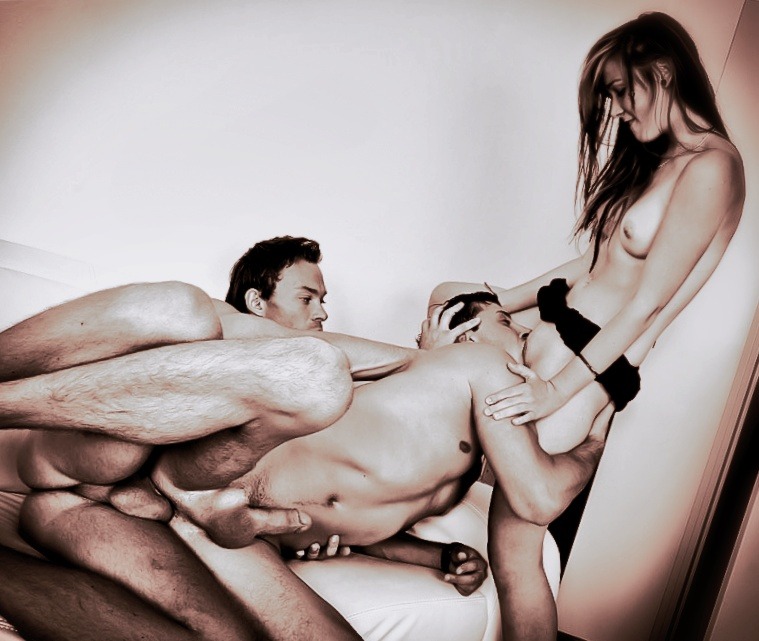
Source: Unknown

While I object to the sepia tinge, strobe vignetting and canted frame, the pervert in my is intrigued by this image.

I have certain reservations about imagery depicting threesomes; therefore, I appreciate how the above eschews the typically stultifying heteronormative script.

I read something about fluid sexual orientation. Namely, I don’t stop to ask is that boy gay or bi. (Although I admit that with the way his head is being forced into the woman’s pubis, I could understand that reading.)

Does it really matter? Everyone here is clearly enthusiastically engaged/invested in the proceedings.

‘Straight’, ‘gay’, ‘bisexual’ and ‘genderqueer’ are words, labels. Increasingly, treated as if it were a discrete street addresses: 123 Main Street, Podunkville, ID.

I don’t think it’s that simple. At best, ‘bisexual’ is comparable to one New Yorker telling another she lives in Brooklyn–as opposed to Manhattan, Queens or the Bronx. (As far as I’m concerned there are only four boroughs.)

Saying I am a bisexual woman who prefers women to men is analogous to mentioning that she lives off the Lorimer L stop.

If she really trusts the person with whom she is talking, she might say: I’m on Ainslie between Leonard and Manhattan.

Even that falls short. Each of us manifests a singular sexual persona; labels are broad, vague and ambiguous, they will always fail to summarize the intricacies of our desires. Words merely facilitate communication by nudge us toward a better heading, towards the truth.