
Dorotheya Dimitrova – [] (2014)
“I ache in all the place where others get pleasure[.]”–Antonin Artaud
Dorotheya Dimitrova – [] (2014)
“I ache in all the place where others get pleasure[.]”–Antonin Artaud


[↑] Dominic Sena + Bojan Bazelli – Frame from Kalifornia (1993); [↓] Source unknown – Title unknown (20XX)
–Ludwig Mies van der Rohe (after Robert Browning’s poem The Faultless Painter).
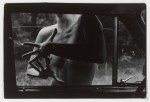
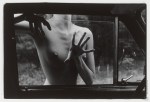

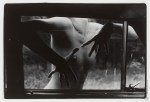
Agresívne prsty IV, II, I, III [from top to bottom] (1987)
The intended order of these images is constructed around how far the window is rolled up.
Those of you who’ve grown up entirely in the age of power windows are probably less familiar with those old manual monstrosities that one had to roll up by hand. You’ve also probably not fought with bitter siblings trying to lock you out of said vehicle by rapidly rolling up the window. If you put just enough weight on the window, the clutch or whatever it is that raises the window will slip and the window inches further open–this can be all you need to force your way into the vehicle.
…
Honestly, I prefer this ordering of the photos. Ignoring how far the window is rolled up, note how in this presentation the framing tracks from right to left across the four frames. It renders a set of images that would otherwise be inextricably entangled with a Repulsion-era Polanski-esque psychosexual paranoia into something more ambiguous/nuanced, a sort of meditation on movement, gesture and memory in the stream of space-time.
Top notch curating right here.

Bo Widerberg – Frame from Love 65 (1965)
I wish I was better able to speak to this image. Specifically it’s composition–which appears like on of those perfectly inspired moments where the resulting photograph reads as devoid of any sort of rehearsal, premeditation or artfulness.
The truth is there is an abundance of all the aforementioned traits (not the alignment of the eyepiece with the angle of the baseboards, the whiteness of the black sweatered arms focusing the lens contrasted with the grey scale of the woman, the angle of the floorboards.
I haven’t seen this film–I’m not sure it’s even available. However, based upon this one frame I would wager that a prevalent theme is the challenge of sharing the world an artist sees through their mind’s eyes with another.
Also, I can’t look at this and not think of the initial sequence in Kieślowski‘s The Double Life of Veronique where Weronika is laying upside down on her bed staring at the expanse of the star filled night sky through a glass orb, which inverts and magnifies everything.

Ashley MacLean & Tracy Matlock – The Emotion-Maker’s Heartbeat (2007)
If I know anything about photography, it’s a result of (not necessarily in order) either:
There’s some back story necessary if you’re to have any chance of understanding the immensity of that last entry.
See: I made some really terrible choices a little more than a decade ago. I don’t just run an artsy sex blog, I’m a bit of a nymphomaniac and well, let’s say I bet on not just the wrong horse but a horse so broken it was determined to drag me down with her.
I ended up living out of my car for close to six months in the dead of winter. Very dark times.
I’m still not exactly sure how I pulled myself out of it. I found a job and then a second one. I worked ninety hour weeks for almost two years.
One job was with a now defunct big box retailer. Short of the summer I spent cleaning houses, it was the worst job I’ve ever had. I was in charge of the music section. This happened as a result of he fact that—much to my chagrin—after seven years of working in a video store, you get used to matching brain grindingly vague descriptions up to the actual source.
We had these in store displays where you could scan a CD and it would link you to All Music’s review and sample tracks. Out of boredom I begin researching music I loved. Doing this thing I now call following the thread from the artists I loved back to the artists who they loved and inspired them.
I’d find an artist who inspired an artist I loved and then I’d skip lunch for a week and buy a new CD every week. Dear God, I found some good stuff. But the most memorable CD wasn’t one I researched it was one I stumbled upon. In truth, I’m not even sure why our store even got it but upon its release we were shipped a copy of Godspeed You! Black Emperor’s Yanqui U.X.O.
I bought it and put it in my car’s CD player on the long drive to my second job. To say it affected me would be an understatement. To say the music got me higher than any drug I’d ever taken would be an understatement. Within a week I had their entire discography. I began to research them, became fascinated with their aesthetic, they creative ethos—everyone contributes equally and democratically.
Accidentally finding that CD changed fucking everything about my life.
I stumbled upon Traci and Ashley’s work mid-way through my third and final year of my third and final attempt at university. I’d procrastinate by spending hours on Flickr’s Explore. I kept seeing their images—all of which I would favorite immediately.
Their Polaroid Spectra images became something with which I was pathologically obsessed. I’d never seen such exquisite Caravaggio-esque color and texture. And Jesus Harold and Maude fucking Christ on Christmas, the effect to which they used those colors. (Even with the threat of Spectra stock being discontinued, I dropped a small fortune I didn’t have on a Minolta Instant Pro. My images never managed to be as masterful as there’s but the ability of Polaroid Spectra stock to render skin tone in daylight is only comparable to the now also discontinued Fuji Astia stock.)
Anyway, I found Traci & Ashley’s work at a time when everything in life was trying to beat the naivete of my belief in collective art processes. I read about how Traci and Ashley worked—one took photos of the other, but the subject always got first edit (control over the content and context) and then the photographer was left to choose from the initial culling what would finally be exhibited.
This is something that has come to figure heavily in my own approach to collaboration.
The above images causes me to get a lump in my throat. I don’t know how else to talk about them except to say: thank you Traci and Ashley, I may never be an important photographer but your images changed my life to a fashion and degree that very few things have or likely ever will. I am—for better or worse—a photographer because of your work.
Made in collaboration — expansive, encompassing, incubating, to say the very least of it — with Traci Matlock.
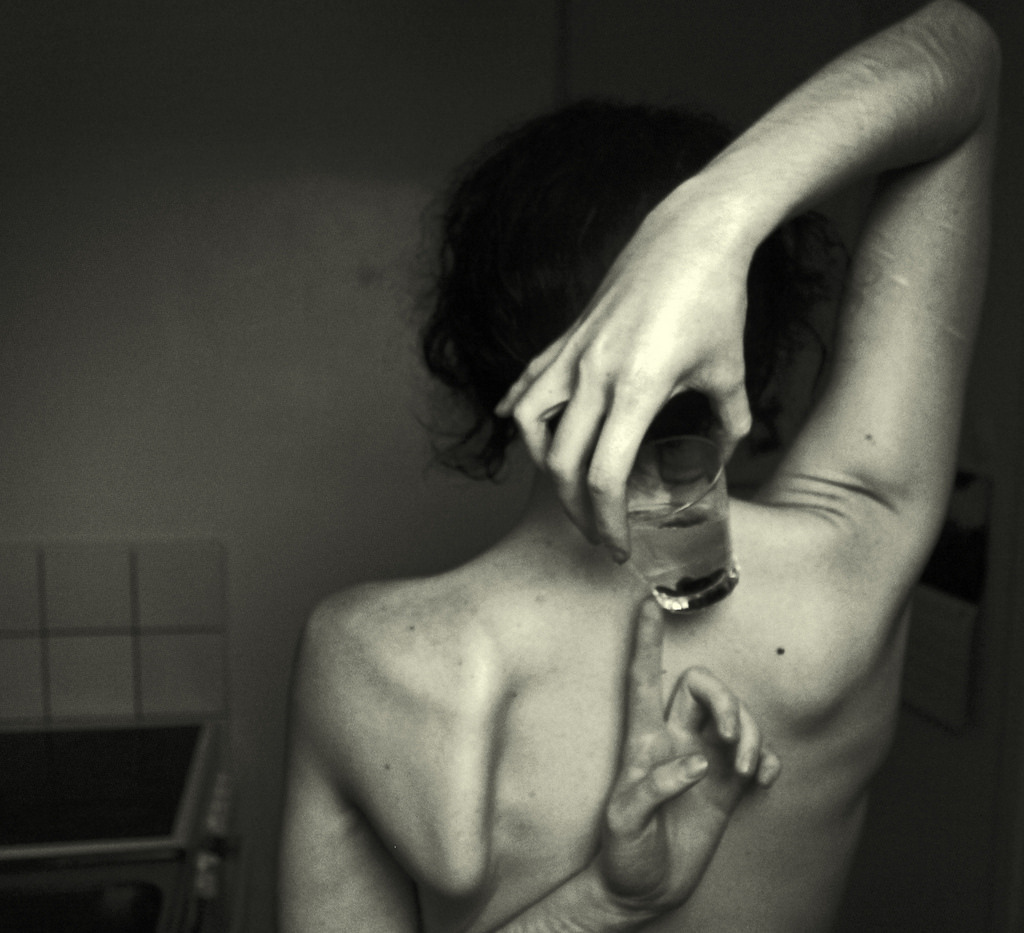
Mathilda Eberhard – Untitled (2014)
Mathilda Eberhard – Untitled (2014)
Flickr retains little more than a ghost of its late aughts glory. In fact, it’s pretty much a completely clusterfuck.
There are some notable outliers whose photostreams’ always showcase bona fide next level shit–looking at you: im_photo, chill and 3cm.
I’d include Eberhard to that list except well although I wouldn’t ever suggest that her work is better than those guys, I am just flat out enamored with her work.
This should surprise no one having followed me for any period of time–after all this is the fifth image of hers I’ve posted.
You’ll notice I tend to favor appending quotes to her images instead of commenting on them–partly because I am so awed by them that my fumbled attempts at expression seem entirely cross juxtaposed with the work and partly because I get self-conscious about the fact that I tend to compare things that move me to the very limited set of work I adore (at least initially) instead of come to terms with them on their own ‘ground’.
For example: for as many image makers as will either claim or accept the critical assignment of overlap with Francesca Woodman’s work, Eberhard is probably the image maker who most completely takes up Woodman’s mantle.
But to state that and consider the matter settle is intellectually dishonest. There’s more to it than that it and leaving it there does a disservice to both image makers.
Unfortunately, it’s not something I can express in the positive–i.e. I can say this is what makes Eberhard’s vision singular. However, it did occur to me that there’s a way I can, for the time being, point in the right direction.
Think of the word ‘desire’. We use it primarily as a noun–to describe a visceral wanting. It’s also a verb. I can say to a friend: I desire a delectable brie.–Although grammatically correct it sounds to the ear unbalanced.
In actuality when we desire, there is a tendency to express desire with metaphor–’craving’, ‘hunger’ or ‘thirst’.
Now, consider the qualifications we add to these metaphors when we use them non-metaphorically. We might say her appetite was ‘insatiable’ but we would be much less likely to say his hunger was insatiable unless we are using ‘hunger’ in some metaphorical sense. One eat until one’s hunger is sated.
I’m not sure if it’s just my pushing the point to reach a satisfactory conclusion, but it seems that we speak of thirst differently. Thirst isn’t sated, it is ‘slaked’–implying satisfaction. The space between ‘hunger’ and ‘being sated’–when measured in time–is less ephemeral than the space between ‘thirst’ and ‘slaked’.
I think when you extend this realization of the tendency in the literal to the metaphorical–desire when expressed via a thirst metaphor is more insistent than desire as expressed via a hunger metaphor.
What makes Eberhard’s work so singularly compelling is the way it methodically charts the terrain of thirst as a metaphor for desire.

Scarlett Hooft Graafland – Turtle (2013)
While in Amsterdam, I ended up at Huis Marseille instead of FOAM. (If this seems improbable, let me reiterate “while in Amsterdam…”)
My mistake turned out to be fortuitous.
The entire gallery was taken up by The Rediscovery of the World, a group show featuring work from up-&-coming Dutch image makers.
Huis Marseille is a sprawling, disjointed space. Despite this, the work was arranged to ensure each of the fourteen artists had their own space & that the work flowed logically from one space the next. Intrusions of the curatorial hand were minimal and always concise. Any accompanying information set aside from the work and limited to pertinent biographic details, conceptual/process related notes only.
I love the photographic medium but I am not always enamored with ‘fine art’ photography. Not the case here. I preferred some work more than the rest (In particular: Juul Kraijer, whose work gave my goosebumps goosebumpy and made me feel all light-headed & tingly), but a facet of each of the artists work managed to resonated with me.
For example: I can’t pretend I understand Scarlett Hooft Graafland’s work. Her schtick seems to be going to exotic locals (in this case Madagascar) & using naturally occurring material to create oneric imagery. She definitely has mad chops when it comes to capturing supersaturated color color: the consistency of her blue skies is wild and the yellow in We are not your Enemies is fucking insane.
Turtle stuck out like a sore thumb next to the rest of the work, though. When everything else is about color intervention in the landscape, the appearance of what seems the photographer herself, nude and kneeling next to a muddy river with a tortoise shell on her back.
The image isn’t entirely out of character with the rest of the works in the exhibit; but it’s hardly in line with them, either. Seeing it as relating to the other work, suggested a narcissism–the Westerner who travels to foreign lands and in a well-meaning effort to present the indigenous people’s as they are, ends up co-opting a culture to which she has no right.
I am not sure my instinct was off, so much as it jumped three to five steps further than it should have. Graafland made photos of herself nude, bent over the peak of roofs in Iceland almost a decade ago. Turtle like represents a continuation of that practice.
I feel like there’s a trap here, in a way. Seeing a bare ass, there’s a tendency to see the frame through a lens of sexuality. I am pretty sure that is not what the work is about; still, there is an undeniable element of narcissism. And that complicates things further–making the question of the sexualized body inescapable for this image.
Interesting enough, this image passed across my dash maybe a week ago. Echoing Turtle’s pose it seems strangely less sexual than the above, at least to my eye. I am not sure why that is, but I think it’s probably not just me.

Juan Troncoso – Premonición 2009 (Made with a Nikon D300)
There are strong similarities between Troncoso’s work and art historical precedents. For example: Iluso smacks of Margritte, Real’s bad acid trip made flesh, borrows from a similar work– which escapes me at the moment but also used fragmented images attached to models’ bodies for unnerving effect–both owing a thing or fifty to Max Ernst.
But I can’t help thinking the references are little more than premeditated sleight of hand. The first clue is the image quality. There simply are not that many people around who can coax decent greyscales from digital equipment. Second, though his Flickr account is noteworthy, his personal website–despite its awkward and unwieldy layout– is incisively curated.
My Spanish is quite rusty but I ran Troncoso’s artist statement from the body of work in which this image features through a translation engine. What resulted was borderline nonsense. I tried to clean it up a bit–bear in mind my Spanish grammar is severely limited by my utter impoverishment when it comes to English grammar:
These images were performed over the course of five years and are chronologically arranged to portray a questioning evolution. A journey of visual interventions that came together in interpretations and symbols. Each photograph is a projection of my imagination, inspired by feelings involving me with this world. [A world where] reality and time intertwine with the infinite. The images seek to portray this connection.
Correlations with Margritte and Ernst shift to the background and I am left thinking of Yves Klein–specifically Saut dans le vide. Whether or not this is an astute response, there is something of Klein’s brash dynamism in Troncoso’s work.
Honestly, it matters less to me how they work than that they do–quite well, in fact.
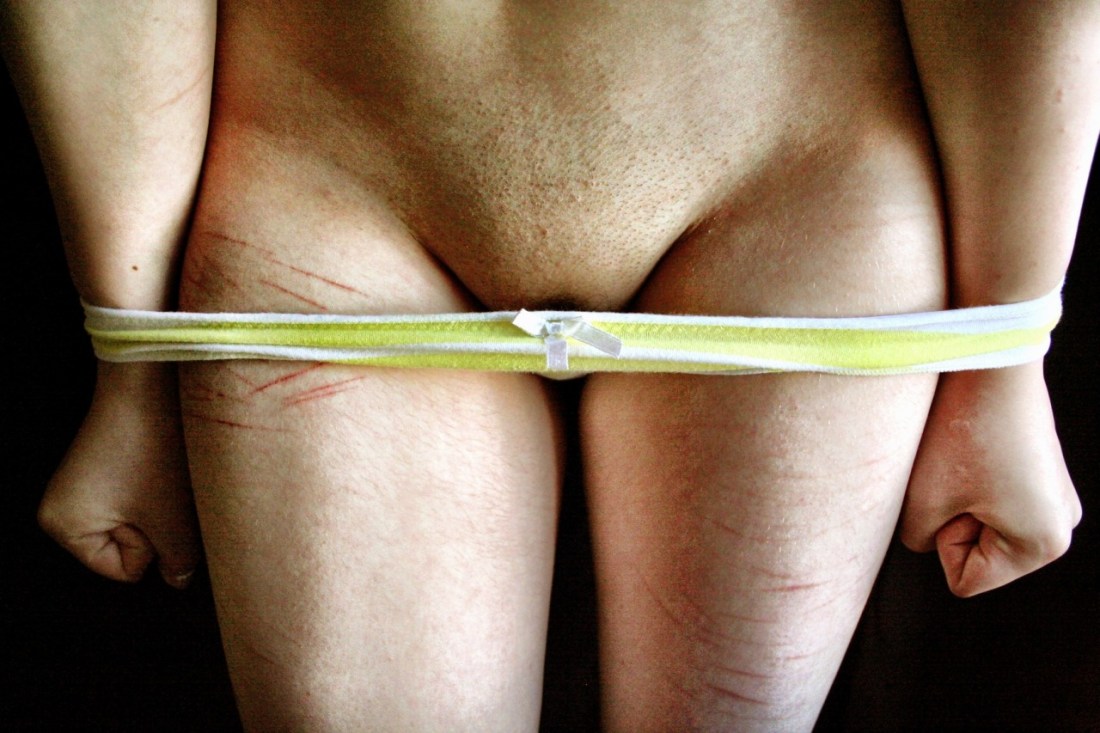
cutter painties – Copyright © Græ Andresen
Normal
0
false
false
false
EN-US
X-NONE
X-NONE
/* Style Definitions */
table.MsoNormalTable
{mso-style-name:”Table Normal”;
mso-tstyle-rowband-size:0;
mso-tstyle-colband-size:0;
mso-style-noshow:yes;
mso-style-priority:99;
mso-style-parent:””;
mso-padding-alt:0in 5.4pt 0in 5.4pt;
mso-para-margin-top:0in;
mso-para-margin-right:0in;
mso-para-margin-bottom:10.0pt;
mso-para-margin-left:0in;
line-height:115%;
mso-pagination:widow-orphan;
font-size:12.0pt;
mso-bidi-font-size:11.0pt;
font-family:”Garamond”,”serif”;}
A former flat mate—who despite being super rainforest crunch is still a friend—claims all conflicts arise as a result of unmet needs.
I chalked it up to hippy naiveté. And I would have dismissed it outright if not for the implicit critique of what qualifies as need.
Needs, to her, included the basics: food, water, shelter and clothing as well as safety, fulfillment and love. She argued being alone or unfulfilled in life causes suffering no more or less physically debilitating than hunger or thirst.
Of course, she went on to use the notion as an aide in unpacking geopolitical concerns—an at best reductive approach—which resulted in me dismissing the idea.
I’ve been re-evaluating that decision. It’s partly as a result of learning that in a month I’ll be laid off from perhaps the only job I haven’t utterly reviled. And the one thing making me not despise this job was learning first hand that I was dead wrong to dismiss my friend’s ideas because when it comes to interpersonal relationships in small groups/communities are concerned, meeting or failing to meet individual needs makes all the difference in the world.
Thus, all this messy brain spew gets entangled with this image.
I can’t claim to be a cutter. On the other hand, claiming I have never cut myself seems a more egregious mistruth. I look at the few small scars that have yet to fade and they do not seem like they belong to me. I never cut to see myself bleed or to feel anything, I cut because in those trance-like moments there was a very real feeling that I was cutting through my body in order to reach something I wanted to destroy with the totality of my being.
It’s the strangest things to feel nothing when presented with my own case; yet, when faced with a cartographic account of similar travels, I ascribe meaning ex nihilo: maplines of unmet needs.
I identify with everything in this image. The clenched fists self-restrained, tightly cinched and pinned by panty elastic to her hips. The three day stubbly growth on the mons pubis—an outward effort to adhere to perceived norms.
There’s further resonance for me: yesterday, I left my desk to wander the deserted world where I work. With all the doors propped open I wondered in an out of buildings. I wasn’t aware that I’d had any destination in mind until I found myself standing in the doorway of the now empty room where the young woman upon whom I have a crush slept, woke and struggled over the nine months.
All that remained was a silica gel pack against the baseboard, a small sheet of cream cardstock gatefolded with different flavors of tea printed on each section, the corner of a blue and white Nestlé plastic wrapper, a few pennies scattered among a litter of baby dust bunnies. Fingernail clippings on the desk and bureau; sequins and a Bobbie pin in otherwise empty drawers. Three or four Kleenex in a CVS pocket pack behind the mirrored medicine cabinet door above the commode and thin white bar waiting in the shower soap dish.
Presence in absence, it’s the obverse are I’ve known for so long—I no longer cut my body, no longer want to destroy, I just want to break through to reach someone, anyone, to touch and in the moment give a portion of what was given to me back to you.

by fred.c.fred
Normal
0
false
false
false
EN-US
X-NONE
X-NONE
/* Style Definitions */
table.MsoNormalTable
{mso-style-name:”Table Normal”;
mso-tstyle-rowband-size:0;
mso-tstyle-colband-size:0;
mso-style-noshow:yes;
mso-style-priority:99;
mso-style-parent:””;
mso-padding-alt:0in 5.4pt 0in 5.4pt;
mso-para-margin-top:0in;
mso-para-margin-right:0in;
mso-para-margin-bottom:10.0pt;
mso-para-margin-left:0in;
line-height:115%;
mso-pagination:widow-orphan;
font-size:12.0pt;
mso-bidi-font-size:11.0pt;
font-family:”Garamond”,”serif”;}
Received wisdom maintains that a boy willing to hold a girl’s hair back is a ‘nice guy’.
Isn’t it more complicated than that? What if a girl doesn’t want her hair held back, wants to hold the boy’s hair back or wants another girl to hold her hair back?
If I were a boy I’d a girl to hold my hair back and were I a girl, I’d want to hold another girl’s hair back.
But I am neither/both and all I have are hair ties.
 Acetylene Eyes