Ao Kim Ngân [aka yatender] – Untitled (2014)

A healthy human body can forgo eating for roughly a month and a half.

Dehydration will kill you in under a week–and this assumes a cool ambient temperature and minimal activity.

Hunger can be deferred; thirst commands an immediate response.

That’s the distinction that occurs to me browsing Ngân‘s work.

Her light fall series is obviously homage to Lina Scheynius’ preoccupation with documenting light. While the above is likely prefigured by Traci Matlock‘s mirror self-portraits.

Both Scheynius and Matlock are endlessly talented photographers. However, in a sense, in the realm of internet famous image makers, wearing such influences on one’s sleeve is potentially problematic.

That’s where Ngân distinguishes herself from thousands of other upstarts: her photos possess an unusual gravity. To get a feel for it, check out the stuff she’s shot of dancers in Ho Chi Minh City; not the way her single, static frames bristle with a sense of flowing, dynamic momentum.

Her personal work features less emphasis on momentum and more on stillness. In that way, it’s in line with Schneyius; however, unlike Schneyius there is a very profound sense that the stillness is in itself requires taxing concentration, is an exercise in willpower.

And this is where we get back to hunger vs. thirst. The work Ngân emulates is–in its sexual politics–interested in the overlap of representation and identity as a means of not only authorship but also as a relationship between the female gaze and the visualization of something not unlike hunger.

The lines between material and flesh in the image above, the delicate touch of the obscuring flowers here and the light on the knees, the position of hands and the texture of the dress and sheets here.

The subverted eroticism in the work is too intensely rendered, too pervasively interpenetrative to fit the framework of hunger. Even thirst seems entirely too willing to wait for fulfillment. This works walks a razor wire line of hope and frustration stretched between expectation and not fulfillment but forever expanding expectations.

Francesca WoodmanSome Disordered Interior Geometries (1981)

Although it’s on some level problematic: I have moments where I think of Ms. Woodman as if she were both still alive and as if she and I were a couple.

Let me try to clarify that so it’s less presumptuous and entitled: I read a lot of critics who bemoan her enduring appeal. They say she wasn’t really all that good. That she’s only canonized due to her broad public appeal–a sort of way to put asses in the seats–so to speak.

I don’t agree with either perspective. If anything Woodman was a great deal better than even her current popularity speaks to–her work still suffers from centuries of entrenched art historical sexism.

As to her enduring appeal, there is a way in which her work comes across as not exactly conversational but… wait, I know how to say it! I just need to steal from someone smarter than me.

In her brilliant summary of the best movie of 2014–Jim Jarmusch’s Only Lovers Left Alive–the lovely and amazing Knitphilia describes the interactions between Tilda Swinton and Tom Hiddleston’s characters in the film thusly: “the pair conversationally present amazing trufax to one another as love gifts.”

As vampires both have lived for centuries, they’ve seen and done it all. The range of new experiences open to them is if not long exhausted, finite. Yet, amazing trufax–and, and! Books and Art and Music as avenues of transmission–are something that can still stir awe in them.

That’s how I feel looking at Woodman’s work! It’s as if the medium is the message and the message is a constant stream of amazing trufax, little loving offerings that this insanely talented young woman who died shortly after my birth keeps leaving behind for me to glimpse if I pay careful attention.

Myself NudeUntitled (2015)

Maybe the most inspired use of a mirror in a nude self-portrait since Francesca Woodman.

First, there’s the sense of dimensionality imposed by her hanging hair encroaching upon the upper right corner of the frame and the manner in which the same hair obscures her reflection’s face. All enhanced by the way her pose–which were it a clock might read 6:12:46–splits the the reflection of the ceiling into a mid-tone grey color wheel.

Next, everything in the frame exhibits an awareness of the ninety degree angle formed in the upper right corner by the floor seam. The woman stands on her left tiptoes, twisting her leg in a manner that would appear awkward to an observer looking at her instead of at the mirror; nevertheless, in reflection it creates an exaggerated Seven Year Itch posture. But the reiteration of the leftward skew halts with emphasis due to  the way her right foot is so firmly planted (you can actually see how close the base of her fibula is to the mirrored surface in the reflection).

Of course, there’s the further glorify of the positive and negative contrast between the brightness of her right inner thigh and right shoulder/arm vs the darkness of her left inner thigh and left side/shoulder/arm.

The coup de grace though is how he shadows are permeable enough so her individual fingers each remain distinctly discernible.

The line of her legs, her pose and even those lines between her fingers all guide the eye to the exquisitely rendered cleft of her ass. However, once there, any attempts to dwell and objectify are thwarted by the way the opposition between light and dark draw the eye down the inside of her legs and outward again, recovering the entire frame and thereby reaffirming we are have been graced with a view of a woman both as she sees herself and how she wants to be seen.

Giangiacomo PepeUntitled (2013)

(PART I)

Back in 1999, Garrison Keillor suggested a broader conceptualization of what sex entails.

Sex is not a mechanical act that fails for lack of technique, and it is not a performance by the male for the audience of the female; it is a continuum of attraction that extends from the simplest conversation and the most innocent touching through the act of coitus.

A dear friend had posted it on her Facebook. It was literally the first thing I saw–all bleary-eyed–this morning.

It was one of those Oh shit moments where someone else somehow manages to express something you’ve been stumbling over for half a decade with a spare elegance.

For me, my experience of photography belongs to Keillor’s sexual spectrum. I mean, what but beauty causes anyone to lift a camera and sight a shot?

My reaction to beauty is unswervingly reliable: it overwhelms me, somersaults my tummy; makes me a blushing, shoe-tip-staring, dirt-kicking, boy-crazy teenage girl wanting from lips that won’t wet to shuddering knees.

***

Soon after the Keillor quote, Willow reblogged this from Sex Positive Activism

I was like what the fuck? A second Oh shit moment in the same day?

Okay, confession time: other than masturbation, I have been celibate for four-and-a-half-years. This is less a personal imperative than the fact that I am too irrevocably fucked for anyone to ever reciprocate the wanting I feel for them.

People always tell me that I need to have confidence. I think that’s bullshit. I don’t lack confidence. I lack a sense of entitlement.

When I was a film student, everyone worked with was invariably asked to do something either outrageous or obscene. No one took issue. Well, mostly. (In hindsight, I realize that I unintentionally created some very fucked up situations for people about whom I claimed to care a great deal.)

A number of things happened to shift this but one in particular stands out. For a group project, I had envisioned a scene with a bleeding, naked man smeared with mud running down a forest track. The actor who was supposed to play the part was a no-call/no-show and so I had to stand in. I was completely unnerved–I have always had a lot of body issues, they just haven’t always been the same–by the prospect of being naked in front of the small crew. I insisted on doing the scene wearing boxer shorts.

Watching the first and only (long story) screening, besides how my refusal to go nude ruined the scene, it hit me how fucked it was that I expected someone else to do the scene nude but I was unwilling to disrobe once I was in front of the camera.

***

As a result of these experiences, I abide by three etched-in-stone rules for photographing others:

  1. The photographer will under no circumstances touch the person(s) being photographed.
  2. The photographer will never ask anyone to enact anything the photographer would be unwilling to enact were the roles reversed.
  3. The photographer will never ask the person(s) being photographed to do anything the person(s) being photographed would not mutually desire the photographer to perform were the roles reversed.

***

The above image is not without flaws but between the mirror and the way she is reaching back to pull aside the crotch of her undergarment to reveal her vulva and anus, it is pornographic and capital fucking-A artful.

This is the type of work I want to make–conveying anger-verging-on-vaguely-self-destructive-arousal. I hardly expect Pepe to abide by my rules but the edge between consent and coercion is ambiguous enough on a good day that I worry about what goes on behind the scenes at his shoots.

I just don’t know how one ethically gets so many people to allow themselves to be vulnerable enough to pose in such a fashion. So many photographers seem to photograph their friends. That would be my preference. But the people in my life–who are fucking awesome and I wouldn’t trade for all the most-getting naked-est friends in the world–all have hang ups about nudity. It’s not that they aren’t sex-positive. (I just can’t do sex negativity. Not even a little.)

I worry that my own sexual frustration and realization that no one will ever ache for me the way I ache for them has tainted or will taing my work. It seems like if I could just find someone with whom I could share this sort of experimental openness in my work it would solve my problems.

The depressing truth is–there is no one who feels in kind toward me.

While in Amsterdam, I happened upon this billboard proclaiming Maika Elan‘s 2013 Pride Photo Award win under the documentary category for The Pink Choice (2012).

I nearly walked right by it as I was stoned, ravenously hungry and reasonably well on my way to getting drunk–not to mention it being tucked away in the plaza abutting the Heineken brewery.

Somehow, the bare legs of the young woman balanced on roller blades snagged the corner of my eye from across the street.

Upon closer inspection, my first thought was this belongs on my blog. I retrieved my phone and snapped several images of it.

Two months later, I don’t question my instinct to share this: it belongs alongside the other images on this blog. Still, I am hesitant to post it. Why?

My initial thought was including the image would provide a great occasion for a sex positive, yay-for-gay post. Now this strikes me as a naive notion at best and more likely disingenuous, lazy and intellectually dishonest.

Issues of sexual orientation certainly overlap with issues of sexuality but the two are not interchangeable.

Being ostensibly a sex blog  I don’t think it’s a good precedent to take the path of least resistance especially when to do so overlooks the fact that what initially fired my curiosity about this image was essentially libidinous– a young woman in her underwear.

As much as that is a problem–the cultural prerogative of sexualizing the female body–it isn’t the image’s problem; if anything, Elan succeeds by offering the viewer so many diverse avenues of approach: attraction, narrative, absurdist humor (seriously, wtf is up with blow drying the cat + who roller blades in doors), inversion of the mundane (aka whimsy) as well as a sense of authentic experience.

And it’s not really something I know how to other than to point out that despite what drew me to the image when I finally turned and lopped south, away from Marie Heinekenplein, I was struck by two realizations: first, I was now just as attracted to the second woman as the one wearing the roller blades– or perhaps more accurately attraction had blossomed into curiosity about them, the nature of their relationship, how they interact with one another, etc.; second, as a terminally unrequited individual, I am frequently and bitterly jealous of ‘happy’ couples, but while this image did make me feel a little sad, it also made me strangely grateful to be alive in a world where love is possible.

passius:

porn4ladies:            passius:

Olga Karasik404 2013

The use of the mirror here is goddamn inspired– obscuring both women’s faces within the frame. (See!! There’s no reason to decapitate yourself in your images to maintain your anonymity. A little creativity goes a long way and makes for better pictures.)

It’s obviously beholden to Francesca Woodman; but it wisely cribs a page from the rock and roll rule book for performing cover songs: make it better than or do it different.

Karasik filters Woodman’s concerns through her own aesthetic sensibility in a way that marks it as reinterpretation instead of a rearranging of elements in a template.

Sadly, it’s either some #skinnyframebullshit; or, :::shudders::: cropped. (I loathe a we’ll-just-fix-it-in-post attitude. Do it right the first time or go the fuck home. Post-production is a safety net in the unlikely chance it becomes necessary; the entire fucking point is not to need it.)

I guess at least evinces some thought went into the decision to opt for the skinny frame.

thebodyasconduit:

‘And in this vision

the present is also revealed as a ruin.’

(Hal Foster)

*

by Traci Lynn Matlock

June 20th & July 9th, 2013

film

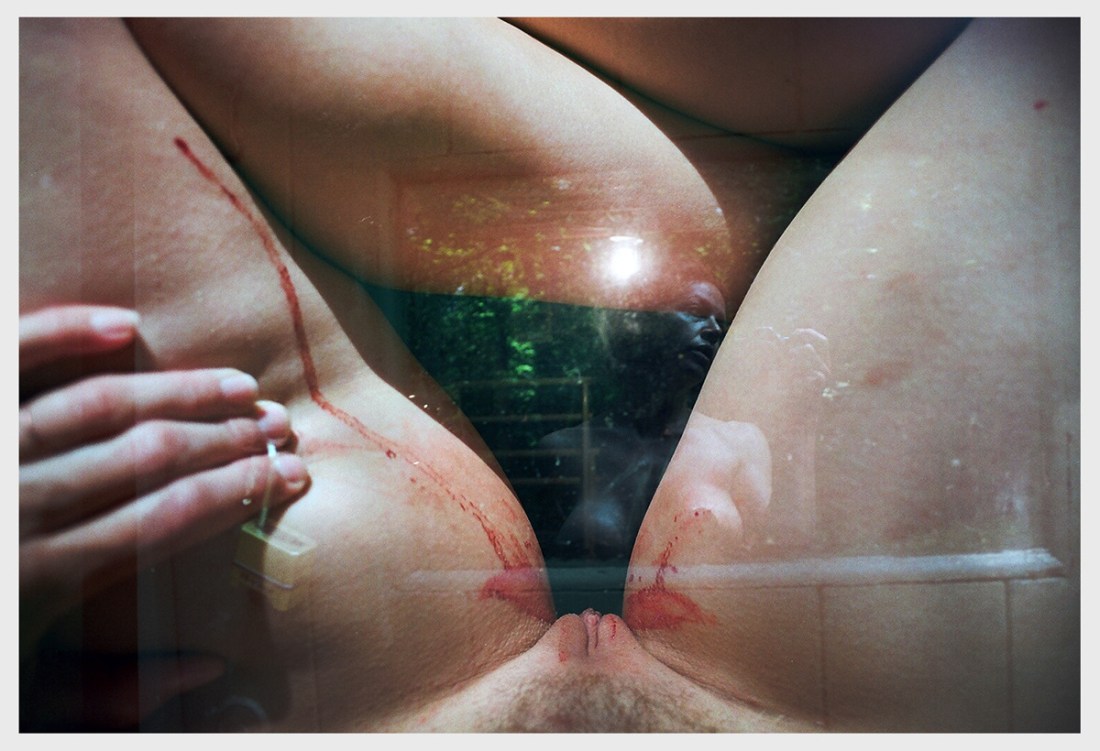
More often than not, articulating what’s going on in my head is like trying to fit an iceberg through the eye of a needle.

It’s like I see 300 images compressed into three seconds and I have to recall every bit of it with eidetic specificity. 

With this image what I can remember runs something like: ugh, multiple exposures; and, must Art always be goddamn sexist, there’s what, centuries worth of images featuring featuring women as essentialized, sexual objects but how many images can you think of where a female bodied individual is portrayed as a someone with a vital inner life independent of what a man thinks of her or the audacity to—clutch the pearls—depict menstruation; and, what would Szarkowski’s reductive Mirrors and Windows make of this?

The enormity of seeing the original thought surface, the marvel of its intricate perfection is all but lost.

My recall is sometimes astounding. I live for those moments.

During the remainder of the time, its like guessing at the original picture based on nothing more than a handful of puzzle pieces.

Occasionally, the pieces lead to more pieces. Given enough time, I can confidently point to an approximation of that first notion. Most of the time though, I can’t.

At which point I am left with the choice of giving up or trying to say something that manages to make sense of the pieces I have and hopefully points however glancing toward what I want to say.

Stories, I have learned, are a valuable tool in this process. Telling a story doesn’t always turn up more fragments. But it frequently triggers additional moments of astonishing clarity.

It doesn’t feel like there is a connection but I feel compelled to talk about how I discovered Matlock’s work.

Usually, I attribute my motivation to buy my first 35mm SLR to encountering her work. But that’s personal mythology; not the truth.

At the time, I was in film school studying cinematography. The summer between my junior and senior year was the first time I was not scheduled to shoot anything for anyone else and couldn’t afford to shoot anything of my own. So despite knowing nothing—less than nothing: fuck all—about still photography, I snagged a Nikon 8008s with a 50mm f1.4 lens. The salesman had to help me load the first roll of film.

The first handful of rolls turned out better than I had any right to expect. And after being prodded by my ‘adopted’ sister, I put some of my stuff up on Flickr. (This was back in the days of the simpler, more elegant interface and with it the now long gone pervasive sense of community.)

Part of me relished nominal attention my photos received. I likely would have bored of it, if it hadn’t been for the Explore feature.

After about six months of shooting, I hit my first plateau. The magic was far from gone but the process had begun to feel like work. It was that dead man’s land between Thanksgiving and Xmas and in combination with my frustration with my photographs, extremely loneliness and handful of other mitigating circumstances, created a perfect storm during which I stumbled onto Matlock and Ashley MacLean’s collaborative work under the moniker tetheredtothesun.

I remember distinctly that this was the first image I saw. Seeing it produced a feeling identical to the moment of surfacing, of mental clarity. Only, the three second time limit had been lifted. I could sit and stare; wonder at it all. Dwell there for a time.

I cannot understand how everything in my life since then has hinged on the flipping of that switch. I still don’t completely understand it. But it opened my eyes to the fact that the work I was making ran contrary to what I longed to create. Further, it lacked willingness to be vulnerable to others.

It’s not especially clear but the original thought I wanted to write about here was a bit of an extended metaphor. Something to do with the way parents track their child’s growth with pencil marks on a door frame. So much of my own creative development lines up in my mind with photographs Ms. Matlock has either helped to make or made herself. (I will write a goddamn dissertation of a post if I ever manage to track down her photo of Smashley titled something ‘a well-explored room’,.)

I don’t get her multiple exposure work. It doesn’t move me in the same way as her more candid images.

Matlock was recently interviewed by The Photographic Journal. Reading it I was reminded of how influential her work has been in my development as a photographer. It’s simultaneously thrilling and unnerving.

rawpix:

May21s†♥mirror/†he…mind(Daniel Schaefer)★

Roulé

Normal
0

false
false
false

EN-US
X-NONE
X-NONE

/* Style Definitions */
table.MsoNormalTable
{mso-style-name:”Table Normal”;
mso-tstyle-rowband-size:0;
mso-tstyle-colband-size:0;
mso-style-noshow:yes;
mso-style-priority:99;
mso-style-parent:””;
mso-padding-alt:0in 5.4pt 0in 5.4pt;
mso-para-margin-top:0in;
mso-para-margin-right:0in;
mso-para-margin-bottom:10.0pt;
mso-para-margin-left:0in;
line-height:115%;
mso-pagination:widow-orphan;
font-size:12.0pt;
mso-bidi-font-size:11.0pt;
font-family:”Garamond”,”serif”;}

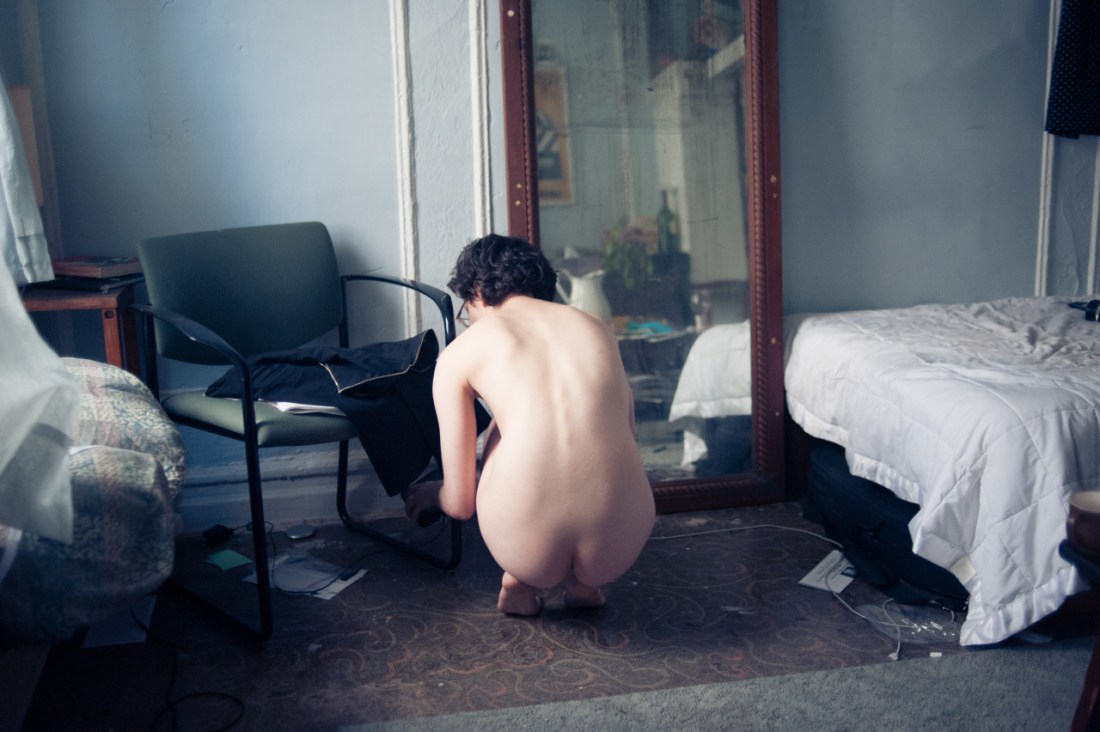
This interior—with its Spartan-with-Bohemian-pretenses—is reminiscent of my shitty, first-post college apartment in NYC.

What’s more startling is the resemblance of the young woman to the lover with whom I shared much of my time in that apartment. She, who in the pauses between our lovemaking, would crawl kneel o check the message on her phone she’d leave charging on the floor just like this.

The composition has an imprecise, snapshot immediacy which would almost certainly have appeared stale and uninspired were it not for the mirror’s reflection adding some much needed depth. Yet, what this image nails is presenting an ideal scale for everything the image contains.

Although she is kneeling, the frame is only slightly taller than she would be if she were standing. If she stood, the frame would have to move in order to contain her. In other words, she is the frame’s anchor—not vice versa; she agency in inhabit a space with implicit instead of merely appearing as an ancillary decoration.

toutdroitaller:

Mathilda Eberhard

Untitled

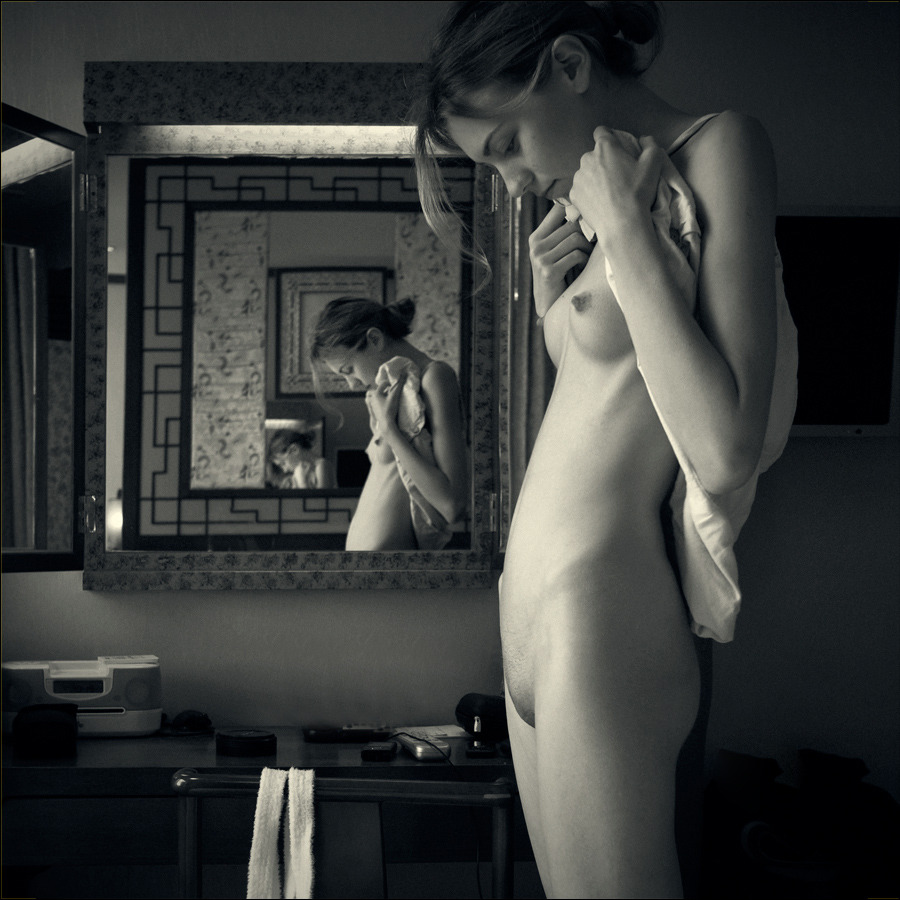
Is it me or is there something almost post-coital about the way this feels to the eye—towel-wrapped, shower-wet hair and still damp skin sheathed in afterglow and diaphanous light?

In spite of being digital, I wish this were an image I had made. It exemplifies so many imagistic attributes I hold dear:·       

  • It eschews the forced intimacy of knee-jerk close-ups    
  • Employs a scale fixed somewhere betwixt Wall’s voyeuristic medium shots and Angelopoulos’ telescopic long shots in order to offer the viewer a wealth of contextual information.
  • A visually compelling interior is presented so as to avoid the trappings of perfect production design. (Tarkovsky is as close to having a deity as I come, but I’m perpetually frustrated by his über-eclectic, pristinely cluttered sets with no room for real people to live)
  • It features a beautiful young nude woman with exquisite, tiny breasts and pubic hair.

All that is missing is a narrative seed, one moment suggesting what came before and what follows. But this is more of a tone poem, it would seem.

Tone poems, though, are slippery as eel skin. And there is a tendency to use them as an excuse for untouched inconsistencies.

For example, the framing here pans the camera slightly right to ensure the golden light on her back appears reflected in the mirror; this wawker-jawing complicated by the extreme wide angle is nearly balanced out by the uneven curtain rod’s counter-angle—keyword: nearly.

Also, her pose is odd. It is clearly staged but she holds it in such an unself-conscious way that it from avoids appearing contrived.

These inconsistencies cut both ways: justifying the unresolved aspects as endemic to the work is what makes it great; it is also what keeps it from being truly exceptional due to such justification obfuscating the implicit awareness the image provides of viewing something up to a terminal point—the snapping of the shutter—and then being left with little except the technical inconsistencies to ponder for clues that simply don’t exist.

The oft trotted proverb goes: good artists borrow; great artists steal.

Whether it was T. S. Eliot or Picasso who provided this sentiment and regardless of any inherent merit, this has become a prima apologia for shitty artists the world over.

With its focus on a scene unfolding in a room lit from frame left, this image ostensibly borrows from Vermeer. Yet, unlike Vermeer—whose canvases present their subjects en media res: reading the final lines of a letter, pouring milk—this woman actions are ambiguous, her pose highly contrived in an effort to appear natural; however, consider what situation might require her to so pull her gown up around her shoulders and face away from a readily available mirror in order to stare down at her nude body?

I would be very surprised if the individual responsible for this image was unfamiliar with Vermeer. However, borrowing here from Vermeer is like asking a friend to lend you a designer sweater to wear with your new backless red dress. 

The theft that does work is from an artist I would wager is unknown to the image maker: VelázquezLas Meninas specifically

Mirrors have a way of fucking with subjectivity. Velázquez depicts the subject—that is, the king and queen—only in a faint reflection; the scene instead focuses on the artist—presumably Velázquez himself—painting. At the same time, note the painter is considering both his subject and we the spectators.

The mirroring in the image above is less complicated but does produce, if accidentally, an interesting effect. By angling the camera so it views the reflection without being itself reflected, as well as the inclusion of the reflection of the young woman’s face reflected from a smaller mirror along the so-called fourth wall gives the room an implicit dimensionality. An implicit dimensionality that, in effect, deletes the physical presence of the camera from the scene; muddling matters of subject/object, observer/observed along with the questions of exhibitionism and voyeurism accompanying them.