The Frenzy of the VisibleSelf-Portrait (2013)

The first thing I notice about this is actually the last thing that registers: these are both close-ups.

I’m not averse to close-ups; they allow for focusing on details that might otherwise be missed and when thoughtfully applied can draw attention to the foreign-in-the-familiar.

However, most close-ups exemplify a knee-jerk, voyeuristic fixation: faces and erogenous zones.

It’s sensible enough tactic–glimpse up-close that which is instinctively watched; but there are at least two flaws:

  1. Contextual diminution imposes a representational metonymy wherein a part of the subject (the face) replaces the whole.
  2. Heaping familiarity on top of familiarity in tandem with physical proximity of the imaging device to the subject fosters a false sense of intimacy.

With something like say: portraiture, these are–at worst–critical peccadilloes. When it comes to imagery preoccupied with explicit content, it’s rather another.

This not only shows something beautiful, it shows its work with regard to why what is being shown is being shown in the way it is. (i.e. in close-up)

To see it: take either image independent of the other. Each is strong image in-and-of-itself; each offers an incontrovertible reading of the scene: a male-bodied individual laying on clean, white sheets, masturbating.

Taken together, the artful foreign-in-the-familiar framing in the separate panels merges to form a close-up than in an acharacteristic manner conceals more than it reveals. (Further emphasized by the matting and the orientation as a diptych.)

Truly a first-rate, fucking crackerjack image.

Source Unknown (Initial poster Scott Loves Cock, maybe?)

My reading of this runs pretty much like this: these two fellows are hanging out and one says: would you mind licking my balls while I masturbate.

I’m not going to lie: a world where desire was addressed in a similar fashion as admitting you’re hungry and inquiring if someone else is also. (By extension, the other person could not be hungry and it wouldn’t be a big deal that one party was and the other wasn’t.)

As fabulous as it all sounds–it’s a pipe dream for hundreds of reasons I can’t possibly get into here.

Here’s the knotty rub (pun maybe a little intended): part of the reason I see this image in the way I do is that I tend to perceive ‘gay’ porn as a cut above porn targeting straight men.

‘Gay’ pornography constitutes a fraction of my lifetime smut consumption, in truth. Whereas, I am familiar with the conventions of ‘straight’ porn: bronzed and muscle-bound male-bodied performer encounters buxom female-bodied performer in a perfectly mundane situation that might happen to anyone, things rapidly and unrealistically escalate and so begins ticking off check boxes on the list of things porn through nothing more than rote force of blind habit has convinced us ‘straight’ folks get off on seeing.

Not to even get into the issues surrounding privilege, objectification, exclusion, etc. & etc.

But as I am largely unfamiliar and therefore oblivious to comparable tropes in ‘gay’ porn, my impression is that ‘gay’ porn is more enjoyable for those who perform in it that is ‘straight’ porn.

It’s a well-intentioned enough view. However, at best it’s essentialist, at worst slut-shaming by proxy–the assumption being that because of the pervasive sexism in the porn, there is no way a woman can derive pleasure from her participation. (I am going to work on this, going forward.)

Finally, my reading presumes from a place of fundamental unknowing that there are no comparable politics of oppression acting in ‘gay’ porn. Just because I am unfamiliar with them doesn’t mean they do not exist. (I’m sure they do, in fact; history shows that as soon as something is commodified, means of exploiting the commodification for material gain come out of the fucking wood work.

Robert Weissner Bree Addams (2013)

As it is, the framing functions. The desk more or less echoes Ms. Addams knees; the window edge starts a wee bit shy of the first vertical third but the vertical blinds and radiant light not only accentuate her form it contributes an implicit leftward momentum to the image.

Her weight is supported by her right arm and foot–her left leg shifts behind the other at the knee, her left hand is extended only for the sake of balance. It’s interesting because this posture suggests between her arms and torso a form close enough to round up to an equilateral triangle–drawing attention to her breasts (exquisitely semi-silhouetted behind sheer fabric), reiterating the shape of her pubic hair. .

With only this image to go on, I’d be pretty excited about digging in to the image maker’s other work. Alas, I think the praise here needs to go to Ms. Addams.

Don’t get me wrong, Weissner isn’t half-bad. He’s got enough technical chops to give his work a faux art sheen. The trouble is: he seems to see himself as a Dan Smith when his work is inline with the ‘art’ as a pretext for sating voyeurism of someone like Fox Photo-Art.

Credit where it’s due: technical acumen is nothing to sneeze at and this is one image is lovely and I certainly prefer Weissner to Fox Photo-Art’s rubbish. Unfortunately, there is so little distinguishing their work from each other or the scads of other female-nudes-all-day-every-day-because-I-own-a-dSLR-and-can-afford-to-hire-beautiful-models that I just have to shake my head and close another tab.

danishprinciple:

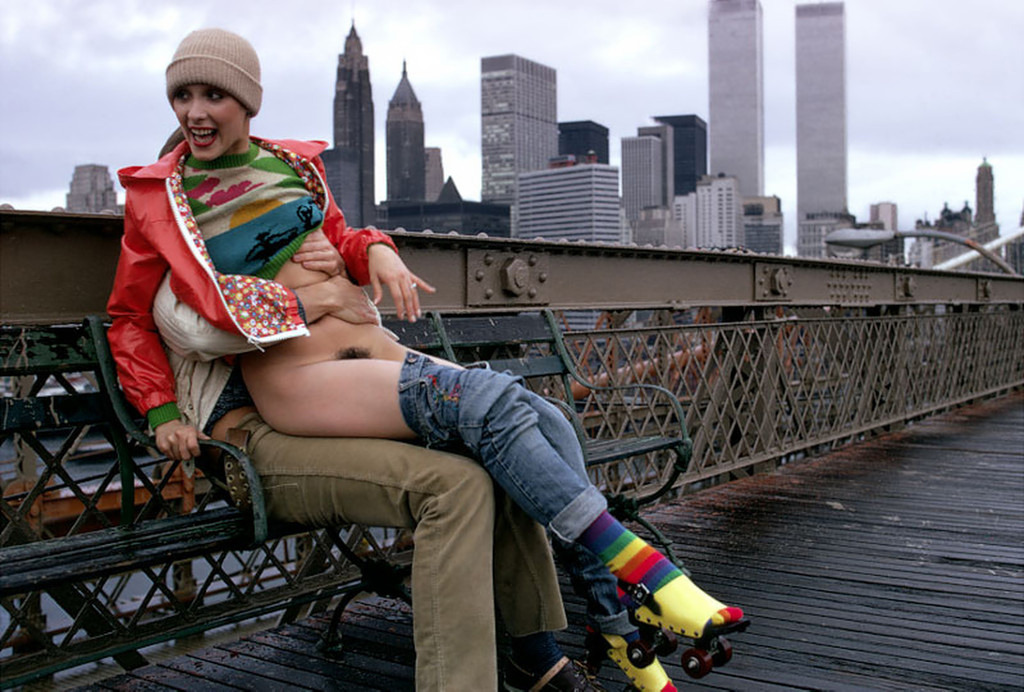
Do it Now! Photo by Richard Fegley ● Playboy Magazine (September 1974)

I have qualms about posting anything originating from Playboy but I had to make an exception here because:

  1. The Brooklyn Bridge is one of my favorite places in NYC. I walk it several times a week.
  2. The politics of public nudity fascinate me and feature prominently in my personal work.
  3. I harbor this stupid dream of making nude portraits of my friends and I in very public around the city.
  4. From the red jacket, loud sweater, rainbow socks and roller skates, the model bears a resemblance to a former girlfriend.  (She would flip her shit over this.)

fototio:

Jeff Bark. from the Abandoned series.

If Jeff Bark were a cocktail, you’d make him by mixing two parts David LaChappelle with three parts Gregory Crewdson and then garnish liberally with some Maria Van Oosterwijck.

*If you do not have Gregory Crewdson on hand, you can make some by reducing Jeff Wall’s brilliant innovation and studied craft to a syrupy, cloyingly cliched confection.

Casting aside my distaste for the antecedents, Bark’s work is nice. Hell, if nothing else at least a quarter of the Tumblr’s I follow have re-blogged this post.

But I think this post–presenting as it does these two images as a diptych instead of their inclusion in progression on Bark’s site–emphasizes identity politics in depiction of gender in images. Although Bark certainly needs to be commended for his equal use of male-bodied and female-bodied models, his work does not strike me as being as preoccupied with matters of gender depiction as these images would lead the casual viewer to believe.

A shame really, since their presentation here manages to be both straight-forward, unassuming and yet still disarmingly intimate.

angmodel:

andrea margaret

Margaret has made work with a veritable a who’s-who of Tumblr image makers: Darren Ankenman, Babak Ghaemian, Todd Hido, Brittany Market, Megan Sample, Erica Shires (whose work is INCREDIBLE), Art T (aka Creative Rehab) & Chip Willis.

Her appeal is understandable: she effortlessly shifts between ingenue, coquette, muse and provocateur. Yet, the shift is not so much like donning a mask as assuming an entirely new identity.

A desirable knack, certainly, but what further distinguishes her work is the fiercely assertive, in-your-face independence that shimmers just below the surface. Andrea Margaret can appear disdainful, bored, playful–often all at once–but it is always evidently she’ll tolerate no sort of foolywang whatsoever.

That’s what makes this picture stand out to me; it’s a self-portrait (as far as I can tell) with a severely limited dynamic range suggestive of a low-end digital rig–an iPhone 4, if I was forced to guess. It’s hell of muddy; but not in a someone tracked-mud-onto-the-floor-you-just-mopped way, in a simpering Delta blues way.

Here, Margaret seems less overtly confrontational. Instead, her provocation is cut with an aching, frustrated determination, perhaps some loneliness as well.

Quite nice, really.

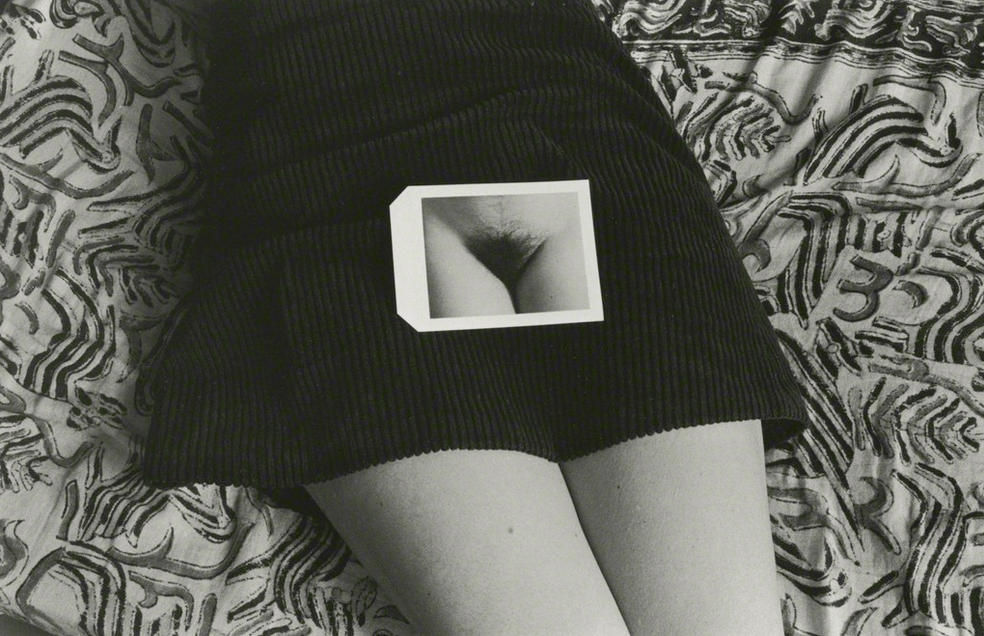
Source: unknown

In the best case, this essentializes female-bodiedness to genitalia. (Duchamp’s Etante Donnés being a likely point of departure isn’t a good enough excuse.) Worst case–which isn’t all that different from the best case–it operates as misogynistic synecdoche.

The presentation is rather clever (mounted Kodachrome slide as a winking meta-joke on fetishization); but, not so clever as to dismiss criticisms.

(There’s maybe also a #skinnyframebullshit argument to posit.)

With these foibles, it‘s still motherfucking gorgeous. I don’t care how expensive and difficult it was to manage, Kodachrome ran circles around later color positive stocks.

And now that Fuji discontinued Astia, there is no longer a world class color transparency stock. Yes, there are good stocks–I use Provia 100, to better than middling results. And a good chrome–in terms of color reciprocity–is indisputably preferable to the best negative stock. (Whereas neg stocks compared to digital are like comparing the illumination of the sun to pitch darkness encroaching on a guttering flame.)

I mention this partly to provide context on my fetish object assertion and as a result of recent speculation that Fuji may be leaving the E-6 party in the next five years; a move that would mark the end of color positive film stocks.

Motherfucking megapixels suck at B&W due to digital only theoretically supporting 75% of the range of blacks the human eye can see. That’s why there will always be B&W film stocks. But despite still remaining grossly inferior, digital is killing color. I categorically don’t want to live in a world where representing colors like those in Steve McCurry’s so-called Afghan Mona Lisa have been rendered obsolete due to an insistence on following the path of least resistance.

Kenneth JosephsonPolapan (1973)

First things first: I have gotten flack for the wordiness of my posts. I post what I post because I believe in contribution as a prerequisite for participation in a community. I don’t have much in the way of original content, so I offer what I can: commentary.

I realize that most of you couldn’t give less of a fuck what I think about images. I don’t give fuck one if you discard what I’ve written when you reblog shit from me. That’s cool. No offense taken.

What I can’t abide is deleting attribution. Don’t do it. If you do, you suck shit through a fucking tube.

Case in point, this image was properly credited in the original post. Somewhere along the line, credit was removed.

It may seem like a small thing. But this has come across my dash several times. Seeing it, i’ve thought to myself: self, the blacks look kinda shallow so this is probably an image created through digital means. It has a bit of the picture-in-picture thing happening, maybe a touch of the album-cover-instead-of-a-face trend. In other words, due to my lack of pre-extant familiarity with the work, I end up mistaking it for a copy cat instead of an instigator.

Further, knowing that this was made in 1973 immediately connects it with Duane Michals Things are Queer and sharpens my ‘inspired picture-in-picture’ formulation toward an insinuation of mise en abyme.

And what is particularly interesting to me about mise en abyme and what Michals focuses on is that you can not only travel inward in such images, it is equally possible–and I would argue more interesting–to travel outward.

danish-principle:

foxphotoart

Fox Photo-ArtGlass Olive [from the Voyeurism Series] (2013)

Initially, I see the stone wall and sapling filtered, dappled light. All of it pulls up a step or two short of full blown flashback to strolling around Fort Tryon Park on a summer afternoon.

This feeling motivated me to look into Fox Photo-Art.

Le sigh. What is it with image makers bearing vulpine monikers and their privileged insistence upon producing self-important, creatively stunted dreck and deeming it ‘art’?

Usually, this attitude causes me to dismiss the work in totality; however, it somehow increases my appreciation of the above image even if there’s nothing especially inspired about it.

Yeah, the composition is solid: the angle of the ledge leads the eye to Glass Olive; her body is situated parallel to the focal plane so her legs can remain open toward the camera.

Unlike the more natural, obviously comfortable positioning of her legs, her upper body is rigidly posed in order to facilitate reflection of light from the bright white pages of Margot Mifflin’s Bodies of Subversion onto her face.

To my eye there’s a startlingly nuanced yet fraught conceptualization at work here: using Ms. Olive’s face to establish a counterpoint to the focus on her pubic area.

Glossing over the implications with regard to matters of heteronormative gaze and sexualization/objectification of female bodies, this strategy somewhat succeeds. Although, it should be pointed out this counterpoint unbalances the image; and only works due to the dimensionality contributed by the angle of Ms. Olive’s legs balanced against the essentially decorative negative space occupying the left third of the frame.

I am almost always appreciative of clever framing. But what fascinates me here is the degree to which the subject remains completely indifferent to being seen in spite of all the visual cues pointing to the precision with which the scene has been staged. The most obvious being that no matter how much you fidget, wiggle or kick, even given the audacity of sitting in such a way in a dress sans undergarments, dresses only fall like this as a result of being carefully arranged.

It’s like the Fox Photo-Art can’t decide whether he’s dealing in conventions of public nudity or upskirt shots.

Speaking of the latter: recently, I’ve seen some commendable efforts (like this) to recast an otherwise exploitative genre in a more consent-driven, body positive/sex positive manner.