Igor Mukhin

Normal
0

false
false
false

EN-US
X-NONE
X-NONE

/* Style Definitions */
table.MsoNormalTable
{mso-style-name:”Table Normal”;
mso-tstyle-rowband-size:0;
mso-tstyle-colband-size:0;
mso-style-noshow:yes;
mso-style-priority:99;
mso-style-parent:””;
mso-padding-alt:0in 5.4pt 0in 5.4pt;
mso-para-margin-top:0in;
mso-para-margin-right:0in;
mso-para-margin-bottom:10.0pt;
mso-para-margin-left:0in;
line-height:115%;
mso-pagination:widow-orphan;
font-size:12.0pt;
mso-bidi-font-size:11.0pt;
font-family:”Garamond”,”serif”;}

If it moves, Igor Mukhin likely shoots it; if it doesn’t, he’ll still take aim.

With nearly 5000 images—split between B&W film scans and Leica AG M9 captures, amassed over 6.5 years—perusing his photostream is like mainlining a hyper-distilled, chaotic mélange of interesting, occasionally ingenious work.

My head doesn’t wrap around such profligate excess easily—limitation is too central a feature in my own process. (Read: I am poor.) But I can let that slide. What I fail to fathom is how Mukhin’s haphazard, throw-it-at-the-wall-to-see-what-sticks curatorial approach works at all, let alone results in such jaw-dropping examples of all that photography should embody.

(To avoid unnecessary disappointment, skip his staid personal website.)

toutdroitaller:

Irina Zadorozhnaja

Whether she is shooting street-travel hybrid images, landscapes or portraits, Ирина Задорожная demonstrates a precocious formal consistency.

Her images feel symmetrical. Yet, upon closer inspection they instead employ an objects implicit extension beyond the frame edge to balance out an equal amount of negative space on the opposite side.

For example: the lower frame edge cuts awkwardly below the model’s wrist + mons pubis. Notice though how this is balanced by the negative space above the model’s head at the limit of the upper frame edge.

It’s a sophisticated, compelling tactic.

I really like this image. The expression in tandem with the pose is both aloof and fragile; the visible texture of the sweater expertly counters the otherwise problematic flatness. The light is probably too harsh but I can forgive that.

#skinnyframebullshit still needs to be called, however. It baffles me how the same artist responsible for this image showcasing how portrait orientation ought to be used, resorted to the typically knee-jerk, portrait-orientation-for-portraits in an otherwise nearly impeccable image.

thebodyasconduit:

‘And in this vision

the present is also revealed as a ruin.’

(Hal Foster)

*

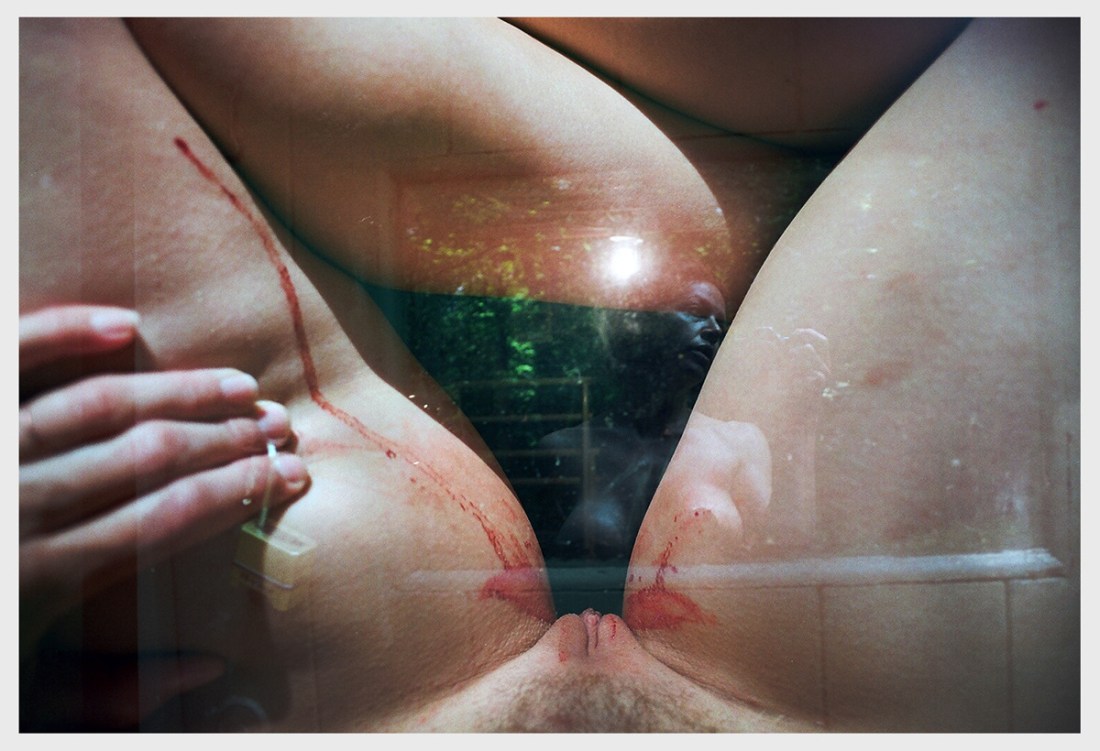
by Traci Lynn Matlock

June 20th & July 9th, 2013

film

More often than not, articulating what’s going on in my head is like trying to fit an iceberg through the eye of a needle.

It’s like I see 300 images compressed into three seconds and I have to recall every bit of it with eidetic specificity. 

With this image what I can remember runs something like: ugh, multiple exposures; and, must Art always be goddamn sexist, there’s what, centuries worth of images featuring featuring women as essentialized, sexual objects but how many images can you think of where a female bodied individual is portrayed as a someone with a vital inner life independent of what a man thinks of her or the audacity to—clutch the pearls—depict menstruation; and, what would Szarkowski’s reductive Mirrors and Windows make of this?

The enormity of seeing the original thought surface, the marvel of its intricate perfection is all but lost.

My recall is sometimes astounding. I live for those moments.

During the remainder of the time, its like guessing at the original picture based on nothing more than a handful of puzzle pieces.

Occasionally, the pieces lead to more pieces. Given enough time, I can confidently point to an approximation of that first notion. Most of the time though, I can’t.

At which point I am left with the choice of giving up or trying to say something that manages to make sense of the pieces I have and hopefully points however glancing toward what I want to say.

Stories, I have learned, are a valuable tool in this process. Telling a story doesn’t always turn up more fragments. But it frequently triggers additional moments of astonishing clarity.

It doesn’t feel like there is a connection but I feel compelled to talk about how I discovered Matlock’s work.

Usually, I attribute my motivation to buy my first 35mm SLR to encountering her work. But that’s personal mythology; not the truth.

At the time, I was in film school studying cinematography. The summer between my junior and senior year was the first time I was not scheduled to shoot anything for anyone else and couldn’t afford to shoot anything of my own. So despite knowing nothing—less than nothing: fuck all—about still photography, I snagged a Nikon 8008s with a 50mm f1.4 lens. The salesman had to help me load the first roll of film.

The first handful of rolls turned out better than I had any right to expect. And after being prodded by my ‘adopted’ sister, I put some of my stuff up on Flickr. (This was back in the days of the simpler, more elegant interface and with it the now long gone pervasive sense of community.)

Part of me relished nominal attention my photos received. I likely would have bored of it, if it hadn’t been for the Explore feature.

After about six months of shooting, I hit my first plateau. The magic was far from gone but the process had begun to feel like work. It was that dead man’s land between Thanksgiving and Xmas and in combination with my frustration with my photographs, extremely loneliness and handful of other mitigating circumstances, created a perfect storm during which I stumbled onto Matlock and Ashley MacLean’s collaborative work under the moniker tetheredtothesun.

I remember distinctly that this was the first image I saw. Seeing it produced a feeling identical to the moment of surfacing, of mental clarity. Only, the three second time limit had been lifted. I could sit and stare; wonder at it all. Dwell there for a time.

I cannot understand how everything in my life since then has hinged on the flipping of that switch. I still don’t completely understand it. But it opened my eyes to the fact that the work I was making ran contrary to what I longed to create. Further, it lacked willingness to be vulnerable to others.

It’s not especially clear but the original thought I wanted to write about here was a bit of an extended metaphor. Something to do with the way parents track their child’s growth with pencil marks on a door frame. So much of my own creative development lines up in my mind with photographs Ms. Matlock has either helped to make or made herself. (I will write a goddamn dissertation of a post if I ever manage to track down her photo of Smashley titled something ‘a well-explored room’,.)

I don’t get her multiple exposure work. It doesn’t move me in the same way as her more candid images.

Matlock was recently interviewed by The Photographic Journal. Reading it I was reminded of how influential her work has been in my development as a photographer. It’s simultaneously thrilling and unnerving.

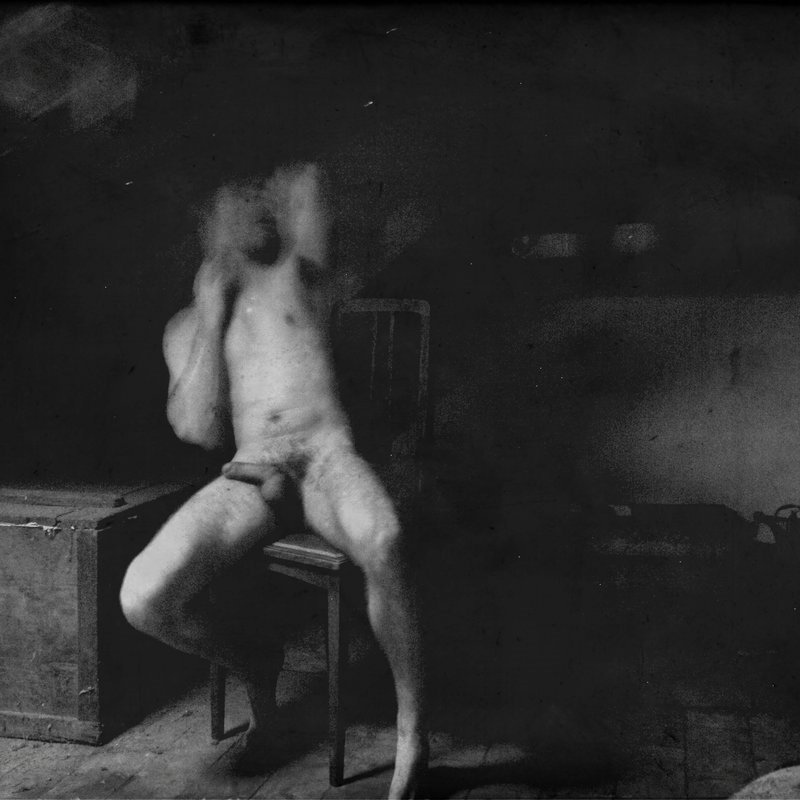
I have tried to source this but neither Google Image search or TinEye are coming up with anything conclusive.

This uncertainty exacerbates my polar reactions to it. Most of the time, the muddiness is reminiscent of Duane Michals early-ish work, particularlly a moment of perfection.

But there are also times–like writing this–where the position way his arms are positioned and his motion blurred face feel more like a horror film, a sort of  E. Elias Merhige’s Begotten-esque haunted house where the ghost seduces then strangles the amorous.

I don’t know what to make of it. Not in an I don’t give fuck one about it, though. It’s so true what is said about the distance between what we love and hate is much less than the disparity separating love from apathy.

There something else rattling around in my head about the body as a house haunted by a soul, but language and I are having another one of our frequent sullen tiffs. Besides, any time it starts to feel like the only thing I have ever known, I start to forget how the stories go.

Ren Hang’s work elicits equal and opposite reactions in me.

Few photographers exhibit such an omnivorous eye; fewer gaze upon such transgressive material.

And I fucking adore Hang’s non-prejudicial and unapologetic depictions of an exceedingly broad range of graphic human sexuality.

Unfortunately, a by-product of what I love also makes the work uncomfortable for me: confrontation.

After more than a half century of pornography rigidly marketed to exclusive sexual demographics, displaying a picture of a woman applying lipstick to her vulva next to a photo of a male-on-male anal sex is an inherently confrontational act. I don’t have a problem with that. In fact, I applaud it: FUCK goddamn centuries of hetero-normativity and straight privilege bullshit.

What bothers me is the way the majority of Hang’s work features on under-current of aggression. As if the inherent confrontation of the presentation takes second seat to something closer to rubbing the viewer’s nose in what is displayed.

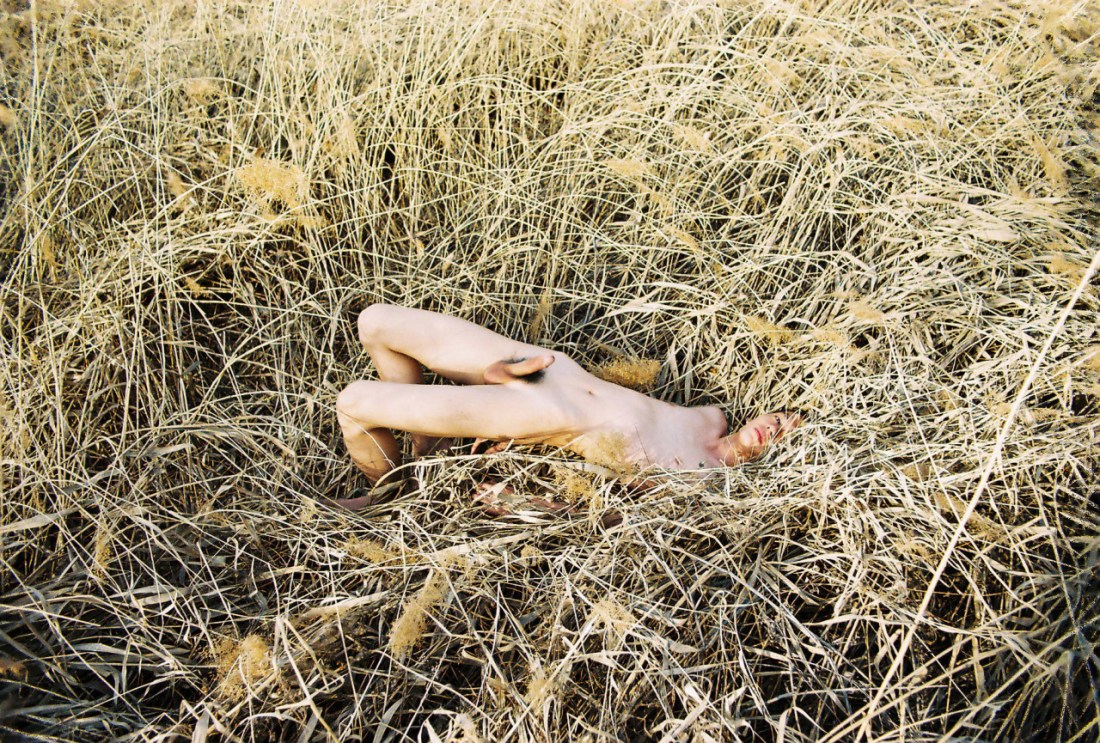
Which is why this image stands out to me: the color of the grass so closely matches the color of his skin that the boys erect cock, thrust hips and come-hither eye contact with the camera evinces an almost counter-intuitive vulnerability.

kalkibodhi:

Tops

KalkiBodhi Archives

Normal
0

false
false
false

EN-US
X-NONE
X-NONE

/* Style Definitions */
table.MsoNormalTable
{mso-style-name:”Table Normal”;
mso-tstyle-rowband-size:0;
mso-tstyle-colband-size:0;
mso-style-noshow:yes;
mso-style-priority:99;
mso-style-parent:””;
mso-padding-alt:0in 5.4pt 0in 5.4pt;
mso-para-margin-top:0in;
mso-para-margin-right:0in;
mso-para-margin-bottom:10.0pt;
mso-para-margin-left:0in;
line-height:115%;
mso-pagination:widow-orphan;
font-size:12.0pt;
mso-bidi-font-size:11.0pt;
font-family:”Garamond”,”serif”;}

This is exactly and uncannily what I want when I am feeling horny distilled to some #skinnyframebullshit that had decent color before some fucker futzed with it.

Still though: unf and total sploosh.

This post is guest curated by azura09:

Hello, I’m azura09 and I’m taking the helm of Acetylene Eyes from May 1-7. We’ve been friends for a number of years and they’re one of people I’m most comfortable talking to about sexuality, gender, and my enthusiasm for porn (both queer and otherwise). I admit that I’m not a photographer and that I have very little working knowledge of what constitutes an artful photograph. Because of this, I’m simply going to focus on images that turn me on and attempt to explain what it is about them that makes me shiver in anticipation. Thanks so much to Acetylene Eyes for allowing me to put my (slightly less refined) taste on display this week.

I’m starting this week off with an image that makes me feel safe.  A kind of safe that seems specifically queer to me, one I’ve never seen straight porn get quite right. It’s that vulnerability that comes with realizing you (and the person you’re with) are on equal footing:

It’s nice to push you down,

make your open your thighs,

 watch you fan your hair out like I got to drown in the best ocean

        to find you, but this isn’t what I need

and I’m telling you, look at all the things you can eat, even as I’m worrying that

I shouldn’t

eat you down to whispering bones.

 queeremmaclaire:

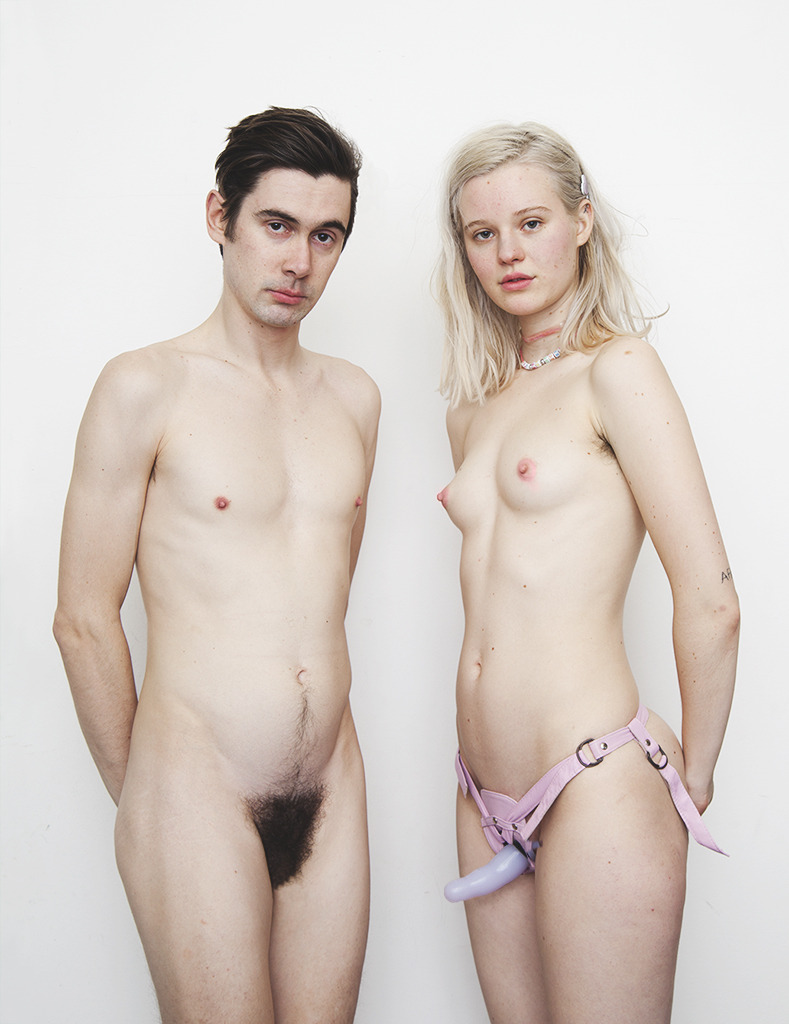
Carson from Crash Pad series with Brooklyn Flaco