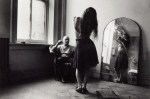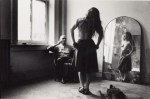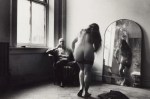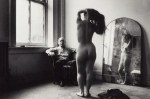
Jane BurtonLimbo #8 from Other Stories series (2008)

One-offs always a risk. By doing something that defiantly refuses to sit at the table quietly with the other children, there is always a very real danger of exposing things the artist would rather remain hidden.

In some ways this work is better than Burton’s other work. Well, maybe not better–more ambitious. The rest of her is so flat. It functions with something like the unexpected flatness in layer that is always the unexpected result of layering multiple negs to make prints in a traditional darkroom–you expect the way the sandwich looks to your eye to transfer to a dimensionality in the print and it never does.

Here: the vague reflection of the trees in the cracked glass speaks to that scrim like compression of dimensionality. Most of Burton’s work functions with the implication of one-point perspective. Whereas this is decidedly two-point. The purposeful center-weighted symmetricality of the rest of the work is thrown heavily off balance. The framing doesn’t make sense–it certainly doesn’t fit an sort of rule of third compliant framework.

In fact the composition is solely about the reflection and the cracked glass. The positioning of the character in the frame is intended to associate the violence of the broken glass with the female genitalia. Note: that the echoing cracked glass is higher and there is no one similarly positioned behind it. There is the ghost of a collapsed heteronormative relationship haunting this image.

And for how easy that all is to ready, it’s troubling that the frame wasn’t cropped. For the closer the frame gets to a 2.1:1 aspect ratio, the more appealing something more along the lines of a rule of fifths becomes aesthetically appealing. Although it’s not exactly, applying a rule fifths does actually contribute a degree of previously missing legibility to the composition.

wonderlust photoworksEcho from Address the Void series (2009)

To my Darkness and my Light,

I
unfold myself; you, in turn, call to me with your warm and aching
mouth— its tongue, a delicate command I will not long withstand.

Your lips spill sighs; I drink until your thirst is sated.

Trembling
hands steady me beneath you.  You guide me toward your deepest
acceptance.  I find a center in you; you grasp me and gasp.

(You
shudder— hands bracing the afternoon light dying against such white
walls.  I see your ineffable Beauty with the eye of god.  I fall and
place this feeble kiss to caress the spine as I pass.)

With you I experience annihilations most will never know.

After
I am restless; you know what I want is what I will never achieve
alone— you coax from my every ending its next beginning.

We must map these new and nameless oblivions together.

thebodyasconduit [Traci Matlock‘s Tumblr] – Ruby Slipper (2015)

As much as I carry on about composition as a facet of qualitatively ‘good’ photography and image making, truth told: I always favor work which presents the singular immediacy of The Moment.

For example: this depiction of a threesome is indelibly imprinted on my psyche. Is it a qualitatively good image? I’d argue it’s no more and no less important than a broad swatch of Nan Goldin’s photos. The difference is the former is fixated on the immediacy of documenting a moment, whereas Goldin is more interested in photography as an act of memorializing.

Admittedly, both are two shadows cast by the same motivation; but, in Goldin’s case there’s an implicit questioning of how perception works. Given that it’s a hop skip and a jump to an assumption that the work must function as some sort of implicit eye training–exists at least in some part as a means of instruction in or illumination of How We See ™.

And to bring it back to the actual image I’m posting: Traci has been posting a lot of work she made last month with Ruby Slipper. Really, their recent collaboration is just the cat’s fucking meow–you really should check it out.

In looking at this work, I am starting to notice the ways Matlock has matured as a photographer. As long as I’ve known of her work, she’s been better than just about anyone at tapping into the objectless transcendence of The Moment. Her compositions have similarly always been on point. Yet, what is emerging in her work is a sort of hybrid between Stephen Shore’s ability to compose a perfectly balanced frame that appears as if he snapped it off hand as a casual afterthought; or, Garry Winogrand‘s seeming accidental–but in truth, anything but–perspectives.

The work also has something to say about the role color should play in photography. I think I’ve always seen Matlock as a follower of Eggleston; this making it even more clear–afterall, Eggleston pretty much single-handedly legitimated the Art value of color.

But seeing that it makes me question such an assumption. There’s really something here interrogating the boundaries between pigment on canvas and painting with light itself. The above image reminds me of a painting–which, of course, since I’m hung over as the queen in Maida Vale, I can’t recall the painter but it’s like van Gogh and Klimt collaborated.

I’ve put this all badly but my point is simply this: good work shows you something new; great work shows you something you’ve already seen in a new and different light.

Given that metric: Matlock’s work is probably whatever comes after good merges with great.

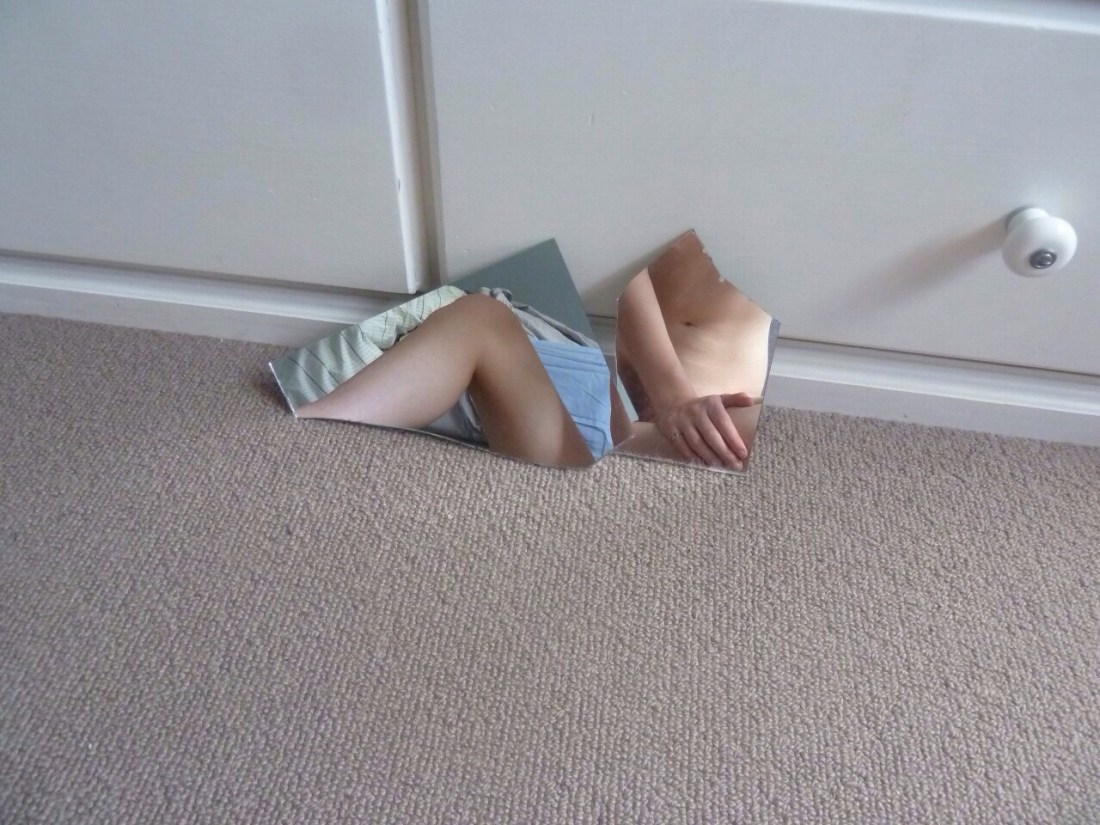
Bronte Sommerfeld – Untitled (2015)

A recurring thought I have about image making is the extent to which image makers are largely motivated by tangential compulsions. Pictures are taken to ensure that moments are remembered, to give voices to experiences which would otherwise pass silently into darkness, etc–it’s not so much about the image as what the image represents.

Whereas, I tend to think of ‘pure’ image makers as those who employ pictures as a sort of map for how they see the world around them.

Those with the former impetus are generally astute practitioners of the latter–but the lesson in seeing is secondary to that which the image bears witness.

I believe it’s easier for an image maker of the former stripe to achieve critical recognition and stature within their lifetime. And although I can’t in good conscience favor one at the expense of the other–the work of the latter strikes me as the path of most resistance.

Sommerfeld’s work seems to be of the latter variety. This image feels as if the image maker saw something in a moment and raised her camera to her eye guided by nothing more than precocious instinct.

And what’s captured is fucking fascinating. The texture of the carpet, the suffused light with soft shadow stretching from the drawer knob insinuating a broader world outside of the frame, the mirror fragments presenting ostensibly naked bodies in a seemingly impossible configuration; the synesthetic texture of the carpet.

The trouble is: with the disembodied reflections presented at the center of frame, the angle of the baseboard, although flattering, sets up an imbalance that is in point of fact too strong to be resolved by the drawer’s vertical line or the drawer’s horizontal in the upper right corner. (Lining the drawer’s veritcal with the frame’s left vertical third would have resolved this but created the problem of losing the knob–something that I think would detract from the image. Thus, the real question is more or less carpet. My instinct screams more–I am and will forever remain a texture whore; but I suspect Sommerfeld would veer in the opposite direction; either way the difficulty of the diagonal baseboard becomes the sole compositional stumbling block in the image and can therefore be summarily addressed.)

Lastly: Sommerfeld is a truly interesting young woman. And if you consider that she made this video as a 16 year old high school student, I’m fairly certain you’ll understand why I would be completely remiss as a curator if I didn’t nudge you, my dear followers, in the direction of her endeavors.

Myself NudeUntitled (2015)

Maybe the most inspired use of a mirror in a nude self-portrait since Francesca Woodman.

First, there’s the sense of dimensionality imposed by her hanging hair encroaching upon the upper right corner of the frame and the manner in which the same hair obscures her reflection’s face. All enhanced by the way her pose–which were it a clock might read 6:12:46–splits the the reflection of the ceiling into a mid-tone grey color wheel.

Next, everything in the frame exhibits an awareness of the ninety degree angle formed in the upper right corner by the floor seam. The woman stands on her left tiptoes, twisting her leg in a manner that would appear awkward to an observer looking at her instead of at the mirror; nevertheless, in reflection it creates an exaggerated Seven Year Itch posture. But the reiteration of the leftward skew halts with emphasis due to  the way her right foot is so firmly planted (you can actually see how close the base of her fibula is to the mirrored surface in the reflection).

Of course, there’s the further glorify of the positive and negative contrast between the brightness of her right inner thigh and right shoulder/arm vs the darkness of her left inner thigh and left side/shoulder/arm.

The coup de grace though is how he shadows are permeable enough so her individual fingers each remain distinctly discernible.

The line of her legs, her pose and even those lines between her fingers all guide the eye to the exquisitely rendered cleft of her ass. However, once there, any attempts to dwell and objectify are thwarted by the way the opposition between light and dark draw the eye down the inside of her legs and outward again, recovering the entire frame and thereby reaffirming we are have been graced with a view of a woman both as she sees herself and how she wants to be seen.

Arno Rafael MinkkinenSandy, Connecticut (1971)

My familiarity with Minkkinen pertains more to his seminal Helsinki Bus Station Theory.

Yes, I would take issues with a few of his tangents but his analogy is otherwise lethally on point.

Given that I was so moved by his words, I was put off by my ambivalence for his images. They reminded me of Jerry Uelsmann–for whom, as someone reasonable skilled in photo manipulation in a traditional darkroom, I have a great deal of respect but whose work does fuck all for me.

Mostly because I’m lazy but also due to the fact that I’m impatient, I didn’t bother to dig deeper into his work.

As it turns out, that was an appreciable mistake. If someone manages to make something that not only speaks with you but connects with you, it’s very rare in my experience that there’s not something similar animating the rest of their work.

Will I ever be into the in-camera optical illusions that typify Minkkinen’s work? Hardly. But, the man really has a knack of translating the feeling of physical intimacy into something visually manifest. That’s no small feat.

Also, I can know see a thread running from Minkkinen to Ahndraya Parlato; a thread that once observed serves to amplify the effect of both.

4201Title unknown (2014)

There’s an all but impenetrable mystery surrounding the site that posted the above image.

What I know is that earlier this year, the site runner posted bevy of images by a Polish photographer and friend identified only as STOTYM. The work was all exceptional; however, one struck me as evidence of a weapon’s grade visual sensibility.

Over roughly the last week, new, seemingly original work has appeared. It’s a hodgepodge of bleak, voyeuristic on-location B roll outtake frames and experimental nudes.

I can’t go as far as saying it’s all good; but, all of it is fascinating.

A leitmotif emerging in the work is an idiosyncratic interaction with reflections.

Reflections can serve a number of different purposes and given infinite time and prolonged interest, it would probably be possible to winnow their uses down to a handful of distinct categories. In general, reflections introduce notions of doubling, documenting the documentarian or allowing for an otherwise impossible angle of view. (Any categories are hardly mutually exclusive. laurencephilomene-photo, for example, shoots reflections of her subjects–without knowing it, one wouldn’t necessarily pick up on this but it is a very interesting added layer of conceptual consistency.)

Whomever is making the pictures posted by 4201 is doing something unprecedented in presenting distinguishable parts of a reflection that contribute to an intricately constructed whole.

passius:

porn4ladies:            passius:

Olga Karasik404 2013

The use of the mirror here is goddamn inspired– obscuring both women’s faces within the frame. (See!! There’s no reason to decapitate yourself in your images to maintain your anonymity. A little creativity goes a long way and makes for better pictures.)

It’s obviously beholden to Francesca Woodman; but it wisely cribs a page from the rock and roll rule book for performing cover songs: make it better than or do it different.

Karasik filters Woodman’s concerns through her own aesthetic sensibility in a way that marks it as reinterpretation instead of a rearranging of elements in a template.

Sadly, it’s either some #skinnyframebullshit; or, :::shudders::: cropped. (I loathe a we’ll-just-fix-it-in-post attitude. Do it right the first time or go the fuck home. Post-production is a safety net in the unlikely chance it becomes necessary; the entire fucking point is not to need it.)

I guess at least evinces some thought went into the decision to opt for the skinny frame.

thebodyasconduit:

‘And in this vision

the present is also revealed as a ruin.’

(Hal Foster)

*

by Traci Lynn Matlock

June 20th & July 9th, 2013

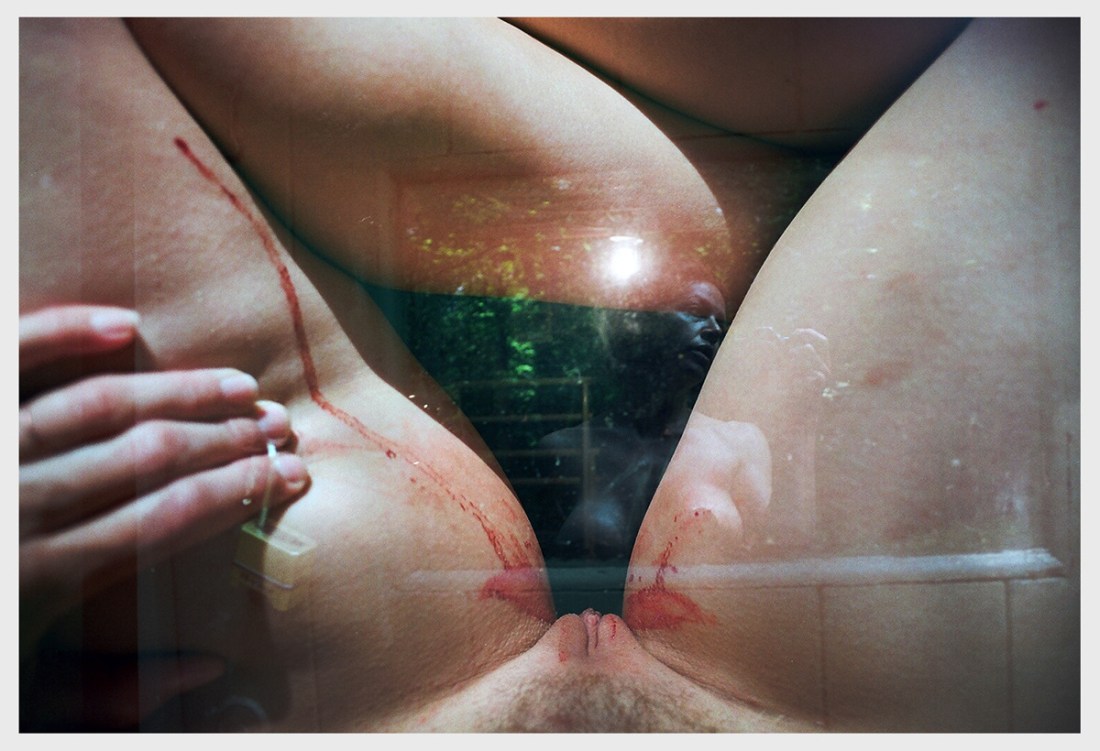
film

More often than not, articulating what’s going on in my head is like trying to fit an iceberg through the eye of a needle.

It’s like I see 300 images compressed into three seconds and I have to recall every bit of it with eidetic specificity. 

With this image what I can remember runs something like: ugh, multiple exposures; and, must Art always be goddamn sexist, there’s what, centuries worth of images featuring featuring women as essentialized, sexual objects but how many images can you think of where a female bodied individual is portrayed as a someone with a vital inner life independent of what a man thinks of her or the audacity to—clutch the pearls—depict menstruation; and, what would Szarkowski’s reductive Mirrors and Windows make of this?

The enormity of seeing the original thought surface, the marvel of its intricate perfection is all but lost.

My recall is sometimes astounding. I live for those moments.

During the remainder of the time, its like guessing at the original picture based on nothing more than a handful of puzzle pieces.

Occasionally, the pieces lead to more pieces. Given enough time, I can confidently point to an approximation of that first notion. Most of the time though, I can’t.

At which point I am left with the choice of giving up or trying to say something that manages to make sense of the pieces I have and hopefully points however glancing toward what I want to say.

Stories, I have learned, are a valuable tool in this process. Telling a story doesn’t always turn up more fragments. But it frequently triggers additional moments of astonishing clarity.

It doesn’t feel like there is a connection but I feel compelled to talk about how I discovered Matlock’s work.

Usually, I attribute my motivation to buy my first 35mm SLR to encountering her work. But that’s personal mythology; not the truth.

At the time, I was in film school studying cinematography. The summer between my junior and senior year was the first time I was not scheduled to shoot anything for anyone else and couldn’t afford to shoot anything of my own. So despite knowing nothing—less than nothing: fuck all—about still photography, I snagged a Nikon 8008s with a 50mm f1.4 lens. The salesman had to help me load the first roll of film.

The first handful of rolls turned out better than I had any right to expect. And after being prodded by my ‘adopted’ sister, I put some of my stuff up on Flickr. (This was back in the days of the simpler, more elegant interface and with it the now long gone pervasive sense of community.)

Part of me relished nominal attention my photos received. I likely would have bored of it, if it hadn’t been for the Explore feature.

After about six months of shooting, I hit my first plateau. The magic was far from gone but the process had begun to feel like work. It was that dead man’s land between Thanksgiving and Xmas and in combination with my frustration with my photographs, extremely loneliness and handful of other mitigating circumstances, created a perfect storm during which I stumbled onto Matlock and Ashley MacLean’s collaborative work under the moniker tetheredtothesun.

I remember distinctly that this was the first image I saw. Seeing it produced a feeling identical to the moment of surfacing, of mental clarity. Only, the three second time limit had been lifted. I could sit and stare; wonder at it all. Dwell there for a time.

I cannot understand how everything in my life since then has hinged on the flipping of that switch. I still don’t completely understand it. But it opened my eyes to the fact that the work I was making ran contrary to what I longed to create. Further, it lacked willingness to be vulnerable to others.

It’s not especially clear but the original thought I wanted to write about here was a bit of an extended metaphor. Something to do with the way parents track their child’s growth with pencil marks on a door frame. So much of my own creative development lines up in my mind with photographs Ms. Matlock has either helped to make or made herself. (I will write a goddamn dissertation of a post if I ever manage to track down her photo of Smashley titled something ‘a well-explored room’,.)

I don’t get her multiple exposure work. It doesn’t move me in the same way as her more candid images.

Matlock was recently interviewed by The Photographic Journal. Reading it I was reminded of how influential her work has been in my development as a photographer. It’s simultaneously thrilling and unnerving.