4201Title unknown (2014)

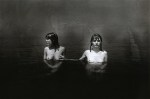
There’s an all but impenetrable mystery surrounding the site that posted the above image.

What I know is that earlier this year, the site runner posted bevy of images by a Polish photographer and friend identified only as STOTYM. The work was all exceptional; however, one struck me as evidence of a weapon’s grade visual sensibility.

Over roughly the last week, new, seemingly original work has appeared. It’s a hodgepodge of bleak, voyeuristic on-location B roll outtake frames and experimental nudes.

I can’t go as far as saying it’s all good; but, all of it is fascinating.

A leitmotif emerging in the work is an idiosyncratic interaction with reflections.

Reflections can serve a number of different purposes and given infinite time and prolonged interest, it would probably be possible to winnow their uses down to a handful of distinct categories. In general, reflections introduce notions of doubling, documenting the documentarian or allowing for an otherwise impossible angle of view. (Any categories are hardly mutually exclusive. laurencephilomene-photo, for example, shoots reflections of her subjects–without knowing it, one wouldn’t necessarily pick up on this but it is a very interesting added layer of conceptual consistency.)

Whomever is making the pictures posted by 4201 is doing something unprecedented in presenting distinguishable parts of a reflection that contribute to an intricately constructed whole.

Source unknown – Title Unknown (20XX)

How much more effective would the above image have been if it adopted a perspective that included both women more or less in scale on par with this image?

It would not only have avoided reducing these two women to little more than their genitals and the area immediately surrounding them; it would’ve made for a better image.

Also, for the last fucking time: the distinction between B&W and color shouldn’t be a desire for it to seem more or less ‘arty’. respectively.

Source unknown – Title unknown (XXXX)

In general, I’m not especially forgiving of tacky composition in erotic imagery.

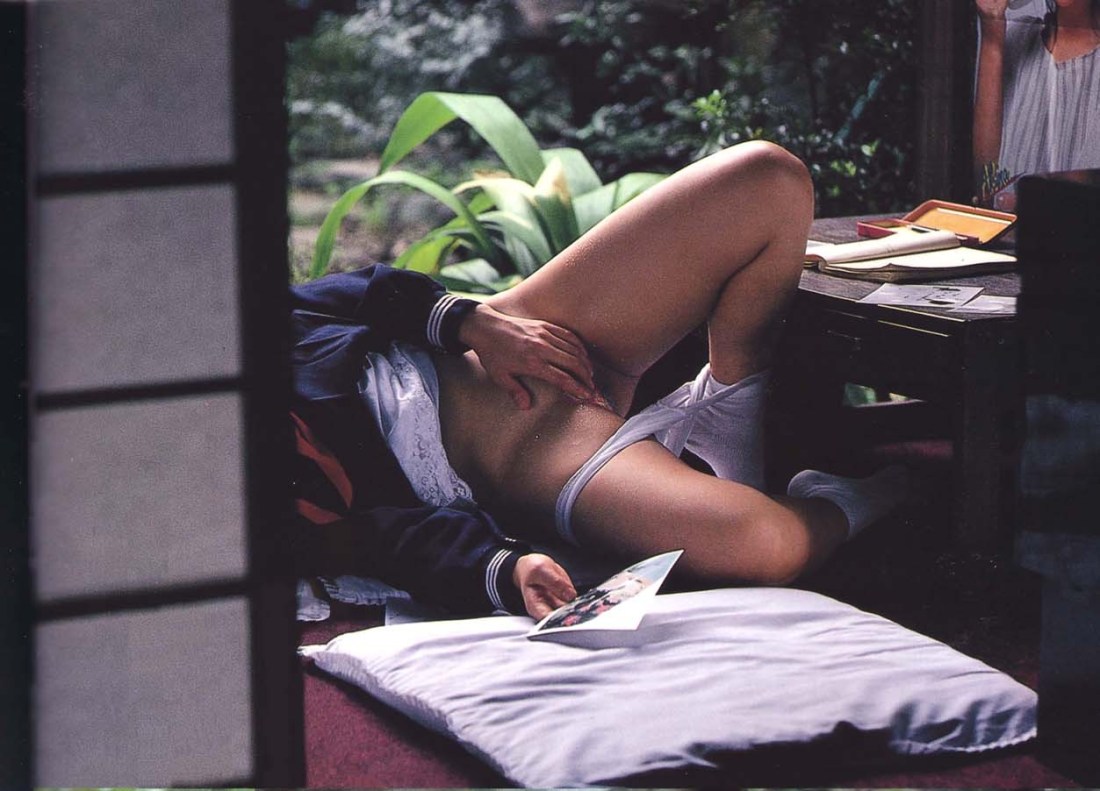
At first glance–with the young woman’s left index finger and genitals positioned dead center–my gut reaction is to scream BULLSHIT.

That I’m not only willing to give it a pass but to actively engage it has less to do with my profound preoccupation with the politics of depicting masturbation and more to do with the fact that unlike the claims by Gregory Crewdson about his own work– the above is a narrative image (albeit a crude one).

Note: the active workspace, school uniform and skin pricked with sweat. I think we all can remember a time when the heat makes focusing on work impossible and high on hormones, the ache of lust is more than one can endure; so in assumed privacy, one pushes aside various clothing blocking unfettered sensual touch–oh but what that twist in her knickers inside her left ankle doesn’t make me shiver– and sets off in search of release (however temporary).

Things run a little deeper than that though. The room in which this occurs is–in the Japanese style–open to a courtyard which not only contributes a lush and verdant green to the proceedings it also insinuates questions of public vs. private that perhaps not completely but at least tangentially implies a cast aside explanation of the ridiculous framing: someone of whom the young woman is unaware is watching her. (This does raise questions w/r/t consent–invariably experiences in life where we can watch others unbeknownst to them occur and how one responds speaks to personal integrity; however, this is too posed, the lighting orchestrated for me to believe the young woman is entirely unaware of her audience.

What the image does exceedingly well is presenting a carefully manicured fiction that invites suspension of disbelief. Two things I notice is that their is a picture of what appears to be a pop star pinned over her desk. You can’t see enough to determine who that pop star might be. In my mind–always hungry to fill in the blanks–it’s a female pop star on whom she has a crush.

Also, the picture in her hand is tilted at an angle that reduces the glare for the camera but not for the young woman. I’d like to think it’s a picture of her and a girlfriend and that the angle is explained by the fact that she’s already orgasmed–the beaded sweat on her legs (which almost certainly is water from a spray mister)–and is exploring the mostly sated, hyper-sensitive perhaps a little horny again already ecstatic afterglow body high that comes with being young, alive and tragically longing for life, as it were, to begin.

The thing this does best is to show that using the frame edges to decapitate a body for the sake for the sake of preserving anonymity is the worst thing you can do. There is almost always a way to preserve anonymity in such a fashion so as not to disembody the subject.

Impossible PhotosSailor Girl (2014)

The Stanford marshmallow experiment has been a leitmotif in my life of late, i.e. the notion of an immediate, cheap thrill vs. putting time and effort into something more gratifying down the line.

Mostly, I’ve been thinking about this spectrum in terms unrelated to photography/image making but I think it serves here.

Plenty of folks more brilliant than I have used a marshmallow now vs. two marshmallows later as a reference for the digital vs. analog divide. I am absolutely inclined to agree with this premise but it does suggest an interesting question with regards to instant films: is instant film a one marshmallow or two marshmallow sort of thing?

Although the question invites an either/or answer, I think it’s actually neither. Or perhaps, it’s marshmallows are fucking disgusting or no marshmallows or maybe three marshmallows after 2-3 minutes.

I mean the Polaroid aesthetic–the sort of mid-50s through 70s overexposed, soft-focus, yellow shifting tinge–has become so ubiquitous as to be monolithic. Yet, the thing that–for me at least–distinguished instant film formats was their near-immediacy.

Almost certainly the absence of middlemen and labs was why Polaroid has this sort of illicit connotation. It democratized porn making, in a way. Instead of consuming what porn purveyors sold, one could–in relative privacy–produce images specifically tailored to individual tastes. And I think for me, the aesthetic has a believability to it.

The thing artist were slow to realize is that even considering the limits of creative control, instant films offered skill and patience the most exquisite rewards.

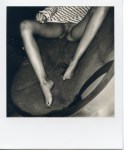
I don’t think the above images are great or necessarily even good (excluding the one in the upper left hand corner–which while I object to the decapitation of the model by the top frame edge gives a very rich since of location, texture), but they are interesting if for nothing else than the lucious tones. Plus, the defects and fingerprints contribute a sense of character to what are artfully executed but ultimately one-dimensional rehash of tired heteronormative erotic tropes.

Allison WhiteScrubbed Clean (2014)

Looking at this I can’t help but compare and contrast with another image by janies. I featured 1.5ish years ago.

Comparing how and why both images work and in what ways that functionality is tied into the decision over whether they are in B&W or color are a worthwhile exercise.

I’ll leave that as sort of a bonus assignment because I’m currently fixating on a different association; namely: Juul Kraijer & specifically this photograph.

Wait! You admonish, wait… what does a high contrast image of a neck speckled with loam have fuck all to do with an low contrast image of a hand covered in twenty ladybugs?

Well, it’s partly the angle of view. White and Kraijer both favor a similar perspective. The former is more dimensional, the presentation of the latter, flatter but they both share a disembodied separation from any sort of definitive contextual connection.

I have zero way of knowing whether White knows Kraijer. But I appreciate the overlap in stylistic considerations and the work that those considerations is rendering far more than a certain other image maker who is currently shamelessly and one dimensionally aping Kraijer’s approach. (Looking at you, Evelyn Bencicova. Further, note how Bencicova’s borrowing of content without any obvious understanding of the unity between form and function in the work she’s referencing results in yes, pretty but ultimately muddled images.)