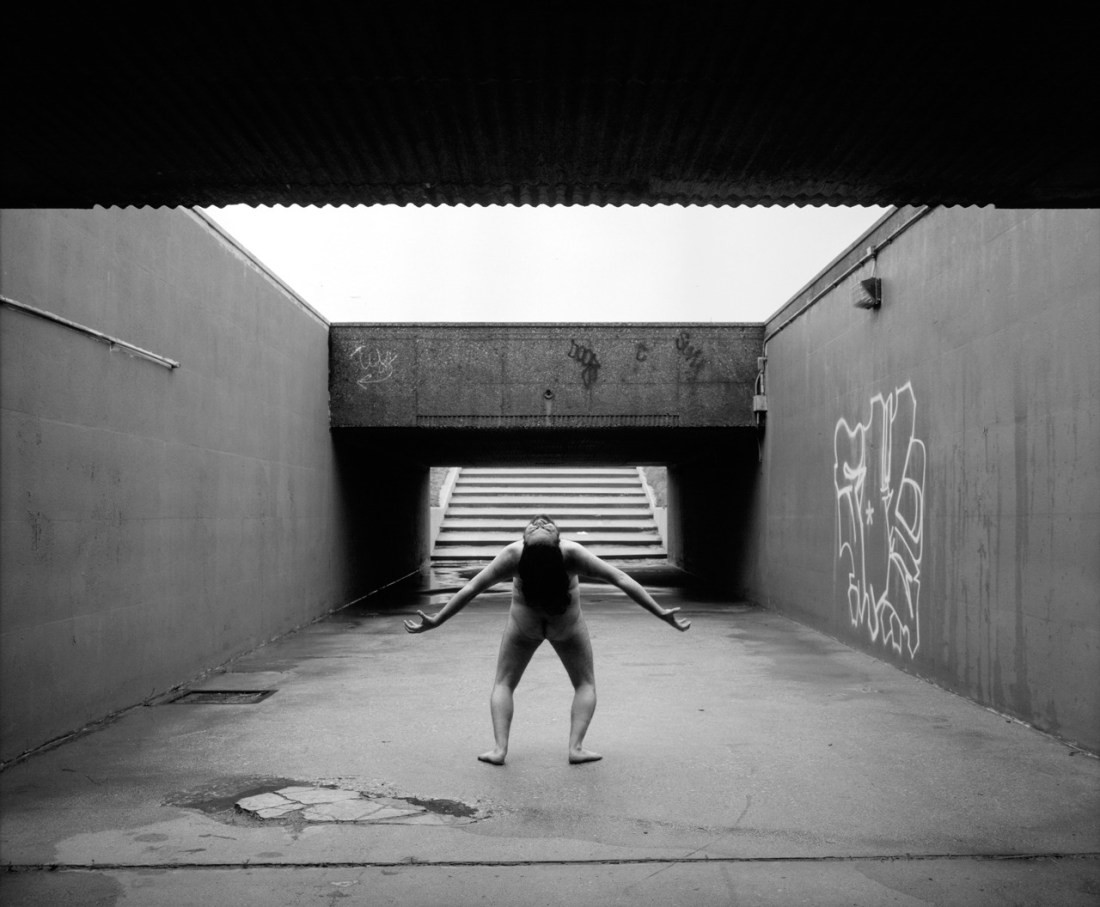
4201Title unknown (2014)

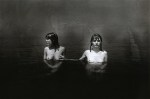
There’s an all but impenetrable mystery surrounding the site that posted the above image.

What I know is that earlier this year, the site runner posted bevy of images by a Polish photographer and friend identified only as STOTYM. The work was all exceptional; however, one struck me as evidence of a weapon’s grade visual sensibility.

Over roughly the last week, new, seemingly original work has appeared. It’s a hodgepodge of bleak, voyeuristic on-location B roll outtake frames and experimental nudes.

I can’t go as far as saying it’s all good; but, all of it is fascinating.

A leitmotif emerging in the work is an idiosyncratic interaction with reflections.

Reflections can serve a number of different purposes and given infinite time and prolonged interest, it would probably be possible to winnow their uses down to a handful of distinct categories. In general, reflections introduce notions of doubling, documenting the documentarian or allowing for an otherwise impossible angle of view. (Any categories are hardly mutually exclusive. laurencephilomene-photo, for example, shoots reflections of her subjects–without knowing it, one wouldn’t necessarily pick up on this but it is a very interesting added layer of conceptual consistency.)

Whomever is making the pictures posted by 4201 is doing something unprecedented in presenting distinguishable parts of a reflection that contribute to an intricately constructed whole.

Source unknown – Title Unknown (20XX)

How much more effective would the above image have been if it adopted a perspective that included both women more or less in scale on par with this image?

It would not only have avoided reducing these two women to little more than their genitals and the area immediately surrounding them; it would’ve made for a better image.

Also, for the last fucking time: the distinction between B&W and color shouldn’t be a desire for it to seem more or less ‘arty’. respectively.

Impossible PhotosSailor Girl (2014)

The Stanford marshmallow experiment has been a leitmotif in my life of late, i.e. the notion of an immediate, cheap thrill vs. putting time and effort into something more gratifying down the line.

Mostly, I’ve been thinking about this spectrum in terms unrelated to photography/image making but I think it serves here.

Plenty of folks more brilliant than I have used a marshmallow now vs. two marshmallows later as a reference for the digital vs. analog divide. I am absolutely inclined to agree with this premise but it does suggest an interesting question with regards to instant films: is instant film a one marshmallow or two marshmallow sort of thing?

Although the question invites an either/or answer, I think it’s actually neither. Or perhaps, it’s marshmallows are fucking disgusting or no marshmallows or maybe three marshmallows after 2-3 minutes.

I mean the Polaroid aesthetic–the sort of mid-50s through 70s overexposed, soft-focus, yellow shifting tinge–has become so ubiquitous as to be monolithic. Yet, the thing that–for me at least–distinguished instant film formats was their near-immediacy.

Almost certainly the absence of middlemen and labs was why Polaroid has this sort of illicit connotation. It democratized porn making, in a way. Instead of consuming what porn purveyors sold, one could–in relative privacy–produce images specifically tailored to individual tastes. And I think for me, the aesthetic has a believability to it.

The thing artist were slow to realize is that even considering the limits of creative control, instant films offered skill and patience the most exquisite rewards.

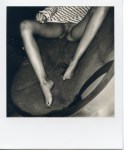
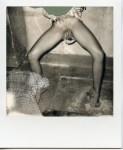
I don’t think the above images are great or necessarily even good (excluding the one in the upper left hand corner–which while I object to the decapitation of the model by the top frame edge gives a very rich since of location, texture), but they are interesting if for nothing else than the lucious tones. Plus, the defects and fingerprints contribute a sense of character to what are artfully executed but ultimately one-dimensional rehash of tired heteronormative erotic tropes.

Tomi KnoxBaby, that’s not where that goes feat. Odette Delacroix (2014)

Even if I don’t always feel Mr. Knox work, I have an affinity for his art porn with a kink-positive perspective along with a healthy leavening of BDSM. (Also the fact that he is stridently committed to analog technologies earns him mad fucking respect in my book.)

With this photo, I like the subject matter but I just don’t understand–beyond the obvious that it’s about what she’s doing with the toothbrush (which by the way, I have on good authority feels freaking amazing)–why her head needed to be decapitated by the top frame edge.

The thing I will say–to keep myself honest–is that it doesn’t bother me as much here as it typical does. And I don’t know if it’s that during the back and forth interviewing Lady Sensuality commented that Knox is one of the most kind-hearted people she’s ever met but despite the extremity of some of the things his work depicts and as much as I feel in the depth of my soul that such work needs to clearly evidence the negotiation of the performers with regards to consent and personal boundaries, looking back through Knox’s archives I’m struck by just how–and it’s dumb to say that an image feels consent-y (that’s not how consent works)–but there always seems to be a (for lack of a better word) joy imbuing the proceedings he documents.

I’d have liked this image more in a wider framing but I think it works as is. I just don’t understand why the negative seems to have been flipped. If you study other pictures of Odette Delacroix, you’ll understand what I’m getting at. 🙂

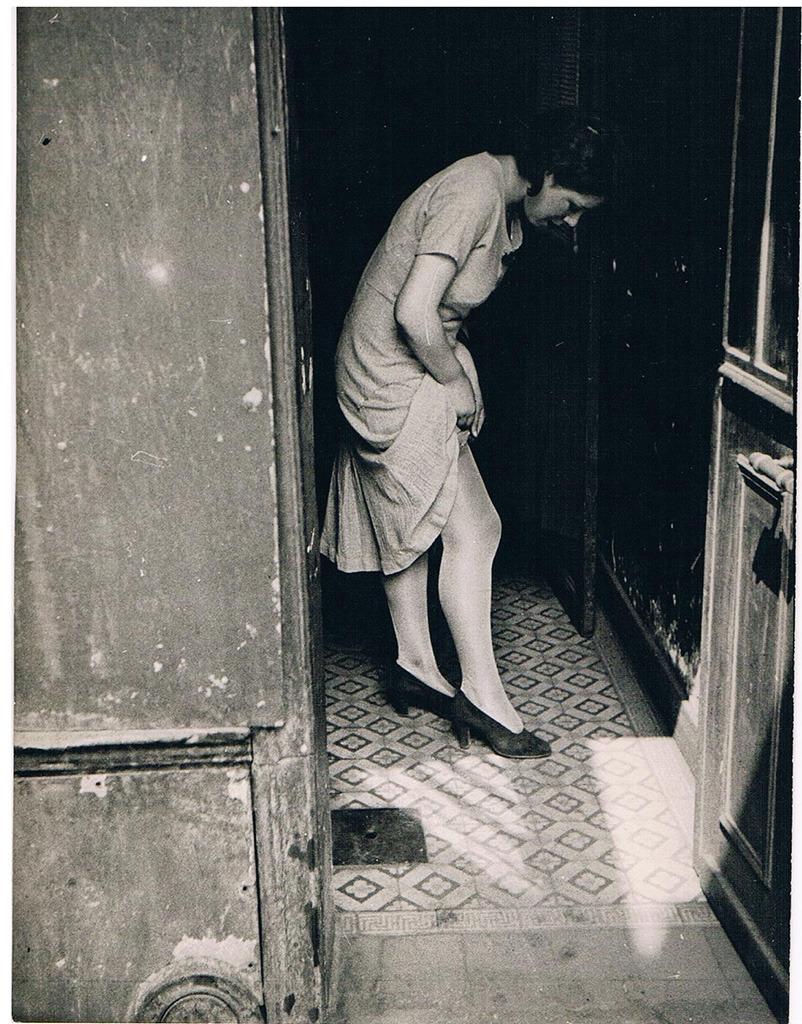
BrassaiAnonymous Prostitute (1930)

I’ve seen this photo attributed to Brassai. I am not convinced that’s correct.

The supposition is probably based upon the date, placing it concurrent with what we might term Brassai ‘sex worker’ period.

The image strikes me as too bright to be Brassai. Further, this woman has clearly ducked out of sight to straighten her stockings. The photos from his ‘sex worker’ period suggest the subjects as collaborators aware of the camera.

Brassai will never be my favorite photographer but I do appreciate the fact that his work suggests he saw sex workers as more than just objects. And that’s what makes me think this isn’t a Brassai–because as wonderful as the unmediated moment presented is, it skives me out a little because the seemingly unaware subject in combination with the title raises all sorts of issues w/r/t consent and objectification.

(Also as an aside: I don’t consider this #skinnyframebullshit. There is a compositional logic for the vertical orientation–drawing attention to this woman’s legs. So yeah the moment presented is intriguing but there are some downright lecherous aspects that are causing me second thoughts about posting this. I suppose the point I want to make is please image makers, strive for this sort of unself-conscious immediacy in your work but at the same time take great pains to lead by example when it comes to questions of consent..)

wonderlust photoworksMx Inchoate (2014)

I always thought that if I could just figure it all out then they saying would take care of itself.

…except when understanding dawned, fitting the unexpected truth of knowing to words proved more impossible than I could have imagined.

But, maybe if I can’t say it, I can show you.

I’m still failing and it’s not really any easier than finding the right words but despite it sometimes the feeling, the tone and the scope of a moment bleeds through from around the edges of my desolation and stuborn idiocy.

It hurt to shoot this. It hurts to look at it. But I have to look.

If I could just show you, if I could offer but a flickering glimpse…

Polina PoludkinaUntitled (2014)

This photograph resonates strongly with me.

I am not sure it’s completely non-appropriative to assert but I feel that if I could use a picture instead of a label to express my sexuality, this would be one of a dozen images too which I’d point. (Full disclosure: I would always point to this first and this second.)

But, you may object, this image is not explicitly sexual. And I am not going to insist it is but I do think it has something interesting to say–as much as mute images may speak–about intimacy.

I have lost a number of friends over the years and especially of recent. It would seem that more neurotypical folks view a continuum of intimacy associated with the concept of friendship and a separate continuum of intimacy associated with romantic and/or physical attraction; each are mutual exclusive and never the twain shall meet.

I don’t understand the dichotomy; either I trust you or I don’t–there’s no middle ground.

And this photography–and much of Poludkina’s work–is obsessively preoccupied with intimacy. In that her work overlaps the work of a photographer of whose work I will always be critical, Jock Sturges–specifically, The Last Days of Summer.

Both Poludkina and Sturges are interested in intimacy; but whereas Sturges primarily uses the nuclear, nudist family as a means of subverting criticisms of sexualizing pubescent youths–and to be clear just because I dislike his work doesn’t mean I feel it is worthy of censure or that it displays any sort of predatory sensibility, Poludkina doesn’t have to front load her work with the same sort of conceptual contortions. (As an aside: browsing her Flickr photostream there’s a feeling that her work is aggressively edited, distilled down to a moonshine of memories–yet instead of the memories we actually remember when we try to remember, the scope of her work reads as the memories we’d prefer to remember if we could remember to remember them. That’s unnecessarily layered and abstract but although I can’t quite articulate it the way in which the one young woman–who is out of focus–is aware of and watching the camera activates a sort of narrative insinuation. Her look somewhere between curiosity, welcome and insular reservation. The feeling of that narrative insinuation is identical to a prominent tone in maybe my favorite films of the last decade Short Term 12it’s streaming on Netflix you have no excuse. This connection is interesting because Short Term 12 is, among other things: a meditation on the stories we tell ourselves and others and how the telling of those stories shapes our perception of the world around us.)

I feel like the strength of this photo is that unlike Sturges’ work it at least remains unblinking to the interpenetration of intimacy and sexuality.

Molhada & QuenteUntitled (2014)

I’ve mentioned my fascination with depictions of ejaculation several times. Mostly it’s the synesthesia wherein watching ejaculation results in a sympathetic resonance. Even without that freezing the essentially random trajectories and their illustrative fluid dynamics is just fucking endlessly intriguing to me. (Further, I think due to the customary highfalutin pretense of fine art photography wanting to explore questions of pornography without being pornographic has caused ejaculation to be a woefully under explored photographic motif.)

I have mixed feelings about the above image. On the con side of things:

  • the close-up framing diminishes contextual clues as to locations and circumstances
  • in tandem with the shallow, low contrast tonal range there is an even further disjunction from interpretable visual cues–rendering the image little more than blow job on a beach.
  • if proximity to the subject comprises a spectrum of voyeur to participant, the camera is–in this case–without question: participant.

By the same token, most of the cons also contribute–at least tacitly–to a knee-jerk efficacy. For example:

  • Although the close-up is a poor creative decision, it does bestow depth and dimensionality to the stream of semen.
  • the tonal range is distinctly reminiscent of some early twentieth century photographer whose name–despite four cups of coffee–I cannot currently retrieve.
  • the caption accompanying and the Molhada & Quente’s mission statement–which I have not reproduced here–it would seem the proximity of the camera to the action was intended more as POV documentation first for the couple and second for mass consumption.

It is entirely understandable why this was shot the way it was–arguably even justifiable. And I’ll never suggest it’s not an interesting image, though I would argue against suggestions it is good. My point is merely the potential for it to be good or even great is built-in. Should the camera have been backed two feet away from the proceedings, it would’ve been indubitably clear that this is public sex.

And I admit I am a context whore but in this case I thing more context also equals a more transgressive document–a result of which I will always be vociferously supportive.