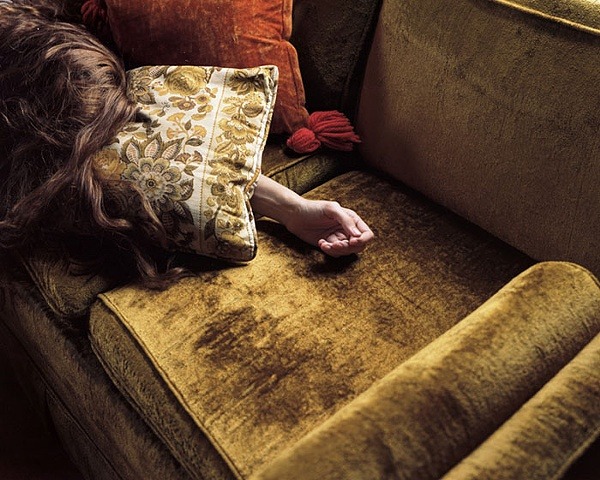
Karin SzékessyJutta auf dem Sofa (1968)

As I’ve mentioned before I went to parochial schools from 2nd grade through high school.

In 5th grade, the school didn’t have enough money to hire a qualified Physical Education teacher. And despite the fact that every student attending already paid tuition, the school came up with the brilliant idea of charging families for extracurricular PE options.

This was how I learned to ski.

I actually did okay, at first. Managing to not fall for the first several hours I strapped fiberglass planks to my feet. Then I had my first lesson and the first thing they did during the lesson was to have everyone lift their foot–right first then left–and touch the tip of the ski to the snow and then the tail.

From that point forward I spent one day a week for the next three weeks falling often and hard. Be I pushed through the difficulty, learned and before long as tearing up green circle and blue square slopes.

Photography and image making are deceptive media. Our culture is so visual and so immersed in lens based modes of representation, that whether most folks give a second thought to it, those of us in the western world are steeped in an unthinking awareness of the basics of how to present a scene.

It’s relatively easy and takes minimal training to call one’s self an image maker. However, inherent talent only goes so far. At a certain point–if this art form means anything to them–they need to do the equivalent of lifting their ski off the snow and touching the tip and the tail to the snow; in other words, a certain dislocation or disorientation is required to truly begin to learn–one must realize that what they thought they knew they know not at all.

What does all this have to do with Székessy photograph. Well: although it’s hardly the perfect analogy–the realization that one knows little to fuck all about art history is probably the more apples-to-apples comparison with the example of learning to ski–as much as we’d like it to be (and as much as new technologies attempt to make it so–a lens does not interpret the world in the same fashion as the human eye.

And it’s not just any one thing that’s different–it’s a complex of things.

On thing is that lenses allow us to render visible subtle gradations in light we don’t normally perceive. Arguably the best example of this is covered as a part of the thoroughly excellent documentary Tim’s Vermeer–which centers on Tim Jenison’s attempt to recreate a perfect copy of The Music Lesson.

I feel like that’s in some way what Székessy image here is trying to convey–beyond a curious and dynamically presented scene.

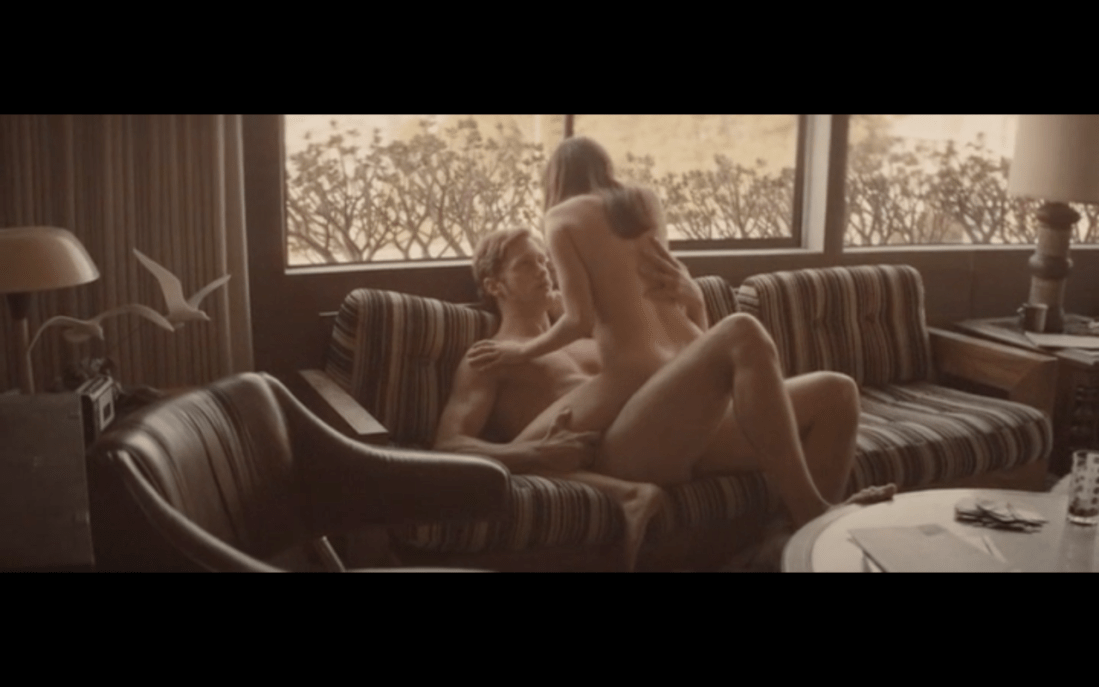
Marielle Heller + Brandon Trost – Still from Diary of a Teenage Girl (2015)

If you haven’t already, you really, really, really, really, really (that’s 5 reallys) should see Diary of a Teenage Girl.

The premise of the film is a fifteen year-old named Minnie (an excellent Bel Powley) carries on a relationship with her mother’s boyfriend Monroe (Alexander Skarsgård).

If you’re thinking isn’t that crossing some kind of uncrossable line? Well, Powley was twenty-one during production. Yes, she’s playing younger but the film is carefully structure to introduce us to Minnie as a precocious teenager. We’re given a glimpse of who she is and how she thinks, responds & interacts with the world around her before anything carnal unfolds.

Minnie’s response to her initial sexual explorations is a natural extension of her personality. And it’s frankly fascinating how the movie uses the fleeting–and yes explicit (but tastefully so) sex scenes–as depth charges to test and more thoroughly define her character.

That there was no outrage over this is likely due to the fact that the makers carefully avoid any sort of obvious or easy imposition of moral prudery–in fact there’s a feeling that it was intended as a sort of quasi-fairy tale as to what the world might be like if the world weren’t so sexually repressed. But, it’s also notable as the film was directed by a woman.

Also, Marielle Heller was one of the few women to direct a film with studio backing. That it’s one of the five best movies of the year, should speak volumes about why we need more women filmmakers.

Source unknown – Title Unknown (20XX)

@knitphilia one of my all-time favorite Tumblr’s and one of the  the handful of the few I sort of know AFK, posted several years ago that:

Beautiful [A]gony was possibly the first (visual) porn I looked at unironically.

I suspect there are a good number of folks out there with similar experiences. I know I’d pretty much sworn off porn until I discovered I Feel Myself.

Lately, I’ve been feeling conflicted about even IFM. For example: this clip by Anabel. It’s definitely hot–I love watching folks give themselves pleasure. But there’s this one cut away to a close up of her vulva, ostensibly to demonstrate how aroused she is. It’s a beautiful shot and you can see that she is really, really wet.

But I feel like that localizes pleasure at the genitals. And from a standpoint of porn to which I’m likely to personally masturbate–I prefer something like Clayton Cubitt’s Hysterical Literature with Stoya (Lord God Almighty, the thought of her hands as she’s orgasming makes me get weak in the knees) or the above–which I love everything about: it looks like shitty iPhone video but with a little focus on framing and lighting, the aesthetic suggests a VHS dub that has been watched so much it’s wearing out; it’s far more graphic in concept than execution and the way she keeps masturbating vigorously throughout her orgasm is remarkable. (At a certain point my nervous system shuts down and I literally can’t keep going because my body locks up. The way her body responds is exactly what happens to me when someone else makes me orgasm and keeps going beyond the point where I couldn’t have on my own. It’s been 6.5 years… I can’t tell you how much I miss it.)

Source Unknown – Title Unknown (19XX)

Although I am not especially into retro/vintage porn thing, I do kind of dig that this image was snapped, printed and published in a magazine that someone held onto long enough to scan and upload it in the Internet age. (Not to mention the way the center fold presents here resembles a similar sort of photo stitching used by someone like Accra Shepp.)

While from an art historical standpoint, it’s enormously problematic to suggest that part of what determines whether something is capital-A Art is survival–how many brilliant works have we already lost because the author wasn’t a white cis man?

Yet, there is something to be said for the test of time. This is an imperfect image–I really can’t overlook the way her legs have been amputated by the frame lines render her legs perpetually spread toward the viewer–not unlike a dead butterfly pinned through the thorax to felt under glass.

There are several allowances that while they certainly don’t mitigate the objectification, they do perhaps soften it: the young woman eschews eye contact with the camera, she’s wearing both a top (ostensibly her own, instead of a wardrobe piece), earrings and a watch; lastly, the three different textures of the back of the couch, the cushions and the carpet are sumptuously rendered in nearly synesthetic detail.

It seems as if the direction she’s been given is that she’s beginning to masturbate. As much as one can accurately judge an expression based on a fraction of a seconds representation of it, she seems very much on board with the notion; however, the contrivance of her pose and self-consciousness directly address the inherent on-your-mark’s-get-set-go! approach that underlies the majority of heteronormative porn.

I feel like if this wasn’t a porn shoot and the goal wasn’t based on a vague erotic notion of depiction of orgasmic paroxysm as narrative denouement, then this image–if it had been content to wait patiently and adopt a wider, less implicitly violent/objectifying frame–could’ve been pornographic art instead of artfully depicted porn.

It strikes me that current international literary cause célèbre Elena Ferrante (and feminist enfant terrible) is addressing something on a similar track when she points out in a recent interview:

Yes,
I hold that male colonization of our imaginations—a calamity while ever
we were unable to give shape to our difference—is, today, a strength.
We know everything about the male symbol system; they, for the most
part, know nothing
about ours, above all about how it has been restructured by the blows
the world has dealt us. What’s more, they are not even curious, indeed
they recognize us only from within their system.

Source unknown – Title unknown (20XX)

This is an interesting picture. I’d have preferred if it were a bit more evening exposed–all the shadow detail in her hair is gone whereas there’s still hints of detail in the cabinet or table to the left of the couch; also, if the camera had been raised perhaps a foot and moved back by a foot, you’ve have gotten both of them more or less fully in frame and enhanced the visual dynamism of the shot.

And as nice as I think the little details are here–i.e. her hand covering his and helping to hold her legs in position, her tongue and clitoral piercing and the books behind her legs on the couch cushion (hell, even the presentation of his erection and testicles is aesthetically pleasing)–what appeals to me about this is the question it perpetuates in my brain: is there a relationship between symmetrical representation and subjectivity?

I’m not at all certain the following applies anywhere outside my own head but I know that there’s always been this rupture or disjunction between the vision in my head and the final print. Generally, the small that rift, the better the photograph.

I think the thing is we tend to look at the world askew. The human brain is amazing at filling in blanks unbidden–sometimes to our detriment (most optical illusions are such because the brain straight up accepts its own grandiloquent assumptions on the regular).

I’ve gotten a bit ahead of myself. I need to backtrack momentarily.

Usually, I’m of a mind that there are two types of people in the world those that separate everything into two arbitrarily ‘oppositional’ extremes of a spectrum and everyone else who isn’t a pretentious douche nozzle. Yet, as blunt tools, things like Szarkowski’s windows vs. mirrors dichotomy do at least provide a set point of departure.

I think there’s another potentially useful distinction–images that are found vs images that are constructed.

It’s easy to just blame street photography as the singularity from which all found images emerge. Even in rigorously constructed studio work, there’s still an element of finding in the eventual edit. Yet, I think the distinction between objective and subjective, has something to do with symmetry.

Constructed work tends to flow outward from a place of symmetry. The trouble with symmetry is… well, it’s mostly an illusion. Spend enough time with a large format camera and you’ll begin to actually see the fruit of the whole Euclidean geometery projected into three-dimensional space. (In simpler terms: try drawing an equilateral triangle on the surface of a sphere. It’s impossible.)

When I’m trying to find an image, I’ll tend to see it but when I lift the viewfinder to my eye–the thing I saw that sparked my interest disappears. I sort of think it’s because what I saw came as a result of my brain projecting a symmetry onto the scene that either wasn’t there or was merely implied by what I saw.

When I experience this discrepancy between what I saw in my mind’s eye and what I see through the lens, I’ve learned to force myself to be patient. To do the heavy lifting, to search for something approximating the symmetry I perceived initially.

On the rare occasion that I succeed in finding it, there’s a sense that the image is less an image and more a window. The image maker steps aside in order to reveal the viewer the objective experience of seeing.

In the above image, there is a literal asymmetry. It’s not so much interested in the ordering of physical space as the conveyance of the moment. Yet, in that it is very clearly subjective. The camera’s focal plane is not a window but instead an approximation of some observer’s perspective.

The thing about symmetry is that we think of it as bilateral–in other words, vertical and horizontal mirroring in one point perspective. But symmetry can exist without centering.

I actually think that is what the brilliant street photographer Paul Graham means when he says:

I have been taking photographs for 30 years now, and it has steadily
become less important to me that the photographs are about something in
the most obvious way. I am interested in more elusive and nebulous
subject matter. The photography I most respect pulls something out of
the ether of nothingness… you can’t sum up the results in a single
line.

His work is full of found images that are more window than mirror and as much as Graham wants to chalk it up to elusive and nebulous subject matter, his work shines because of the way he finds a meta symmetry that doesn’t get in your way, doesn’t distract you from what your seeing but instead functions as a feeling.

The distance between the subjectivity of above image and the window-like objectivity of Graham’s best work is identical to the distance separating artful porn from pornographic Art.

Clare LaudeUntitled self portrait from When Water Comes Together with Other Water series (2014)

I spent the winter break of my junior year of college watching Fassbinder’s arguably best film Berlin Alexanderplatz.

Upon returning to my filmmaking class, I felt a spark to get out and make something. It seemed like I had all these new and intriguing ideas.

One of my classmates–and truthfully my only rival for dominance in the class–inquired what I’d watched over break. It was so casual and off-handed that I didn’t realize the trap until I was snared.

Tarkovsky, Wenders and Fassbinder are unparalleled geniuses, he started: But to schmucks like you and I what they offer in inspiration is just as addictive as any drug. We much be wary in approaching them, mindful of the profound effect they have on us.

I thought of him as a preposterous bloviating dickbag at the time, but increasingly I’m realizing he isn’t wrong.

And that’s what sucks me in to Laude’s work. She wears her profound regard for artists such as Andy Goldsworthy and Tarkovsky on her sleeve but does so in her own distinct voice–I’d label it quiet, more in the way of the lack of volume being the point (think John Cage’s 4’33").

Further, I think I just share a certain affinity of personality with the artist since she expresses a connection to two of the most important places to me in the world: Island and Berlin.

And I’m always excited to see nude self-portraiture seamlessly integrated into fine art photography as an element instead of the sole focus.

Source unknown – Title Unknown (20XX)

With the ubiquity of un-sexy Hollywood sex scenes, why can’t someone figure out how to make a film with a layered, nuanced, well-developed female protagonist with a relate-able, accessible and engaging story and put the above scene in it.

Excepting regressive and prudish attitudes towards female sexuality, there’s no reason this scene couldn’t be part of an awesome indie feature. Yeah, maybe she wouldn’t be completely naked but notice how in the throes of ecstasy even though her pose is cheated toward the viewer for maximum visibility, this scene–based on the what 60-something frames in this gif–is about her pleasure.

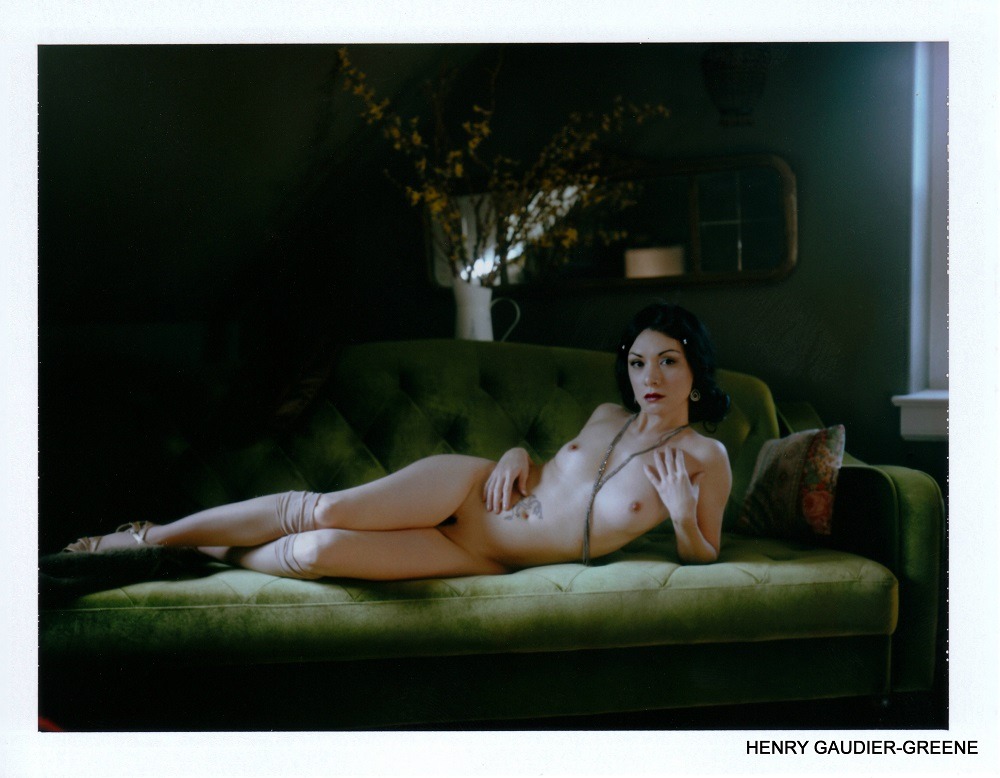
Henry Gaudier-GreeneTanya Dakin: Absinthe and Caviar for Breakfast. (2013)

One (1) of six (6) 4×5 Fujiroids created by Gaudier-Greene and Dakin appearing in Issue 7 of the always comely analogue only art-zine 62nd Floor..

Tanya Dakin is a Philadelphia based model/photographer/provacateur writing a book about her vagina; she shares explicit photos depicting her DD/lg relationship and has the most beautiful ink I’ve ever seen. 

Gaudier-Green is a photographer who shares my commitment to film and shoots with Pentax 67ii.

I dig their respective work with limited reservations–Dakin is a competent image maker but I am far more taken with her no safety net approach to life and the uncompromising openness with which she shares herself; Gaudier-Greene’s has preternatural aptitude for color work and any sort of instant film he touches becomes a medium for the transmission of god-like beauty; thus the lack of specificity in his B&W film work is never something I quite know how to reconcile.

They remind me of Luis Buñuel and Salvador Dalí: individually I respect the quality and care with which they craft their work; however, it always feels as if their personal work suffers from the echoing absence of the things that render their collaborative endeavors so effortlessly transcendent.

That’s not to say this image is free of problems and distractions–it isn’t. But between the attention to color and light, the wawker-jawed composition gets its volume turned down by the ‘realness’ of a fully-experienced unmediated moment in which two impressive talents merge into a single, uninterrupted and timeless genius.

Anastasia Cazabonpart of From the Secret World series (20??)

Artist Statement:

These images are based on my own childhood, specifically the transitional period between the ages of 9-15. This period of liminality, when girls are on the threshold of womanhood, can be one of the most defining and vital stages in a woman’s life. In this stage of life, young women become acutely aware of the world around them and how they are portrayed within the world; physical appearance is suddenly pushed into the spotlight and with that comes insecurity, excitement, jealousy and narcissism.

Relationships with other girls are also critical and these friendships are often fleeting yet intense; feelings of love, envy and rivalry pervade adolescent female companionship. These friendships are also marked by polar swings of emotion – one day encompassing cruelty and the next kindness.

These images revolve around the secret, yet everyday lives of adolescent girls. The power of this transformative time is characterized by the struggle to reconcile one’s girlhood while moving into womanhood – an experience that elicits strong feelings of both fear and longing.