Pixoom PhotographieTitle Unknown (2015)

If you’ve followed this blog for any time, you are most likely painfully aware of my aversion to portrait orientation in lens based image making.

I refer to it–with profound contempt–as #skinnyframebullshit.

It’s a term I use a lot and I’m always linking to the same article I wrote more than two years ago. So–with the notion in mind that someone seeking to determine counterfeit from legitimate currency always studies the real item instead of the fake–it occurred to me that being as this image is not only stunningly gorgeous but also in no way shape or form #skinnyframebullshit, that it might be time for me to create a positive reference instead of a negative one.

It’s maybe not the best place to start but one of the things that doesn’t directly relate to my hatred for portrait orientation but does inform it is the increasing ubiquity of digital imaging technology. (Again, if you’ve followed me for any time you’ll know that I am obsessively anal about differentiating between digital and analog processes. Yes, they are built off the same chassis but their respective functions are vastly different in practice.)

By now, you all are familiar with shitty Youtube videos wherein due to the shape of and interface of our smart phones you get a preponderance of video with vertical frames. It’s ugly, sloppy and I would maintain a poor reflection of the author’s basic intelligence.

I’ve been pretty active in Internet photo communities since 2006. Back then, folks making work were basing it off the history of lens based image making up to that point. Yeah, you had vertical oriented images but whether or not there was a reason for them to be vertical (i.e. an internally consistent compositional logic) they were the distinct minority.

Of that minority, a plurality featured this sort of self-conscious flipping the physical camera body on its side makes me look more like a photographer. When you do it, you feel a little rebellious.

Now, if you’re a person shooting on film, then you drop what you shot at your lab (or better yet, process yourself); and then you pop your slides or negs down on a light table and have a look-see. The thing you note immediately is that your vertically oriented frames break the flow of your reading your slides. You end up having to flip the filmstrip, contact sheets or whatever. Invariably, this causes you to favor either the landscape or portrait images due to the fact that it’s easier to read images that are in line with however you have the page currently oriented.

I learned quickly that there really needs to be a compelling reason for a shot to be vertically oriented. And with my reluctance to deal with vertical oriented shots, I realized that almost categorically, image makers opt for vertical orientation as a compositional shortcut. Like: oh, hey…what I want to shoot won’t fit this way, I’ll just flip the camera and that’ll fix it. Makes sense. Except one small thing and I’ll state it as a truism–you will always get a better shot by moving your body in relationship to the object or by using a different focal length lens. It’s just a fact.

And if you apply that to the history of photography, it’s interesting to note that most images with vertical orientation are–wouldn’t you know it–within the architectural genre. Why might that be? Well, in relationship to an edifice there are few options with regard to moving in order to achieve the framing you want.

Thus, I maintain rather rigidly that in general, if you aren’t shooting architecture, you can go ahead and shoot that vertical but then maybe move around and shoot the same thing landscape from different positions. I’m confident that all things being equal, you’re going to find you prefer the landscape frames.

One of the first things a beginning photography student hears about is the sacred rule of thirds. As a rule of thumb, it serves–and ensures photography instructors cut down substantially on the godawful wawker-jawed, indecipherable images. But like any rule, it’s nothing more than a general guideline that you really have to understand before you’re allowed to start ignoring it as you please.

Yes, the rule of thirds is an abstraction of the Golden Ratio. And with the tendency to frame the subject at one vertical third line and then leave a great deal of negative space to the left or the right, it does produce appealing images. (Note: how images that are perfectly balanced within the framework of the rule of thirds tend to have the effect of leaving you confused about what you’re supposed to be looking at.)

My theory is that with vertical compositions, the rule of thirds is less useful as a guideline; the expectation of the eye is something more in-line with the golden ratio.

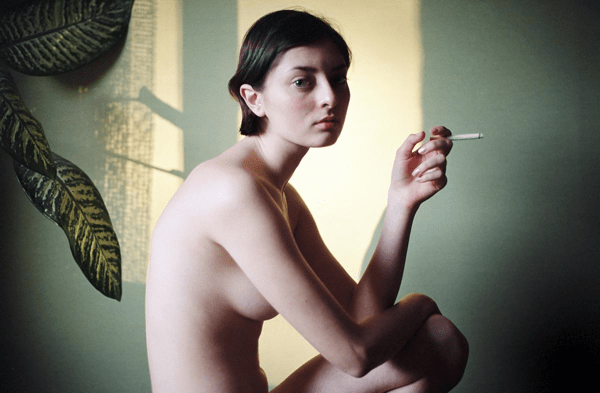
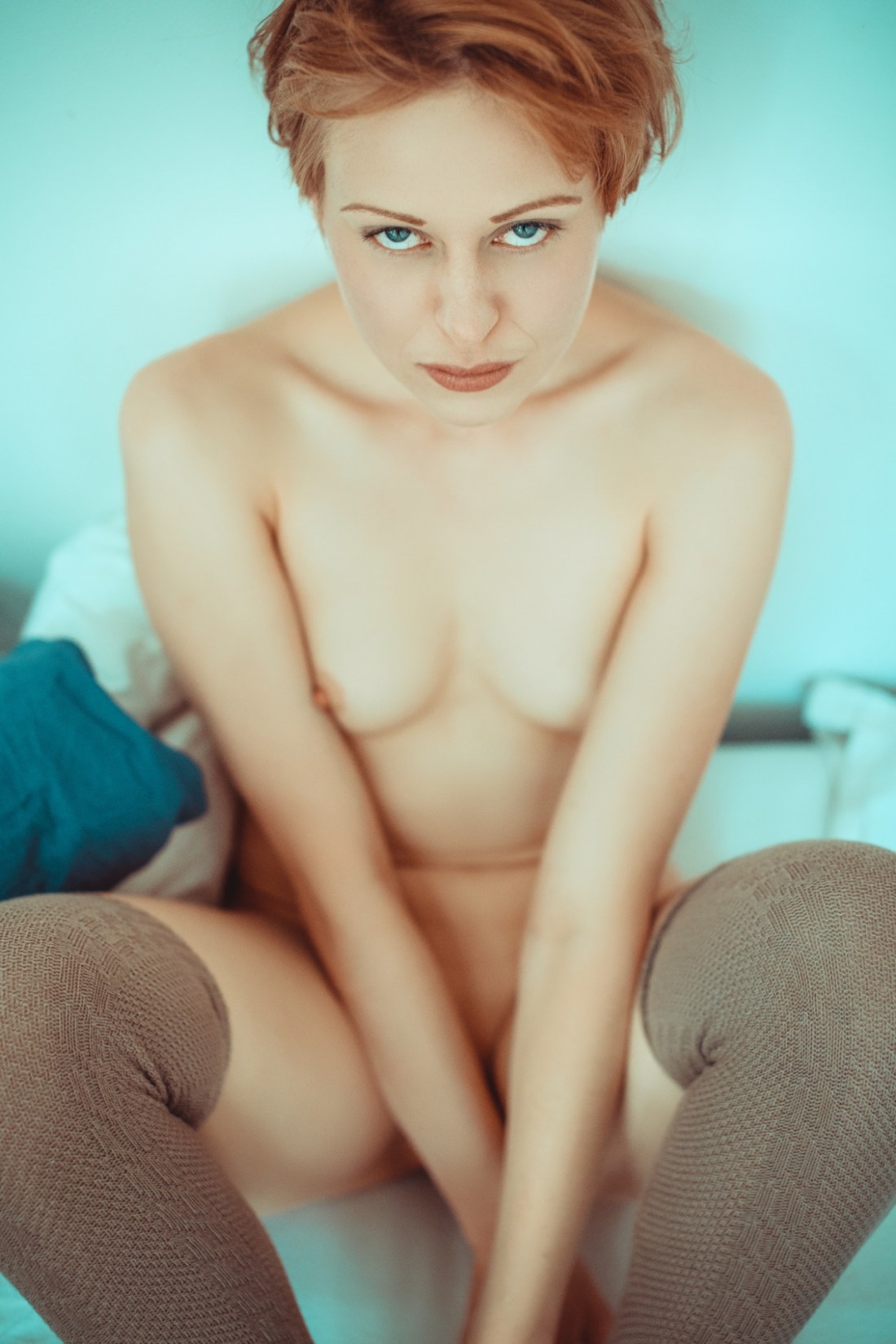
There is only one horizontal line in the above image–dividing the frame top-to-bottom roughly 60/40. Katjuschenka is ever so slightly off-center (consider the mid-line of her face)–balanced expertly by her right knee opening what would’ve otherwise been a repetition of the angle of her arms.

There’s essentially only two colors in the frame–red (hair, skin tone) and blue. Everything falls in line with those tonal hues. Focus is sharpest on her eyes. (And as a dizzying bonus, check out the texture in her stockings. Dayum.)

A creepier photographer would’ve focused on the nipple or at least increased the depth of field so that it would remain in focus. But the decision to do that makes this image about the color and framing. The eye contact is neither coy nor pouting. It’s not flirtatious but it does convey a sense of knowing a great deal that the viewer does not.

This image is breathtakingly exquisite. If you’ve got to go vertical, this is the baseline. Either make it clear that the composition was the only thing that would’ve communicated the magic of that moment or go home with your weak ass #skinnyframebullshit.

Gene OryxProvocazione (2015)

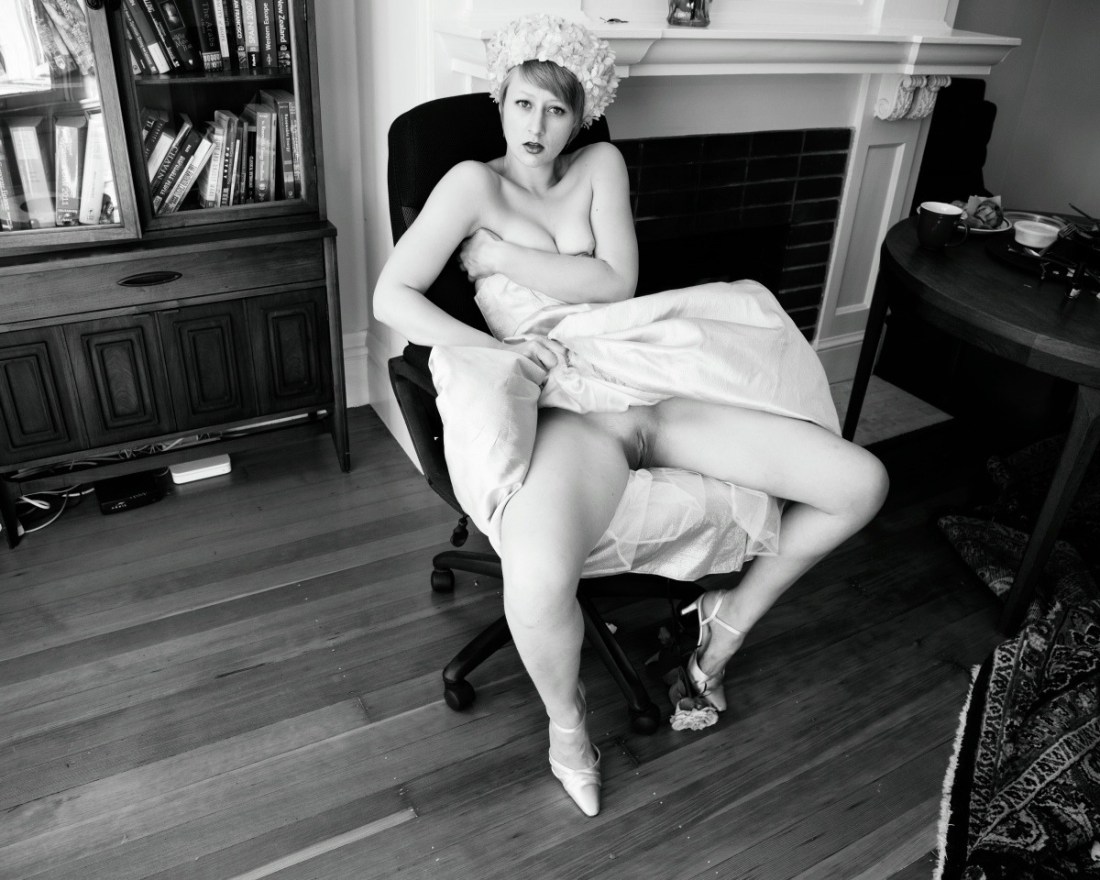
I’ve stared at this enough to realize it’s a backless evening gown she’s wearing backwards.

Remember that feeling when you were young and on the threshold of sharing your body with someone new? How your back teeth were filled with bees and your knees went all jello-y electric? That’s what her line of the dress caused by her right thumb makes me feel.

(And it’s probably #skinnyframebullshit, but I’m too biased in this case to insist.)

Polina PoludkinaUntitled (2014)

This photograph resonates strongly with me.

I am not sure it’s completely non-appropriative to assert but I feel that if I could use a picture instead of a label to express my sexuality, this would be one of a dozen images too which I’d point. (Full disclosure: I would always point to this first and this second.)

But, you may object, this image is not explicitly sexual. And I am not going to insist it is but I do think it has something interesting to say–as much as mute images may speak–about intimacy.

I have lost a number of friends over the years and especially of recent. It would seem that more neurotypical folks view a continuum of intimacy associated with the concept of friendship and a separate continuum of intimacy associated with romantic and/or physical attraction; each are mutual exclusive and never the twain shall meet.

I don’t understand the dichotomy; either I trust you or I don’t–there’s no middle ground.

And this photography–and much of Poludkina’s work–is obsessively preoccupied with intimacy. In that her work overlaps the work of a photographer of whose work I will always be critical, Jock Sturges–specifically, The Last Days of Summer.

Both Poludkina and Sturges are interested in intimacy; but whereas Sturges primarily uses the nuclear, nudist family as a means of subverting criticisms of sexualizing pubescent youths–and to be clear just because I dislike his work doesn’t mean I feel it is worthy of censure or that it displays any sort of predatory sensibility, Poludkina doesn’t have to front load her work with the same sort of conceptual contortions. (As an aside: browsing her Flickr photostream there’s a feeling that her work is aggressively edited, distilled down to a moonshine of memories–yet instead of the memories we actually remember when we try to remember, the scope of her work reads as the memories we’d prefer to remember if we could remember to remember them. That’s unnecessarily layered and abstract but although I can’t quite articulate it the way in which the one young woman–who is out of focus–is aware of and watching the camera activates a sort of narrative insinuation. Her look somewhere between curiosity, welcome and insular reservation. The feeling of that narrative insinuation is identical to a prominent tone in maybe my favorite films of the last decade Short Term 12it’s streaming on Netflix you have no excuse. This connection is interesting because Short Term 12 is, among other things: a meditation on the stories we tell ourselves and others and how the telling of those stories shapes our perception of the world around us.)

I feel like the strength of this photo is that unlike Sturges’ work it at least remains unblinking to the interpenetration of intimacy and sexuality.

Sally MannThe Last Time Emmett Modeled Nude (1987)

In my admittedly short lived travels in fine art photographic circles, Sally Mann tends to be merely tolerated in public while she is derided and/or dismissed for her ‘excessive sentimentality’ behind closed doors.

So it’s not surprising to witness her wondering aloud in HBO’s excellent documentary What Remains: The Life and Work of Sally Mann whether or not she’ll be ‘pilloried’ by the critics when she exhibits her new project.

It’s a telling scene. Mann’s observation demonstrates a keen understanding of the disparity in her reputation between consumers of culture and the cultural gatekeepers/overlords.

The accusation of ‘excessive sentimentality’ is a palpable hit. The sentimental lies at the foundation of virtually everything she’s ever made. (Except maybe the cibochromes–which if you haven’t witnessed, you are truly missing out on some of the most staggering color work since Eggleston.) 

The cultural gatekeepers/overlords aren’t so patient with sentimentality given their unquestioning adherence to the syllogism dictating that the sentimental is to art as Kryptonite is to Superman.

It all strikes me as too convenient. Yes, Mann’s chosen medium is photography. But that doesn’t mean her lineage can only be traced back through Gowin to Callahan and the Bauhaus movement. Mann belongs equally to the tradition of Walt Whitman and Henry David Thoreau both of whom are comparable sentimental and adored for the fact.

A better criticism might be to draw attention to her blemished, unnecessarily dark printmaking.

Or better yet, acknowledge that–as the aforementioned scene illustrates-even when anxiously doubting herself and her work, she plays the conceptual art shell game masterfully.

What makes her work great is she always predicts criticisms that will arise from the work and uses the work to refute them in advance.

What makes Immediate Family the greatest work she’s ever likely to produce, is its naive, unblinking curiosity that didn’t manage to see the snake until it had already stepped on it and still somehow avoided getting bitten.

It’s impossible for me to narrow that work down to a single favorite image. But this image of Emmett is easily one of the top five.

Vlad Kenner [aka VK Photography] – Lady Sensuality (2014)

I don’t feel connected enough to the Tumblr model community to offer pronouncements on it. But based on the relentless quality of work from Cam Damage, Jacs Fishburne, Katlyn Lacoste and Johanna Stickland, it seems to this total outsider that nude modeling demands not only dedication and hustle but impeccable curatorial acumen when it comes to identity/brand/persona.

I’m pretty sure I had seen things Lady Sensuality had done prior to this .gif hitting my dash. Even now, her smile transforms me into a great big old pile of bashful turtles.

But what really grabs me by the throat is her work. She’s direct and unapologetic about her body/sexuality. At the same time, there’s a sense her work necessarily exists outside any predetermined personal comfort zone.

Lady Sensuality’s work isn’t that much more objectively explicit than say: Rayne Tupelo’s (who I adored and dearly, dearly wish was still making work). She embodies an edgy transgressing of ‘socially appropriate’ boundaries. To me, looking at her work feels liberating.

In fact, I am so thoroughly impressed that as much as I am terrified by the prospect of interacting with–let along photographing–strangers, I would do just about anything for the opportunity to collaborate with her on something in the very near future.

Oles RomanyukTitle Unknown (2014)

This is a wonderful reminder that making great work sometimes demands saying: ideal, schmideal.

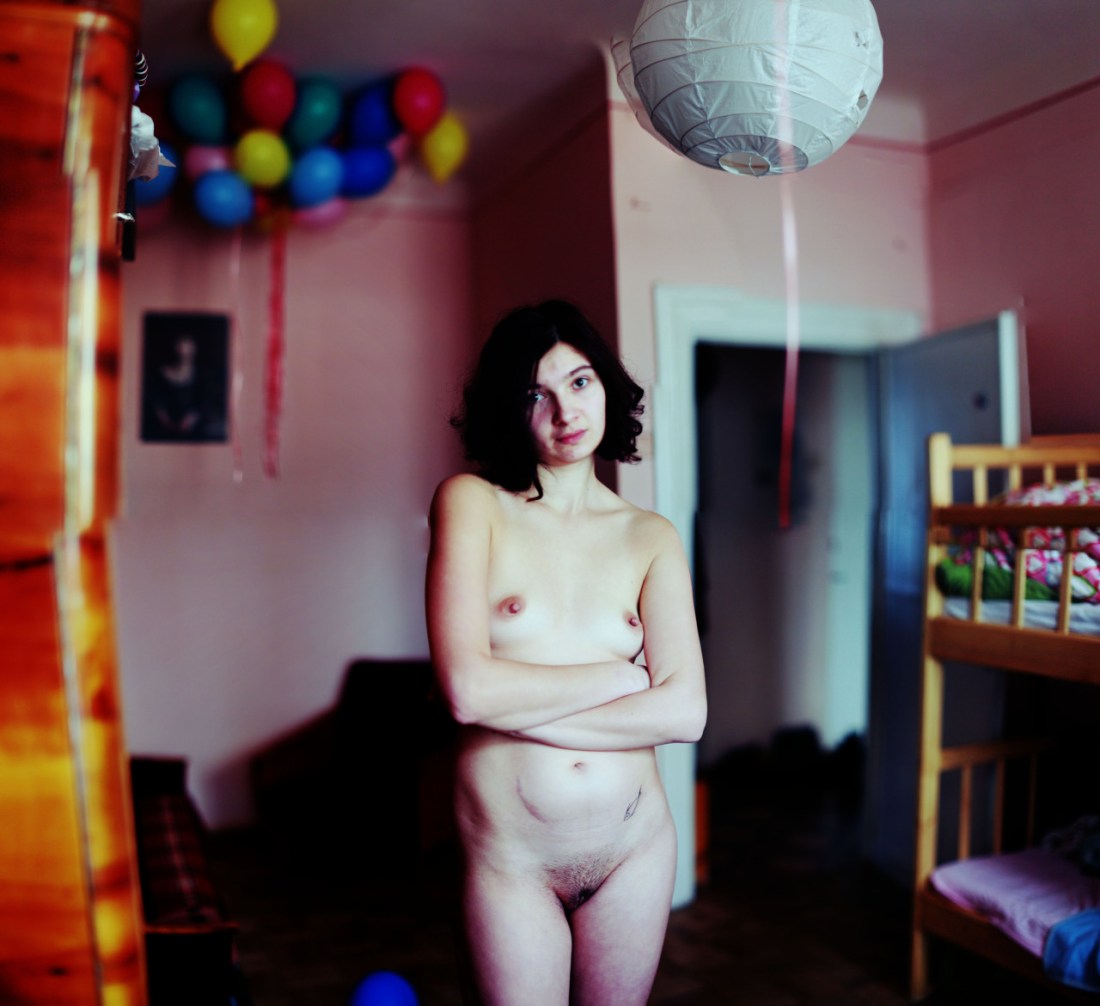
For example: this is probably a stop and a half overexposed and shifts her skin tone so that it echos the wall’s magenta.

Her body is emphasized; yet, unlike a lesser image, emphasis does not entail isolation–the wood paneled whatever at the left frame edge, the balloons and the pistachio green blanket all jump up off the picture plane. With the subtle bokeh, a convincing dimensionality manifests.

No matter how killer the colors or compelling the presentation of space, what gets me is the way the image focuses my attention on the feelings this work illicit.

I have a very strong sense that this young woman belongs here–this is her space.

The feeling is something that while I am sure there regardless; but without the nudge, I likely wouldn’t have paused with it long enough to tease out how to articulate it.

I think that is crucial, actually; given the young woman’s posture/expression–crossed arms, head tilted slightly, eye contact–she appears a little uncomfortable.

If she were separate from her surroundings, her discomfort would entail all sort of unsettling implications given her nudity.

Her belonging in this space colors the discomfort with a playfulness. As if the photographer–who is also her lover–begs her to pose nude and despite lingering misgivings, she agrees.

Margo Ovcharenko01 from Without Me (2008)

‘Intimacy’, ‘vulnerability’, ‘trauma’ and ‘stories’ are terms which recur in Q&As with Ovcharenko.

Although entirely befitting, they’re ultimately terms of abstraction.

In other words: what does one mean by ‘intimacy’: loneliness, togetherness, expressions of passion, etc., etc.

Don’t misunderstand: I am hell of fond of her work’s aestheticization.

Still, deep in the mix there’s something either coy and waffling; or–worse–intellectually dishonest.

I think it has to do with the way Ovcharenko speaks about her work.

In any interview with The Calvert Journal she offers the following explanation as to the implications of sex and violence in her work:

Sex and death are two of the most sensitive subjects for humans. The fear of death and the desire to prolong life by the passing on DNA are at the heart of everything. All of the social constructions that allow us to live in cities, such as the police and government, lead to perversions of these basic instincts. I am interested in how that works. I’m like a little girl poking a dead frog with a stick: I am sad and frightened but curiosity wins out. (Emphasis mine.)

It’s an adroit response that eschews abstraction. Viewing her work it’s easy to see her as a well intending child poking a dead frog with a stick.

Yet it runs counter to something on her website. (Note: I may be wrong in attributing the remark to Ovcharenko; how the quote appears is ambiguous due to a muddled layout. It could be attributed to the attribution is the author or several subjects.)

Pornography is an ugly and disgusting phenomenon. Erotic can be beautiful, porn–never.

Besides patently disagreeing with the statement, it contradicts her own admitted impetus for creating: what drives us to pornography except being sad and frightened but having curiosity win out in the end.It’s not merely that I disagree with her here.

Also, given her interest in depicting androgynous/non-gender conforming/homosexual folk, I find the absence of any explicit statement supporting LGBTQ rights considering the total clusterfuck in Russia at the moment to be somewhere between naively, tone deaf and irresponsible/exploitative.)

The last thing rankling me about Ovcharenko needs to be unpacked.

Remember that Wired article to which I took such umbrage: 10 Photographers You Should Ignore? It bothered me that the underlying point wasn’t that you can’t or shouldn’t learn from renowned fine art photographers; it was: unless you are making the work you want desperately to make then fuck off and die because you have no business behind a camera.

Fine art photography is a starting point; a set of initial vectors for approaching material. At some point the process and material will demand a very deliberative departure.

The problem is–just like religion–fine art photography is taught as if it is little more than a trigonometric function.

Until I come up with a pithy term in line with #skinnyframebullshit, I am going to call this approach to fine art photography as a trigonometric function as ‘photography as a function’.

The notion arose earlier this week while I was trying to write about Harley Weir.

I’ve run into her work a handful of times. It’s clean, solid. There’s a unity of content and form, muted colors, grounding in art historical perspective/scale considerations–it is what I expect fine art photography to look like.

But I felt fuck all for the work itself. Until I saw this; my brain did this thing it does where it leaps free associative and anchors images to music. I heard that line where the song says: 

But for now we are young
Let us lay in the sun
And count every beautiful thing we can see

I realized this feeling of being young, in love and overwhelmed by the beauty of everything was the raison d’etre for Weir’s images.

Now: why isn’t that made obvious by the work? Perhaps because there is too much emphasis placed on aestheticization and not enough on simplicity and clarity of effect.

(I dig Heidi Systo but her work is just as much photography as a function as Ovcharenko or Weir.)

I do feel an undeniable connection with Ovcharenko, though. In fairness, while the above dates from 2008, and while her newer work does little to avoid repeating the aforementioned pitfalls, it is at least much sharper.  For example, I am in love with 07 from her Hermitage series. It stands out from the rest of the images as a young girl who is bored with poking a dead frog with a stick, so instead she pokes it because she’s suddenly curious about why poking it makes her sad and frightened.

Dane – Johanna Stickland (2013)

First off: this is really the first time I’ve put a face to the name Johanna Stickland and Jesus Harold and Maude Fucking Christ on Christmas she is breathtaking.

Looking back I’ve seen oodles of her work before but it’s never clicked until this that it’s the same young woman in so many wonderful images.

I won’t lie: I am completely taken with this. If you’re a regular, you’ll ask: but what about your intractable opposition to #skinnyframebullshit?

It’s not #skinnyframebullshit. Why? Well, the composition doesn’t echo the model. Instead, the frame is oriented in this fashion to compensate for both the lack of room (the area between the shrubs and the chain link fence is quite narrow); also, if the camera were landscape oriented it would create all kinds of problems–there would be even more of the bokehed fence (which as it is teeters at the edge of too much), not to mention the shrub which you can see jutting into the lower-right corner of the frame would appear in the frame and distracting from the loose one point perspective that constantly refocuses the eye on Ms. Stickland and her intensely penetrating stare.

Lastly, this fence–like so many of its brethern–is slightly canted. Ms. Stickland’s pronounced lean away from the fence combined with the upper arm intersecting so precisely with the first horizontal third expertly balances the frame.

I am curious to know more about the image maker responsible for this but I can’t find fuck all about Dane anywhere. Alas.

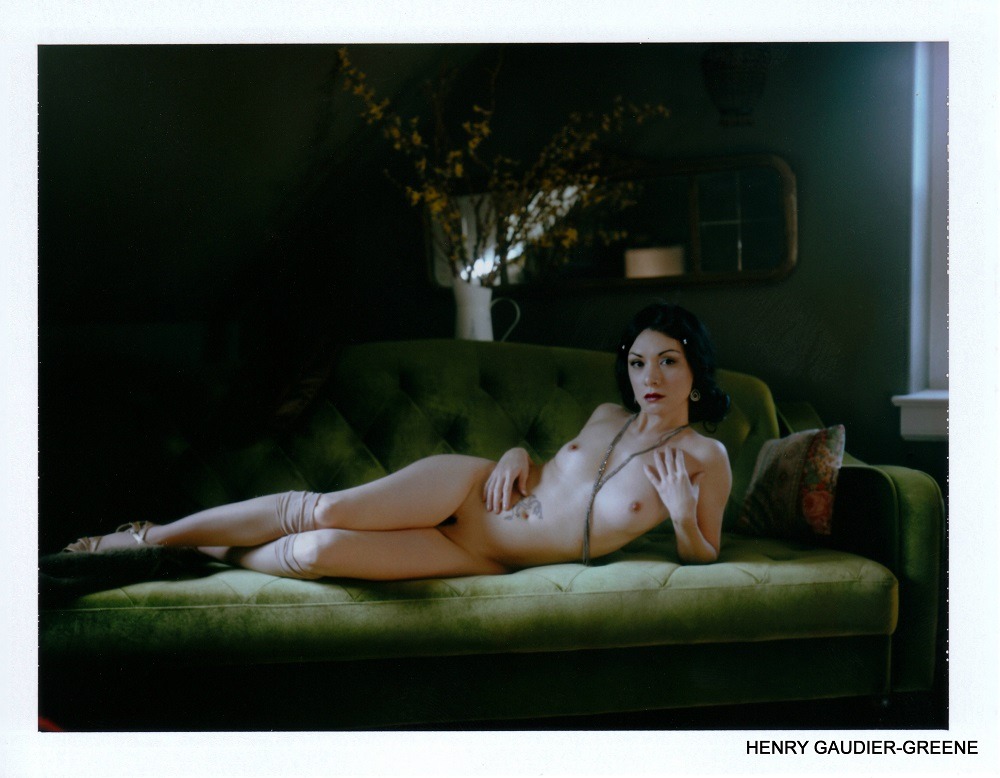
Henry Gaudier-GreeneTanya Dakin: Absinthe and Caviar for Breakfast. (2013)

One (1) of six (6) 4×5 Fujiroids created by Gaudier-Greene and Dakin appearing in Issue 7 of the always comely analogue only art-zine 62nd Floor..

Tanya Dakin is a Philadelphia based model/photographer/provacateur writing a book about her vagina; she shares explicit photos depicting her DD/lg relationship and has the most beautiful ink I’ve ever seen. 

Gaudier-Green is a photographer who shares my commitment to film and shoots with Pentax 67ii.

I dig their respective work with limited reservations–Dakin is a competent image maker but I am far more taken with her no safety net approach to life and the uncompromising openness with which she shares herself; Gaudier-Greene’s has preternatural aptitude for color work and any sort of instant film he touches becomes a medium for the transmission of god-like beauty; thus the lack of specificity in his B&W film work is never something I quite know how to reconcile.

They remind me of Luis Buñuel and Salvador Dalí: individually I respect the quality and care with which they craft their work; however, it always feels as if their personal work suffers from the echoing absence of the things that render their collaborative endeavors so effortlessly transcendent.

That’s not to say this image is free of problems and distractions–it isn’t. But between the attention to color and light, the wawker-jawed composition gets its volume turned down by the ‘realness’ of a fully-experienced unmediated moment in which two impressive talents merge into a single, uninterrupted and timeless genius.