@thewillowraeBathsheba (2016)

Either you already know who Willow is–in which case your response is most likely: holy fucking shit, she’s THE BEST. If you don’t, here’s a little by way of introduction:

Willow is a twenty-something model and  image maker She has a super conservative Xtian family–from whom she is estraged (as I seem to recall). She also suffers from a chronic illness.

I first encountered her work via @nymphoninjas Submission Sundays. But she also her own submission site The Coffee Club.

Her work was always both edgy and raw–two traits I feel are indispensable to any ‘good’ creative work. Willow’s personal work has been evolving rapidly. I featured one of her images almost a year ago; and the degree to which her work has sharpened in such a short period of time is goddamn jaw dropping.

Willow included a statement of sorts with these images. I’m including it here as she originally posted it:

First set in a series focused on
rereading stories of women from the Bible and finding the distortion and
misogyny in the way the Protestant church portrayed these women.

And it came to pass in an eveningtide, that
David arose from off his bed, and walked upon the roof of the king’s
house: and from the roof he saw a woman washing herself; and the woman
was very beautiful to look upon.And David sent and enquired after the
woman. And one said, Is not this Bathsheba, the daughter of Eliam, the
wife of Uriah the Hittite?And David sent messengers, and took her; and
she came in unto him, and he lay with her; for she was purified from her
uncleanness: and she returned unto her house. 2 Samuel 11:2-4

When I was in school, I remember our studies through 2
Samuel in my Old Testament Survey class. I remember Bathsheba being
painted as a seductress and a whore. In reality, she was just a woman
taking a bath being pressured into having sex with the king. Could she
really say no? The rest of the story was that Bathsheba became pregnant.
Then David sent Bathsheba’s husband, Uriah, to the front lines of
battle where Joab was instructed to have his soldiers in the front step
back to ensure Uriah was killed. The king then married Bathsheba and her
child died after she gave birth. The whole experience must have been
traumatizing to Bathsheba, but Biblical teachers paint her as a slut. No
person should shamed for bathing or wearing short skirts.  No one
should be made to feel unclean or guilty for being seen nude or enjoying
being naked. This has been your Anti-Christian Bible sermon for the
day.

Like Willow, I attended an Xtian high school where one out of seven periods each day was dedicated to an academic study of The Bible.

I think one of the things you’ll miss unless you share a similar upbringing is the degree to which everything objectionable to the story of Bathsheba is implicit.

I mean: Xtian schools have either a very rigid dress code if not a uniform. My school only transitioned to a uniform after I graduated. While I was a student: boys had to wear dress slacks three days a week and jeans twice a week; girls had to wear skirts/dresses three days a week, could wear pants twice a week and jeans twice a month (on Wednesdays).

Attendance was taken each morning and instead of ‘here’, ‘present’ or the obligatory joker who felt responding ‘gift’ was somehow clever, we responded: skirt or pants when our name was called.

And there were ultra-specific rules on how short a skirt was allowed to be. The usual rule was the hem of the skirt had to be longer than the tip of your longest finger with your palms pressed flat against your thighs.

The generous teachers would let you do this wile standing–which gives you about an extra inch shorter. Most of the teachers would make you kneel. I cannot tell you how many times I’ve seen a teacher call a young woman in front of a class to make her–in front of everyone–kneel with her hands pressed against her sides to reveal that her skirt was not long enough.

You get berated for pride, for vanity. I’ve seen young women have to apologize to the entire class for the visible skin of their legs.

By the time you get to the story of Bathsheba–there’s no need to explicit slut shame. As a young woman who has survived through puberty, you know that the way men look at you shifts. You adjust–the way you see yourself becomes bifurcated, you’re constantly not only aware of being, you’re aware of how you are seen.

You read think pieces about how young women in public schools are sent home because their legs, thighs or bra straps are going to distract boys from paying attention. It’s rape culture through and through.

But what you don’t understand is that it’s even worse at an Xtian school. By the time you hear the story of Bathsheba, you know that decisions regard your own body have ramifications beyond yourself. And so you hear how David say her bathing on the roof and there’s no need to mention that she shouldn’t have been bathing where she might have been seen–that’s already thoroughly ingrained.

I mean David was the king. He lived in a castle. He could’ve gone walking anywhere. But he went walking on the roof. And when he saw a woman bathing–he was so in lust for her that he kept staring (you know despite clearly not having her consent to watch her or even if she didn’t mind being seen, he certainly didn’t have her consent to respond to her nakedness in the way he did.

But what Willow doesn’t mention is that this is treated as David’s great sin, his downfall. It’s sad, because he’s tempted and succumbs to temptation. But the sadness hinges on how he let temptation encroach on his relationship with some magic man in the sky–who you’ll note is just the sort of asshole who will make a bet with Satan that his number one fan won’t turn on him if God lets the devil take away all the good things in his life. (See: the story of Job.)

There’s this disconnect that David had any sort of agency in his actions. It’s all like if he hadn’t been tempted, it wouldn’t have happened. But God let him be tempted… so in order to not view God as an asshole, you have to slut-shame.

Anyway, I have more to say on this topic but I’d rather move on to the images themselves. Bathrooms can be notoriously difficult to make images in. The lighting tends to suck. There’s usually too much white space. So, it bears mentioning that Willow has done a great job with this. The light is compelling, the colors liven things up without distracting too much from the subject.

I have mixed feelings on the camera angle. Yes, the sort of God’s eye view is conceptually resonate; however, the angle of the corners of the niche the tub is installed into with a sort of 3 point perspective look is a little too forceful. (If it’s not clear what I mean compare the visuals in a Sam Raimi or Robert Rodriguez film–or Bayhem, for that matter–and compare it with the visuals in Hitchcock or Kubrick’s work. Although I think it is actually worth noting that the composition in Willow’s images being more like Raimi or Rodriguez and the way in which those creators are more closely tied to genre and visual conventions lifted from comic books…)

I also think the images in their present configuration and presentation don’t entirely work. This relates to the story of Bathsheba but were clearly viewing a character who went to an Xtian school thinking back and sort of empathize with the way Xtianity throws women under the bus.

My first and strongest response to the image was that thought that it was one of those new fangled graphic novels where people who can’t draw, make images instead of drawing panels. That led to the thought of how much I’d like to see Willow have the resources to be able to stage her vision of David watching Bathsheba on the roof at night (’cause that shit would be in-fucking-credible) and how the way she’s framing this project has this sort of implied narrative within a narrative.

Even if that’s not what she’s planning to do with it, I have to say that she’s doing some crazy exceptional and fearless things with self-portraiture that are both intriguing and important.


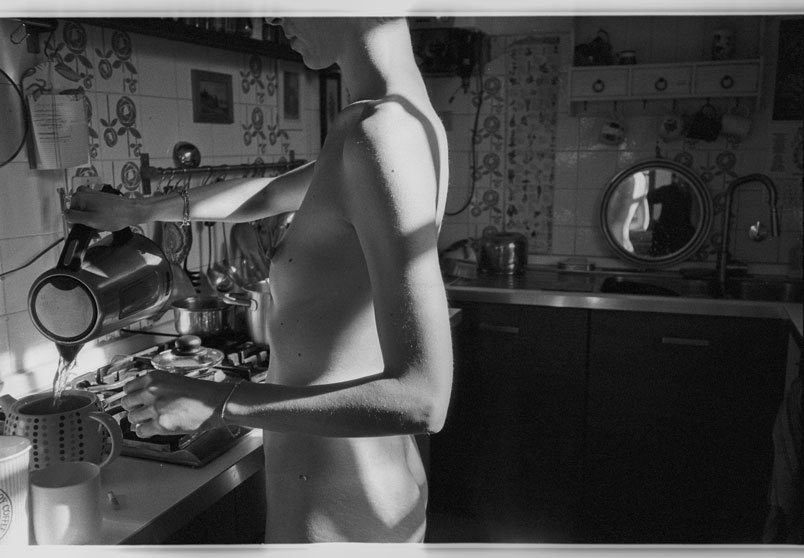
Giangiacomo Pepe – Untitled (2016)

Everything about this photograph is effing exquisite.

If we’re evaluating it in terms of the Zone System, the majority of bright areas in the frame are either close to overexpsoure or legitimately blown out. In other words: zones IX and X.

It’s similar with shadow details, there’s pure black (zone 0) and black with hints of tonality.

This compression of both highlights and shadows, stretches the dynamic range of the mid-tones.

There aren’t really enough instances to really distinguish zones VII and VIII. I mean they’re there but the objective underexposure of the frame effectively renders fucking dynamic ass microtonal variations in zones III through VI.

The staging leans heavily towards frame left. The young woman’s back bifurcates the frame. Her pouring water into the teapot and the visible kitchen accoutrements pull the viewer’s gaze leftward.

As an photographer/image maker, you always want everything in your frame to work together to not only present a visually interesting moment cut from the fabric of space and time but to also present it in such a way that the viewer not only sees something but sees something in a particular way.

There’s a general rule regarding composition: that due to the tendency for the human eye to miss things that are center field, we tend to favor things slightly right or left of center. (Part of why the rule of thirds is so sacrosanct.)

A technique frequently employed to unify positive and negative space in the frame is (when you’re representing people) have their eye line look off into the negative space.

For example: if you position someone so they are in the left third of the frame, the should be looking to the right; whereas if they are in the right third of the frame, they should look left.

This breaks that rule but it does something else that is ingenious: due to where the young woman is standing the frame is divided into light and darker halves. This allows the viewer to see more of what she’s doing while also render the reflection of the light on her back in the what is it a silver serving platter leaning against the backsplash.

I would be very surprised if Vermeer’s The Milkmaid wasn’t some sort of inspiration for this shot. They make almost completely opposite technical decisions but the reasons for those decisions are governed by practical concessions to the limitations of the available space.

Also, I’m head over heels for the way the angle of the light accentuates the fine hair on her arms. Freaking gorgeous work.

Source unknown – Title unknown (19XX)

There’s a very fine line between simplicity and knee-jerkiness.

This is a square frame. (Judging by the color and insinuation of texture in the border, I’d wager it’s Polaroid 600.)

The act of penetration is just ever so slightly above and right of center. And given most Polaroid cameras are technically TLRs.

It’s a good bet that whomever framed the image, intended to have the explicit action dead center. The discrepancy between the viewfinder and the taking lens due to parallax saves it.

Er… perhaps it doesn’t.

See: initially, I thought I liked the way that the frame is divided into implicit quarters by the L form of her legs. With more careful consideration, I’m not sure it’s such a great idea.

HOWEVER, it does work here–although it is less about the implicit parsing of the frame and more to do with the way the parsing flattens the frame.

Normally, I’m not someone for flattening the frame. But it’s interesting to note that the fellow here is almost entirely parallel to the focal plane. She’s actually every so slightly foreshortened. (It’s not obvious when you look at her abdomen but consider how her leg is straddling the crook of his hip and then trailing back away from the camera.

There are a couple of reasons this ambiguity aides the photograph. First, it draws in more context. There’s not a lot to take in and while I’m not all that big a fan of close-ups, this has the feel of a hotel room to it. But not in a way that makes you think… oh, hotel room. It’s not something you’d necessarily think of unless someone asked you directly where this scene was shot.

Also, while the subject is pornographic, there’s enough of an auspice of formality that renders the whole thing somewhat understated and demure even. (I’m thinking here of how you cannot photograph water. But you can make images of water when it is contained–in a cup, or a stream bed; or in motion, rain and you don’t show the essence of water so much as you can draw attention to certain characteristic attributes.)

The foreshortening also suggests overlap with the paintings of Caravaggio–in color and mood. But I’d be remiss if I didn’t point out how much the remind of Gauguin’s work from Tahiti. (I can’t explain why…just look at it and I think it’ll be plain as day… I just don’t know how to say it.)

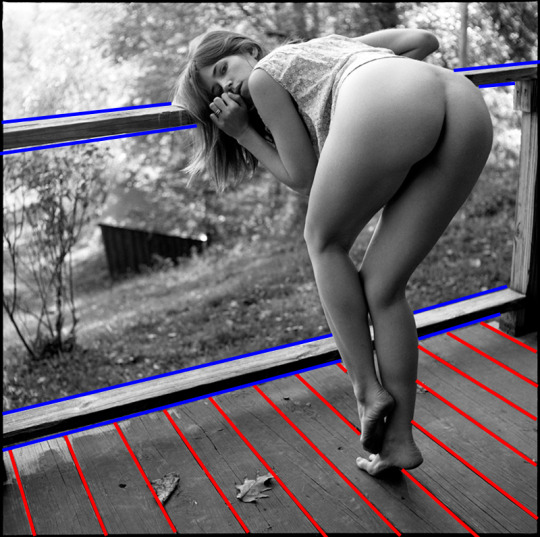
Sanders McNewMelanie King (2014)

Often, I drone on and on about the notion of ‘composition’–as if y’all magically know what I mean.

I mean I do try to at least apply the term consistently, usually meaning something like the way visual information is arranged and presented within a given frame.

Unfortunately, such a definition is a bit too open and inclusive as to be functionally useless.

Interrogating matters of composition might be better separated into several congruent examinations. There’s the notion of the frame. This gets tied up in ideas of inclusion and exclusion. However, there are also tangential concerns about the way things like the angle of view and tilt/pan/cant of the frame subtly informs psychological resonance.

There’s also questions of space. This can pertain to depth of field. The way a scene or setting is depicted. (Generally, it’s this to which I’m referring when I mention composition–the way a photography parses visual information in space through a lens in an effort to not only show the viewer something but offer them a particular way of seeing it.)

I’m not sure the above is a great photograph. I like it enough. But what I think is truly exceptional about it is how clear an example it is of parsing visual space for the viewer.

image

The default order of operation for reading images is left to right. Yet, that doesn’t always work. (As anyone fixated on making images exemplifying bilateral symmetry will tell you: it’s rare that things that appear symmetrical are truly and rigorously so.)

So one thing photographers do is to us contextual elements within the frame to guide the viewers’ eye over the frame.

The lines highlighted in red pull the eye upward and left and then the lines highlighted in blue shift the eye left-to-right. Melanie’s gaze directly into the lens closest the loop and the eye circulates following the lines highlighted in red inward, then the blue lines drift right and then we’re back at the beginning again.

What’s also skillfully applied here is Melanie’s position vis-a-vis the lines. She’s in front of them and therefore blocks them. That makes her the undisputed subject of the frame. (The DoF presents both her and deck in sharp focus but the scenery behind her goes soft and bokeh, further pushing her and the porch to the foreground.)

Denis PielHeat, Santa Fe, NM from New Mexico portfolio (1984)

Here’s an image which triggers so many associations/causes memories to effervesce unbidden, causing me question my own objectivity in appraising its merits.

The frame is bifurcated: upper half vs lower half. Several interesting things are going on with this. First, the upper half does take up slightly more of the frame (like just eyeballing it I’d say that top is 55% and the sand in the lower half is about 45%).

The upper half has all the detail, contrast, dynamic range–all the positive space; whereas the lower half remains (except for the inspiredly disturbed sand between her right elbow and his left hand and the contrast added to the texture of the sand to create a slightly darker swath of sand radiating up and rightward from the lower right corner of the frame).

This has an odd way of perfectly balancing the composition.

Perfect symmetry is one of my interests as an image maker. But once you get right down to it, actually perfect symmetry is virtually impossible. Even the best lenses have some sort of distortion. Thus, my interest is always piqued when photographers find ways of invoking the spirit of the law of symmetry without being slavishly beholden to the letter of those law.

But I’m also fascinated with this image because of the way it simultaneously reveals and conceals–which is a stellar example of the conceptual underpinnings of the image echoing the physical form (composition). It literally both reveals and conceals the lovers–rendering the visible but also wedged in deep shadows. There’s the desert sand juxtaposed with the chrome and tires. Also, this is ostensibly a public space wherein something that is supposedly private is occurring, presumably surreptitiously.

It’s a narrative image–even if it is too vaguely defined for the viewer to penetrate further than the scenario. A man and a woman taking shelter from the sweltering mid-day sun to communicate their physical passion for one another. There are no indicators of who they are–although I’m inclined to say she’s aristocratic (pale skin); whereas, judging by the depth of his tan, he would almost certainly have to worked outside under the sun for years.

What resonates about this most with me is it invokes a memory of my last trip to Iceland. I’d spent the day in Skaftafell and was taking the bus back to Reykjavik. The bus stopped at Seljalandsfoss in the final half an hour of light– Everything washed in an thin orange patina. I remember being impressed with the vistas but feeling that there wasn’t really a incantatory photo waiting to be discovered.

Yet, as we boarded the bus and continued on our way and the light emptied from the landscape and the sky, we passed through the seemingly endless stretches of lava fields between Seljalandsfoss and Skogafoss. Beside the road, there was what looked like a small campfire.

As the bus sped closer, I just had time to make out two young woman huddled with their backs against the front bumper of their rental car they’d pull off onto the shoulder–more screen and mud than shoulder–of the Ring Road. They were both extending their hands, warming them in the glow put off by one of those camp stoves you peel back the top and set alight. Thus I see something here that reminds me of the intimacy of shared shelter in inhospitable environments.

On top of that, I believe that the car is probably a more blunt symbol. you can also read the photo as if the couple has been run over. In my own experience, when physical intimacy is good, it very much makes you feel as if you’ve been run over but have some how survived uninjured and, in fact, more alive than you ever imagined you could be.

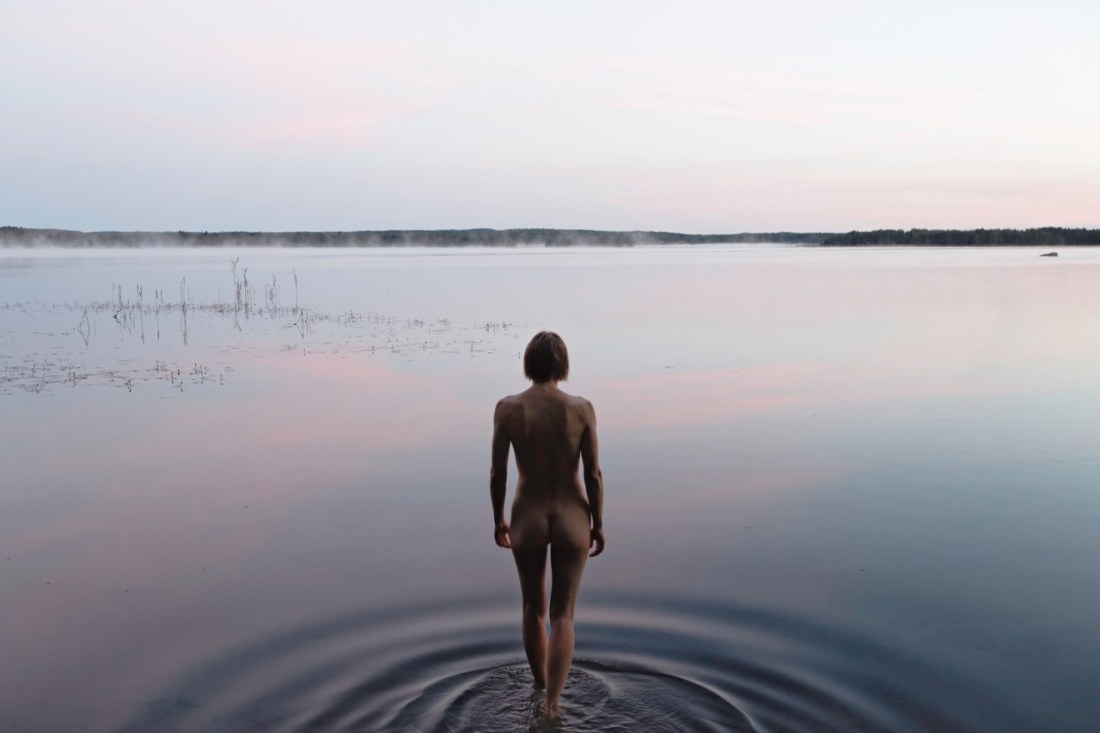
Elina BrotherusBlack Bay from Artist and Her Model series (2010)

I’m frequently asked how I know so much about art history. My response is usually two fold:

  1. I don’t really, and
  2. What I do know is the result of having a Survey of Western Art professor that while not an especially dynamic classroom presence was passionate about the ethos embodied during the Renaissance and the endless possibilities for conceptual interrogation presented by modern art; also, he took a personal interest in my endless reserve of irreverent curiosity.

People usually tell me that by virtue of being able to identifying the latter proves the erstwhile as a fallacy.

While I can certainly follow the logic leading to such an assertion, I feel like there’s a lot that I learned that never took. Given a a list of epochal buzzwords, I can probably do a workperson-like job of putting them in proper chronological order. I can probably even identify a half dozen famous works that sprung from various movements. But it all seems so arbitrary to me, I have a difficult time applying factual trivia I memorized in order to be able to fill in a blank on an exam towards an sort of practical purpose.

In other words the relationship between/ruptures/disjunctions governing the disparity between say Expressionism and Impressionism is something about which I have a really difficult time giving more than half a fuck.

On the other hand, I am INTRIGUED by mapping the evolution of representation of 3D space in 2D (aka perspective) from Giotto to Fra Angelica through Masaccio to Perugino and Rapheal in the Italian Renaissance on to the deconstruction of perspective that was Cubism.

Brotherus’ image reminds me of Adi Putra’s Once in a Blue Moon. Yet that similarity is likely less due to influence (think of influence as pouring a portion of wine from one glass into another) than a sort of positioning in an art historical context (thing of the art historical context as the grapes that are used to make Cabernet Sauvignon, it grows virtually everywhere and is the same grape but climate, soil and other conditions shifted the taste so that two different wines that come from the same fruit taste entirely different).

The one image reminding me of another actually cued a third image. I couldn’t remember the title but I remembered enough of what’s depicted–a man, dressed like a dandy, standing on what appears to be a mountain peak staring into the clouds.

It’s not a mountain, in fact; it’s a jagged shoreline–not just clouds but also fog. The painting is of course the definitive work of romanticism, Caspar David Friedrich’s Wanderer above the Sea and Fog.

Friedrich famously proclaimed:

[T]he artist’s feeling is his law.

It strikes me that both Brotherus and Putra are working within a similar scope as romanticism–Brotherus is likely influenced directly whereas Putra is almost certainly unaware of any connection to the broader art historical context. (That’s an assumption but one based on the fact that I’m not inclined to suggested Putra is a fine art photographer whereas there’s nothing else that better applies to Brotherus’ work.)

Interestingly, I think a goodly amount of the work produced by internet famous photographers and their ilk actually embodies an unconsidered, knee-jerk affinity for a romantic approach.

So while I’m not 100% on board with Brotherus’ work, I do appreciate that she definitely appears to know what she’s doing with it. I just feel like her work would benefit from a shift away from a sullen reimagining of Wordsworth and instead striving for something closer to a Walden era Thoreau as itinerant nomad.