Titti GarelliLa pagelle (2003 – 2004)

As an undergraduate, I studied Ludwig Wittgenstein’s later works extensively.

W. has a reputation for being demanding, founded on the fact that his first foray into philosophy–the Tractatus Logico-Philosophicus–was considered and continues to be considered one of the most singularly visionary/revolutionary philosophical works to emerge in the 20th century.

With such a stunning entry on the scene, you’d expect W. was rather pleased with the reception. In point of fact, he was not. He felt that very few people who professed their affection for the work actually understood fuck all about it; to the point where he all but disavowed the Tractatus and swore off philosophy, opting to become an elementary school teacher in rural Austria.

He returned to philosophy, in time. A goodly number of self-proclaimed experts present him as The Philosopher Who Changed His Mind. Going on to do work that sought to revoke his already monumental contribution to the discipline. I don’t see it that way. The Tractatus is heavily steeped in philosophical form, tone and procedure. The later work seeks to address the ways in which philosophers go wrong in striving to understand philosophy or anything else. What’s so fascinating about it is his tone completely diverges into something that’s half stodgy middle school teacher with the driest ever sense of humor and half trickster therapist.

W’s trip is essentially this: words do not convey meaning in the way a candle gives light to a lantern, words have meaning because of how they are used in the stream of life (in context).

My professor had all these grand notions about me applying W.’s ideas and methods to a comprehensive deconstruction of the creative process. She had me reading Eliot’s Tradition and the Individual Talent alongside Bloom’s The Anxiety of Influence.

It was difficult. I was a full time student at one of the best colleges in the northeastern US who was also working 35 hours a week. The workload was daunting and I chafed under the pressures of this assignment–mostly because I was insistent that in order for something to be good it had to be entirely original.

Garelli’s watercolor (above) is not original. The woman is an exact redention of an erotic French post card circa 1920s. The style is reminiscent of that artist whose name I cannot recall at present who made erotic sketches on ledger pages.

But there’s a clever nod to modern art cognoscenti, in that this woman is reading and has been painted onto an academic report card.

I never wrote that paper applying W’s ideas to the notion of originality in Art. There are a number of reasons for this but I think the most important to convey is that I think it lends itself a little too cynically towards the notion that the passing of time/underlying trends in taste and fashion and privilege determine what constitutes originality more than you know, being original.

The difficulty is that being original isn’t really something you can consciously accomplish. The eye sees without a need to see itself seeing. Or, as the Zen master would offer: don’t put another head on top of the one you already have.

I do think W.’s ideas are useful for analysis and criticism. However, I think too many ‘experts’ want to separate knowing from doing.

The less abstract way of saying it is you’ll jump much farrther with a running start than from a standstill. Doing the work day in and day out is indispensable. It’s hardly easy and rarely involves any sort of ground breaking originality. It’s one foot in front of the other, nothing more and nothing less.

Originality rises not when you seek it out but when in the course of ritualistically doing the work you find something unexpectedly intriguing. An errant thought, a wild hair that leads you far afield and when you look up you find yourself lost in a completely unfamiliar landscape.

The mistake is to search for the originality in the destination instead of realizing the endless and infinite is only open to you while you are moving.

If I were going to write that paper on Wittgenstein and the Creative Process, I’d almost certainly begin it with that line from Heraclitus about never stepping into the same river twice.

wonderlust photoworks in collaboration with @kyotocat – [↑] Vestibular; [+] Hasp; [↓] Wombs & Tombs (2016)

I’ve highlighted Emma’s intensity, poise and versatility several times already.

When I found out she was passing through NYC on her way back from overseas, I contacted her to see if she wanted to work together.

Given her work, my expectations were impossibly high and she still managed to exceed them by a factor of at least 20.

The hardest part of editing was selecting scenes where I managed to–through some fumbled bumbling miracle–make a photo that didn’t completely distract from her cultivated sense of her body in space/time, her meticulously considered poses and affinity for experimentation.

Honestly, I held back about a half dozen good images; simply due to the fact that afforded the opportunity to work with her again, I am certain we can do them better than they turned out this time ‘round…

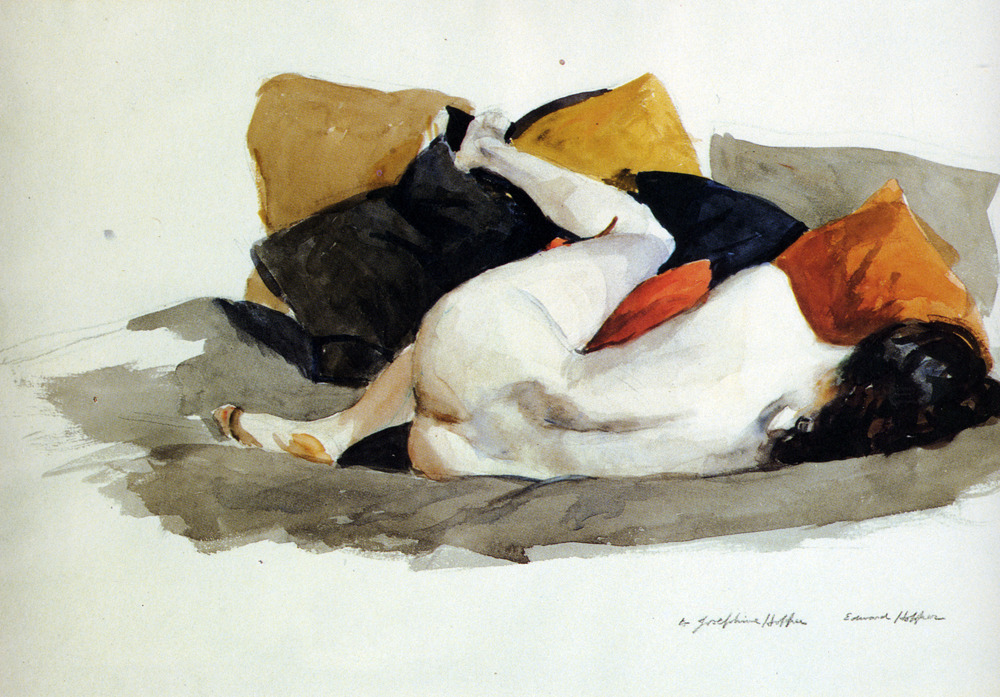
Edward HopperReclining Nude (1927)

Just because I can easily spot a Hopper from across a crowded gallery doesn’t necessarily mean I ‘know’ him or his work all that well.

Everyone knows Nighthawks; most folks know Automat and Summer Evenings. However, his style is so singular that’s all you need as a framework for sussing out the rest. A Hopper is a Hopper is Hopper.

I am extremely conflicted about his work. When I was first introduced to his work in my mid-to-late teens, I detested it. (But I was a surly teenager and was angstily wrong about more things that I was right.)

To this day, I still can’t honestly say I like his work. And if you’re thinking that given my background in filmmaking, this fact is a bit odd, you’ll hardly be the first person to think so and point it out to me.

There is something inherently cinematic about most of Hopper’s work. And what’s especially challenging is that it’s difficult to point to any one thing. Yes, he typically employs longer frames. Yes, there’s a way in which detail increases immediately surrounding the characters and diminishes in the foreground and background. For example: Nighthawks could be a Hollywood set or an approximation of narrow depth as a cinematographic means of emphasizing the area that is supposed to draw the viewer’s attention. (And in researching this post, I discovered Girl at a Sewing Machine, which I think is a great riff on the Dutch Baroque–specifically Vermeer’s Milkmaid and Woman Holding a Balance.

Additionally, the narrative suggestion of most of his renowned work should also draw me in. It doesn’t though…

I think this is due to two different factors. First, I’m not super into the French painters who influenced Hopper. (Some of Degas’ stuff is okay and Hopper unquestionably owes him a huge debt.) Second, I always feel like there’s a fine line between iconic and pop art–no, that’s not entirely accurate; I think Hopper’s iconic is always a little too pop art-y for my taste.

Another thing I don’t especially like that I suppose I picked up on by osmosis is his problematic relationship with his wife Josephine Nivison–the subject in the above image.

There’s an article in The Guardian from more than a decade ago present in anticipation of a Hopper retrospective at The Tate. It goes to great pains to paint the couples relationship as stormily complicated but sidesteps matters of sexism and misogyny. (Especially absurd given that the article presents Josephine as Hopper’s ‘muse’–a concept which is inherently mired in the consumption of women by entitled white cis-het men.)

But the reason I posted this was because a dear friend is currently convalescing with me. She had a health emergency overseas and I flew her back to the US and she’s been staying with me in an effort to get healthy. (It’s been a bit trying–mostly due to the fact my roommates initially agreed to her staying with us and have subsequently changed their tune to giving me 30 days notice to find a new space and move out… but that’s an entirely different story.)

This image resonated with me because it’s how my friend lays when she’s in the throes of a particular bad episode of pain. (it’s certainly inspired the way he uses the tones from the mustard and saffron throw pillows to accentuate her right heel, ankle, flank and back of her neck.. it doesn’t manage to come even close to offsetting her cadaverous pallor.)

Vincent SerbinPhotogram no.65 (2009)

What fine art photography is and today entails is largely due to the legacy of John Szarkowski.

A talented photographer in his own right, he’s now known primarily, however, as the Director of Photography at MoMA for just shy of three decades; where he proved almost singularly responsible for shepherding the black sheep medium that was photography into the fold of western canonical art historical and critical acceptance as capital A Art.

One of his endearing critical notions was that photographs function in only one of two ways:

  1. As windows looking out onto the world, or
  2. Mirrors in which we come face to face with ourselves.

I’ve always been flummoxed by this dichotomy. Partly because dichotomies translate a little too readily into dialectical propositions and partly just because when presented with a rigid either/or divergence, I’m always inclined to search for a third option. (Here’s I’ve purposely chosen ‘third’ as opposed to ‘middle’ due to the fact that although I’m always striving for balance, I am frequently too far outside the box to accept a middle way when others have established what I often feel as arbitrary/artificial extremities.)

Anyway, the point of this post isn’t to take Szarkowski to task, exactly–the windows/mirrors opposition is useful when dealing with say coming to terms with someone like Larry Towell vs say Jerry Uelsmann

Windows/Mirrors do contribute to my understanding of Serbin’s work insofar as Serbin’s work holds up a mirror to my own art historical imagination, causing me to return to artists I know well but are not always at the forefront of my mind.

I think the most obvious point of resonance is William Blake. The titling of the works as well as the way figure(s) are position bear an uncanny resemblance.

Then there’s the same gumbo of spirituality, metaphysics and philosophy that animates Duane Michals work. (To show my work with this assertion, consider Michals’ The Spirit Leaves the Body alongside Serbin’s The Omega Point Theory.)

And to state the patently obvious: there’s clearly some unresolved da Vinci issues at play in the work.

The above appeals to me for its simplicity. It’s more a coup de grace of design acumen than photographic insight. The seamless tonality and the layering of the ink blot reminiscent of Ralph Steadman serves not only as an enticing background but also interferes with the negative and x-ray in ways that further, seamlessly unify the disparate elements of the print.

I think you could read it as a momento mori, except that those seem to function more as a glitching insinuation than a front and center provocation. For example: the negative could be a Tarkovsky polaroid. And while it could be read as life being smaller in the scheme of things than death, there’s a sensual tone to the neg which rather pointed undercuts that notion, rendering the entire print a sort of darkly sinister, yet life affirming joie de vivre.

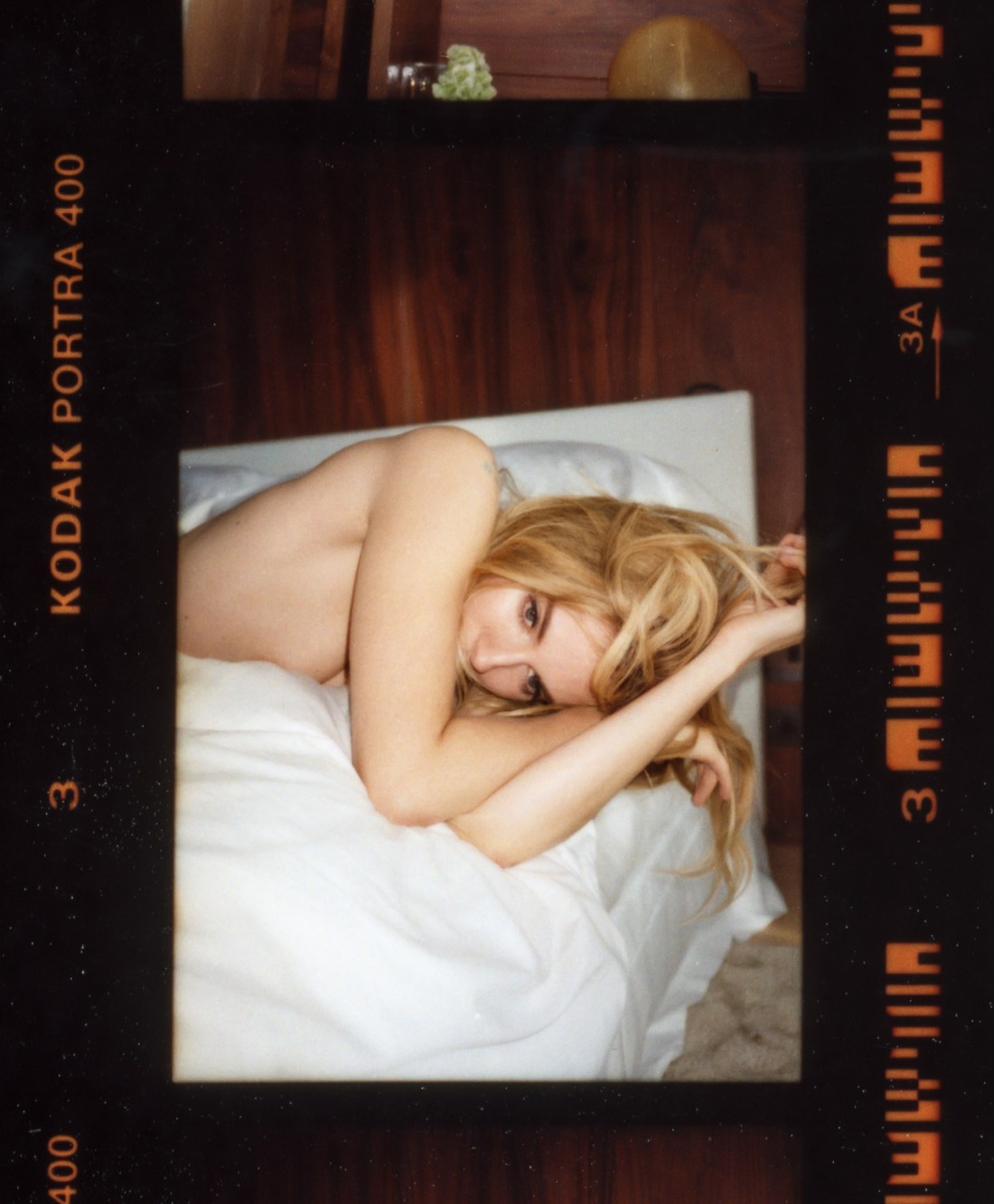
Tom CraigSienna Miller (2014)

There are a number of interesting aspects to Craig’s work.

The thing that stands out predominantly to me comes as a result of my time as a student of film making. In my program, there was one student who cultivated a persona not unlike Francesca Woodman while she attended RISD–essentially, I am the personification of commitment to excellence in craft and the fulfillment of the future of art in my medium due to my vast reserves of talent and genius.

This kid–let’s call him Martin–held that it was art if it was able to be replicated identically. In other words, a measure of the artistic merit of a work of film meant that with infinite resources, it would be impossible to recreate exactly a sequence or scene. The art in cinema for Martin was in its singularity.

That’s one thing Craig is exceptional at–providing a sense that his camera not only carefully parses the visual world to not only show the viewer a scene but to instruct us subtly on how to see the scene with which we are shown. (Here I am thinking less of the above and more of this or this one on the top right.)

He’s a bit of a chameleon. His approach to various commercial efforts demonstrate a surprising versatility. Eddie, London (2014) has a sort of polished flat affect; it looks corporate and commercial. Yet, appearing as such this carefully diminishes the clever, preciousness of the work. The result is playfully coy, offhand and casual in a way that marries the aesthetic to the conceptual underpinnings in an unexpected manner.

In other work, he’s riffing splendidly on William Eggleston or re-imagining Paul Graham. One thing that is almost consistent across his work is his use of light. I mean, to my eye it’s obvious that he’s obsessed with Joel Sternfeld–the attention to light in any of his images suggests this but in particular, the light in this is pretty much in line with virtually any color plate in American Prospects. (Oddly, even this doesn’t stay 100% consistent across the work. Consider this new-ish image with it’s recollection of the sort of dreamy haze in someone like Paula Aparicio’s work, mashed up with an affinity for Uta Barth, Andrew Wyeth and Whistler filtered through a mash of UK flavored ambience.

Lastly, I think the vertical orientation in the above is intriguingly utilized. Given the bed and the position of Miller’s body, my own instinct would be to use a horizontal frame. However, one of my objections to #skinnyframebullshit is that the compositional logic that the orientation echoes the positioning of the subject within the frame is not an acceptable reason to fly your camera on it’s side before firing the shutter. But it works both ways… the rationale for a horizontal frame instead of the vertical above is predicated upon a specious, knee-jerk association. In practice, had this frame been horizontal it would’ve contributed a sense that Miller is merely recumbently lazing about. Instead, the skinny frame encourages the eye to drift up and down–reinforcing that Miller is by no means a layabout and is actually rather pensive.

Source unknown – Title Unknown (2009) 

Any halfway decent Philosophy 101 course is going to touch on the notion of an ontological argument.

The premise goes like this: God must exist because a God is perfect and that which exists is more perfect than that which does not exist.

I feel as if a lot of modern images suffer from an ontological raison d’etre–namely, the image you capture is better than the image you don’t because the former exists and the latter does not.

All sorts of justifications are employed to shore up this rationale: if I don’t take a photo I won’t remember or it seemed to suggest something that would make a pretty picture.

I call bullshit on both. On the one hand the notion that folks need to Instagram every prettily plated meal and a trendy eatery cheapens the notion of persistence of memory. I’m sure it was good and all but are the huevos rancheros you had a brunch really something you want to remember ten years from now? (It’s like they teach you early on in film making–there’s no need to shoot coverage of a scene with closeup inserts that show the protagonists movements. He grabs something off the counter and picks up something else on vanity in the vestibule. It’s unnecessary to show a close-up of his wallet and his keys, respectively; unless either figure prominently later in the plot.*)

But the second impetus–it seemed like it would make a pretty picture–is, at least, more fundamentally honest in that it assumes that someone else seeing the image will through seeing it gain something.

The proliferation of ready-at-hand imaging devices has not materially improved image making. This is due to the fact that the vast majority of the impetus to create images is grounded in the capitalist act of conspicuous consumption. It’s not enough that I eat and remember what I ate, it’s necessary to show that one is eating here there or having this or that unmediated experience.

It gets even worse with porn. Consumers of erotic content are spoon fed a stylized and highly unrealistic version of sexuality. What I always find so completely bonkers about that is that–by and large–when folks set out to produce DIY porn, instead of asking themselves how do I convey what my experience of sex is like (or perhaps better: inquiring as to why they have the urge to produce such content and then exploring how to place what they want to show in line with what they create), porn provides an easily replicable template for making you the porn star or starlet of your own triple X scene.)

The above is–to my eye–quite different. It’s clear that the audience is seeing something pornographic in nature but the focus is on the expression of an intense, in-the-moment experience of physical pleasure. Yeah, it’s goes way too dark in areas and the shadow cast by the tripod in the upper left corner is detrimental to the immersive effect the image seems to be seeking; but, the way she’s looking back over her shoulder isn’t something that could be easily staged.

Karin SzékessyJutta auf dem Sofa (1968)

As I’ve mentioned before I went to parochial schools from 2nd grade through high school.

In 5th grade, the school didn’t have enough money to hire a qualified Physical Education teacher. And despite the fact that every student attending already paid tuition, the school came up with the brilliant idea of charging families for extracurricular PE options.

This was how I learned to ski.

I actually did okay, at first. Managing to not fall for the first several hours I strapped fiberglass planks to my feet. Then I had my first lesson and the first thing they did during the lesson was to have everyone lift their foot–right first then left–and touch the tip of the ski to the snow and then the tail.

From that point forward I spent one day a week for the next three weeks falling often and hard. Be I pushed through the difficulty, learned and before long as tearing up green circle and blue square slopes.

Photography and image making are deceptive media. Our culture is so visual and so immersed in lens based modes of representation, that whether most folks give a second thought to it, those of us in the western world are steeped in an unthinking awareness of the basics of how to present a scene.

It’s relatively easy and takes minimal training to call one’s self an image maker. However, inherent talent only goes so far. At a certain point–if this art form means anything to them–they need to do the equivalent of lifting their ski off the snow and touching the tip and the tail to the snow; in other words, a certain dislocation or disorientation is required to truly begin to learn–one must realize that what they thought they knew they know not at all.

What does all this have to do with Székessy photograph. Well: although it’s hardly the perfect analogy–the realization that one knows little to fuck all about art history is probably the more apples-to-apples comparison with the example of learning to ski–as much as we’d like it to be (and as much as new technologies attempt to make it so–a lens does not interpret the world in the same fashion as the human eye.

And it’s not just any one thing that’s different–it’s a complex of things.

On thing is that lenses allow us to render visible subtle gradations in light we don’t normally perceive. Arguably the best example of this is covered as a part of the thoroughly excellent documentary Tim’s Vermeer–which centers on Tim Jenison’s attempt to recreate a perfect copy of The Music Lesson.

I feel like that’s in some way what Székessy image here is trying to convey–beyond a curious and dynamically presented scene.

wonderlust photoworks in collaboration with Lyndsie Alguire – [↑] The Right Light; [^] A Piece of the Sky; [+] Fever Dream; [v] Invisible Syllable; [↓] Annunciation (2016)

Nothing short of pure joy to work with @suspendedinlight and I could’ve easily included double the images here. (About half turned out really damn well.)

These were the most intriguing and distinctive to my tired eyes, though.

I am already very eagerly anticipating the opportunity of work with Lyndsie again in the future.

Source unknown – Title unknown (200X)

With images, my personal preference is to always have some sort of insinuation of a comprehensive context; thus, here: all you can see is three people and a bed–contributing a sense of this-could-be-happening-anywhere-in-the-western-world. (Whereas, I’d prefer to actually see the window in the background that is merely implied here; also, maybe enough of the way furniture is oriented in the room so that I have an inkling of whose space it is, i.e. is it her space or is it one of the boys’ domicile? The sheets make me feels like it’s hers…)

That one small-ish quibble notwithstanding, I do like this because it feels like it thwarts a lot of assumptions that would typically be projected here.

For example: I’ve been asked by several followers if it’s possible to depict a subject with their legs spread wide and have the resulting image not come across as objectifying. My answer is usually something along the lines of viewing the vulva as an eyelid–if it blinked open would the newly unshrouded iris be staring directly at the camera? Then yes, there’s a huge potential that the image will be read as objectifying.

In this case, however, I feel like this is perhaps an exception that proves the rule. And the why of that I think has to do with the fact that the focus is on attending to her pleasure. I mean–yes, the one gent has his finger inserted into her anus up to the second segment; and yes, it’s probably a warm up for anal sex.

The tableau is arranged to play towards the camera but the participants are ignoring the camera. The way the guy with the finger in her ass is always bracing her butt with his hand doesn’t seem solely about ensuring a good view. It feels like an effort to organically provide additional support as she’s trying to hold her own leg back and out of the way.

The whole thing feels (to me) intimate and attentive. I think this is another image I might want to borrow inspiration from to pursue in my own work at a later date.