Source unknown – Title unknown (201X)

This is not a good image. It’s a victim of shitting lighting in a small bathroom and being taken on a front facing camera phone propped up against a soap dispenser or tooth brush caddy. (I wouldn’t say it’s #skinnyframebullshit, however.)

But there’s something that ought to be a greater concern than whether or not an image is good. This is poignant and brave and because of those two things it’s also true and alive in a way that few things in life are.

Or to put it another way: this goes a lot deeper than your usual camera phone in front of the mirror in a state of provocative dress or undress, that have become de rigeur among mid-to-late teens and twenty somethings. It says I wasn’t sure I wanted to know but I decided that not knowing was worse than knowing. (If there’s a prerequisite for being an artist, it’s probably that.)

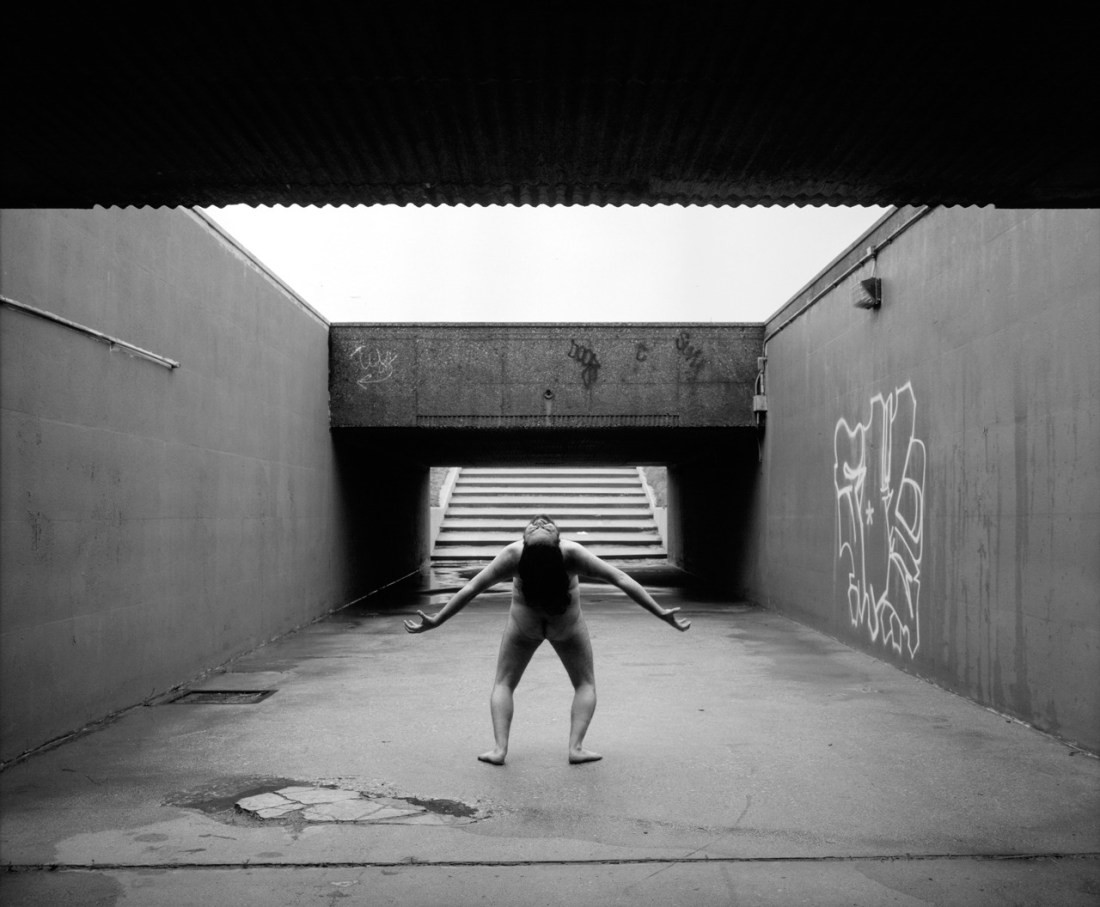
Claire LaudeUntitled from Upward on the Streaming It Mooned (2016)

I’m super into Laude’s work.

My immediate reaction to encountering this was: It reminds me of Stanley Donwood and Thom Yorke’s work on the album art for Radiohead’s OK Computer.

Actually, it took me a bit to figure out why in the hell I jumped to that conclusion. See I read the line work to the right of the figure as De Stijl-esque.

As–I’m sure–most of you know, De Stilj was essentially a form of abstract art based in Amsterdam, interested in reducing representation basic forms and colors. One of the key practitioners being Piet Mondrian. (It’s interesting to note that Mondrian fled mainland Europe for London to avoid the advancing tide of fascism that served as a prelude for the Second World War.)

The lines run off the wall onto the body and in so doing becomes less abstract.

There’s also the way in which the square and above the figure and the crude right arm, suggest a sort of robot personae. It’s as if an automation and abstraction flow together into a body rendered penitent through connection.

And if there was ever an album that dealt whole cloth with the topic of alienation in a historical context, it’s OK Computer. (Of which–confession: I appreciate only reluctantly. Radiohead has never and from all appearances will never be my bag.)

But I do think it’s interesting that OK Computer was released right around the same point into Clinton’s second term as we are into the current ‘president’s’ first… Although there isn’t much separating Clinton’s neo-liberal globalization vs 45′s nativism, there is a means in which abstraction as a trend has been co-opted and employed as a means of perpetuating these varied flavors of fascism.

It feels to me as if Laude is trying to harness the lightning of understated menance for the purpose of questioning the invisible effect rules and codifications of form have on shaping not only the relationship with the viewer but history itself.

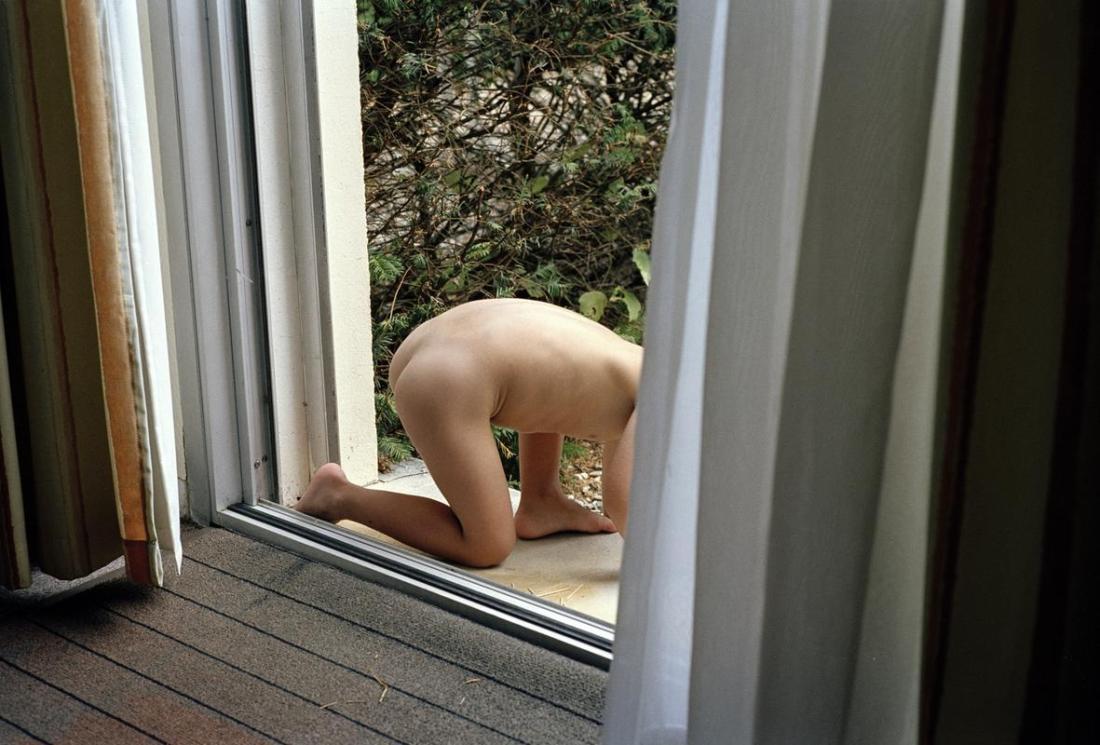
Géraldine Layjuillet from Un mince vernis de réalité series (2006)

A photography teacher introducing Lay to a room of undergrads might talk about the foreign in the familiar or refer to an unassuming eye. Perhaps, accompanied by explication relating the work’s influence to anyone from Stephen Shore to Jeff Wall to Paul Graham.

It’s not that I don’t think these points are extraneous–hardly; it’s that I think instructors need to vary their approach given the materials.

All too frequently, I think we reduce informed analyses to the presumptions of tradition. Painting is compared to painting; photography is compared to painting and cinema. It’s all really more interpenetrative than that.

We’d be better to look at modern art as a confluence of modern media, modes and methodologies–much in the fashion that the medieval cathedral formed the nexus between architecture, sculpture (broadly: masonry, woodwork, etc.), painting and even fiber based arts (liturgical robes, tapestries, etc.).

The best approach to Lay is, in fact, not visual–or only tangentially so; it’s textual.

Looking at the work is enough to justify this premonition, at least as far as in my own case. However, one needs look no further than the statement accompanying Un mince vernis de réalité to solidify this perspective–I understand not one lick of French but I’m guessing from context and Google Translate that it’s a section from Nabokov’s short story Transparent Things.

I’ve tried on at least half a dozen occasions to dive deep into Nabokov. He strikes me as a peculiarly brilliant mind more interested in conveying the form of his ideas than presenting them in a simple straightforward manner. His text is unnecessarily overwrought, at times serpentine and lacks the sort of glittering, glib irreverence of say Perec.

But the jist of the quote is a notion that’s not unfamiliar to me–Martin Buber makes it the singular focus of the second most influential book I’ve ever encountered: I and Thou.

The crux of the book is that there are two flavors of relationships between the individual and the world which surrounds them. There is the world of objects: subways, coffee cups, paper clips and xerox machines. We even see other people as perhaps not objects but ‘other’ in a similar fashion to objects we perceive in the world around us. Buber terms this relationship of our perception of objects in the world as ‘other’: I-It.

There is a second form of relationship. It is far rarer. Imagine: that you are standing on a bluff overlooking the ocean. A dear friend is facing you with their back to the ocean telling you a story–perhaps something to do with their misadventures traveling to Machu Picchu. Behind them the color in the sky shifts and you notice this devastatingly beautiful purple you’ve ever seen. You are utterly speechless at the site. You want to show your friend. But you know as soon as you spake of it, the spell of the wonderment will be broken. All you can do is point and hope that your friend will turn and see what it is you’ve seen in the same way. (And let me tell you, if you find that person who all you need to do is point: hold them close, not having to explain to someone why something is special is one of the greatest gifts you can share with another person.)

Buber terms this wordless wonderment, this transcendent moment of perfect, unmediated awareness: an I-Thou relationship.

Trying to explain it like this: a little like trying to explain to someone who hasn’t ever tasted coffee what coffee tastes like. It’s not something you can accomplish with words. Instead, you boil water, grind the beans and steep a cup for them saying this is warm and good, try it. If you don’t get it, spilling all the ink in the world won’t bridge the gap that you’ll cross once you know that to which you are being pointed.

The other curious thing though is that Buber maintains that there exists within every I-It experience the spark of moment of I-You relationship. I think most good image making centers on trying to document that spark.

What distinguishes Lay is that she’s not interested in the spark, she’s interested in the I-You moment. In effect, her camera is the same as the finger you are pointing so that your friend will see the purple tinged clouds hovering above and reflected in the ocean below.

It’s an unusual approach and while I don’t think it always works out for her, it works enough for one to see what she’s about. I’ll always respect work that attempts the risks failure in pursuit of an ‘impossible’ end. But the work that truly gets me fired up is the work that succeeds in accomplishing what we’ve heretofore accepted as impossible.

Daniel RampullaKa’imina’auno (2014)

I’m on the fence regarding whether or not this is #skinnyframebullshit. The upward thrust of the elbow and the downward pull of the arm in tandem with the strong high-to-low angle of the light certainly establishes a dynamic tension.

I’d give it a pass except for the fact that I think the primary consideration in choosing vertical orientation was as a means of isolating the subject against the improvised background–which appears to be a flannel sheet. Therefore I’m inclined to think the composition echoes the subject out of necessity more than consideration toward a unified reading by the viewer. Namely, I can’t tell if the figure is supposed to be lonely–in which case a wider, empty frame would’ve communicated that point better as in this claustrophobic frame there is a way in which the scant distance between the subject and the background, the light and muscle definition appear tangled up in some notion of physical proximity and embrace. It’s not that it doesn’t work with the image, it’s just that it muddles things given the statue-esque icon insistence of the given perspective.

All things being equal though, I do like this. I feel like there are strong parallels with Patrick Gomme’s work–something I very much want to like but for which I suffer a greater and opposite distaste. (It’s not that Gomme is insincere, so much as the aestheticization of insincerity seems to be the point of the exercise.)

By constract, Rampulla is entirely earnest–maybe even clumsily so.

Evie CahirUntitled (2013)

I’ve been following Cahir for around two years now. She’s extremely talented; her doodles and cast offs are at times nearly photo-realistic.

Recently she’s been working on a comic called A Single Tear. The overall aesthetic seems like harsh pencil drawings from snapshot reference material with a certain Munch-esque whimsy for visual abstraction/oddity.

What’s noteworthy beyond the excellent craft, is her drawings work so damn well in part because of her frames. Her compositions are legible, dynamic and cinematic in the extreme.

I’m particularly taken with her depictions of the Berlin neighborhood of Neukölln–because she nails the interplay between the ethereal late day light and the electric feeling of this city’s (I’m writing this in an bar several blocks from Hermannplatz) chaotic fuss and bustle.

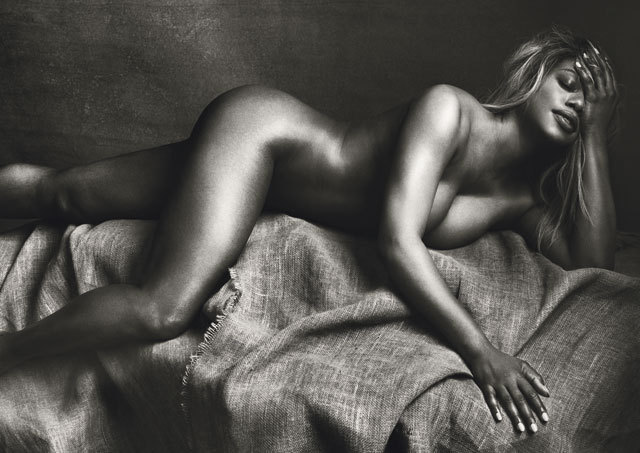
Norman Jean RoyLaverne Cox for Allure Magazine (2015)

Honestly, I’m just kind of perpetually flustered by Ms. Cox. She is articulate, brave and as jaw-droppingly talented as she is beautiful. (She’s the only reason I still bother with OITNB—because seriously don’t even get me started on Jenji Kohan’s and her faux edgy, patronizing bullshit better-than-thou narcissistic tokenist bullshit.)

The response to this image of Cox has been predictable. Noah Berlatsky, at Playboy of all places, exposes radical feminist exclusionism in several responses.

And I don’t want to diminish the import of the image–because in a way it is revelatory. The problem I have with it is the implicit violence of the frame edge. It’s one thing to present Cox as sexy–I’d say it’s unavoidable, she’s positively sultry like always–it’s the symbolic rendering of her immobile by the amputation of her feet that doesn’t sit well with me.

wonderlust photoworksMx Inchoate (2014)

I always thought that if I could just figure it all out then they saying would take care of itself.

…except when understanding dawned, fitting the unexpected truth of knowing to words proved more impossible than I could have imagined.

But, maybe if I can’t say it, I can show you.

I’m still failing and it’s not really any easier than finding the right words but despite it sometimes the feeling, the tone and the scope of a moment bleeds through from around the edges of my desolation and stuborn idiocy.

It hurt to shoot this. It hurts to look at it. But I have to look.

If I could just show you, if I could offer but a flickering glimpse…

Amy Montali – [1] In the Garden (2004); [2] History (20XX); [3] Souvenir (2009); [4] September (2007); [5] Stain (20XX); [6] Holiday (20XX)

I’m sitting in a cramped little vestibule-like area that opens off my shitty basement apartment into a claustrophobic backyard sobbing my stupid eyes out.

You know those moments: when warm light touches the world just right; and the perfume of spring lingers in the breeze; or, the players on the stage play their music as if muddy horns and staggering joy were the only magic anyone ever needed, when words or subtle turn of phrase makes the truth of the song, a chorus you can’t help but sing and in singing it, singing as if singing were the only one that might maybe save this sick and dying world.

I exist for such moments. And people always fault me, tell me my expectations are unrealistic, that I am asking too much.

But then, then I stumble upon beauty like this. Work that shows me the world I already see, proving that someone else sees it too, sees hope and beauty and love and so, so much more joy than all the words ever spoken could circumscribe. And it is all so terrifyingly easy to overlook…

In those moments, I always know I ask for too little; I should ask for more.

Amy Montali is everything.

Everything.

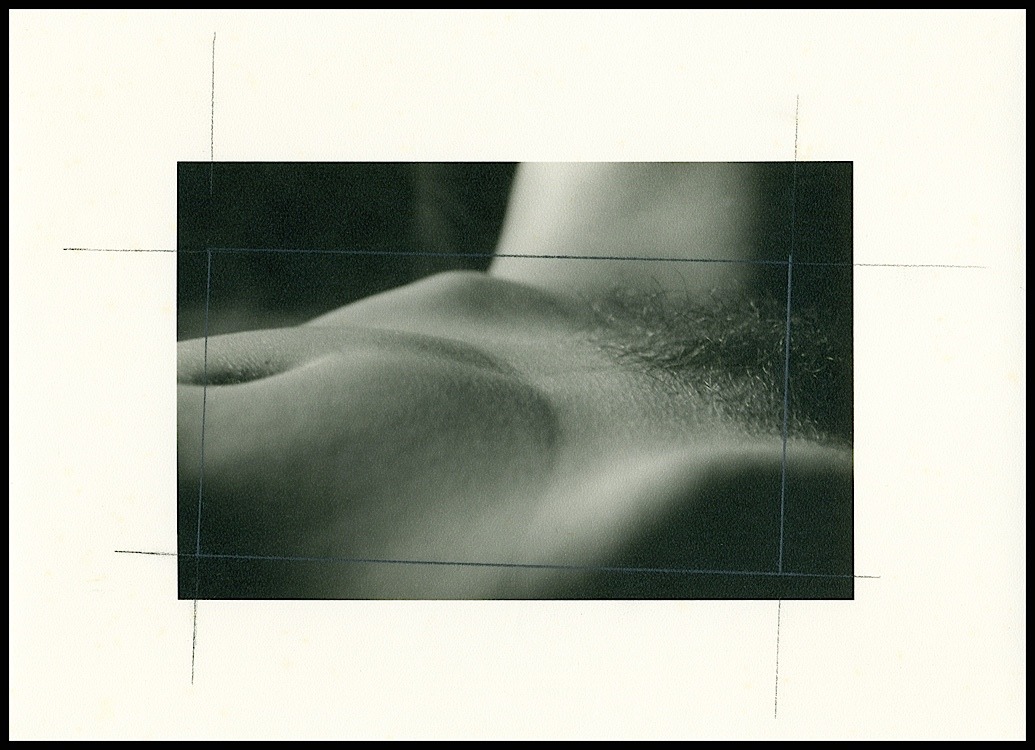
Isabel DreslerNon-Binary. (2014)

He seems to me equal to gods that man
whoever he is who opposite you
sits and listens close
           to your sweet speaking

and lovely laughing—oh it
puts the heart in my chest on wings
for when I look at you, even a moment, no speaking
           is left in me

no: tongue breaks and thin
fire is racing under skin
and in eyes no sight and drumming
           fills ears

and cold sweat holds me and shaking
grips me all, greener than grass
I am and dead—or almost
           I seem to me.

But all is to be dared, because even a person of poverty

—tr. Anne Carson; Fragment 31 If Not, Winter: Fragments of Sappho (Vintage, 2002)