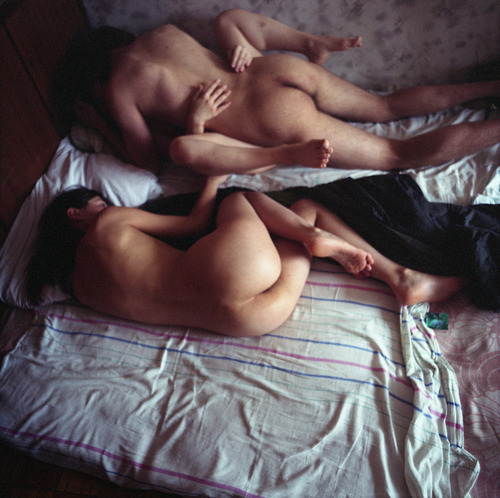
choomathy:

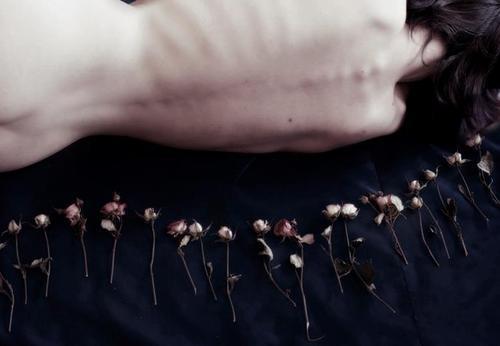
this series was fun. I remember my tutor tried to get all “damn girl I love your work with feminism what a deep concept” and I was like nah I just like baths and … nipples

Baths and nipples, indeed.

Jaw, meet the floor. Floor, jaw. Get familiar with each other because every time I look at these my brain explodes.

I guess I can see reading a feminist agenda into this but I’m inclined to immediately link it with Bernd and Hilla Becher’s industrial typologies.

But either way, this as precocious as it is astonishing. Crazy props to Chloe Killip for not only having something captivating to say but finding the most breath-taking way of saying it.

When printing something one is given two options: portrait or landscape.

As best I can tell this is a vestige of painting: vertically oriented images were favored for portraits while horizontal frames lent themselves to the panorama of landscapes.

Although arguably more of an unconscious convention in painting, this logic has been actively internalized by photographers and virtually enshrined by digital image makers.

The trouble is two-fold: the logic of photography is not interchangeable with the rules and precepts of painting (no matter how the latter interpenetrates the former). When applied to each other, these conventions produce schizoid, contradictory compositions.

Photography—and by dint digital imaging which however misguided is based upon it—has internalized the landscape orientation.  Unlike painting, I do not think this internalization has been unconscious—after all, if you have ever looked at a strip of 35mm film on a light-table there is an easy-to-see bias towards horizontal framing. (I am so accustomed to this that when I encounter vertical compositions now, I tend to tilt my head sideways when looking at them.)

Portrait orientation is not without its uses in photography and digital imaging. Unfortunately, it more often than not contributes very little to the compositional ‘sense’ of an image; serving expedience by quickly fitting the subject to the frame—instead of forcing the image maker to contemplate the discontinuity between the subject/frame and subsequently address it in a more artful manner.

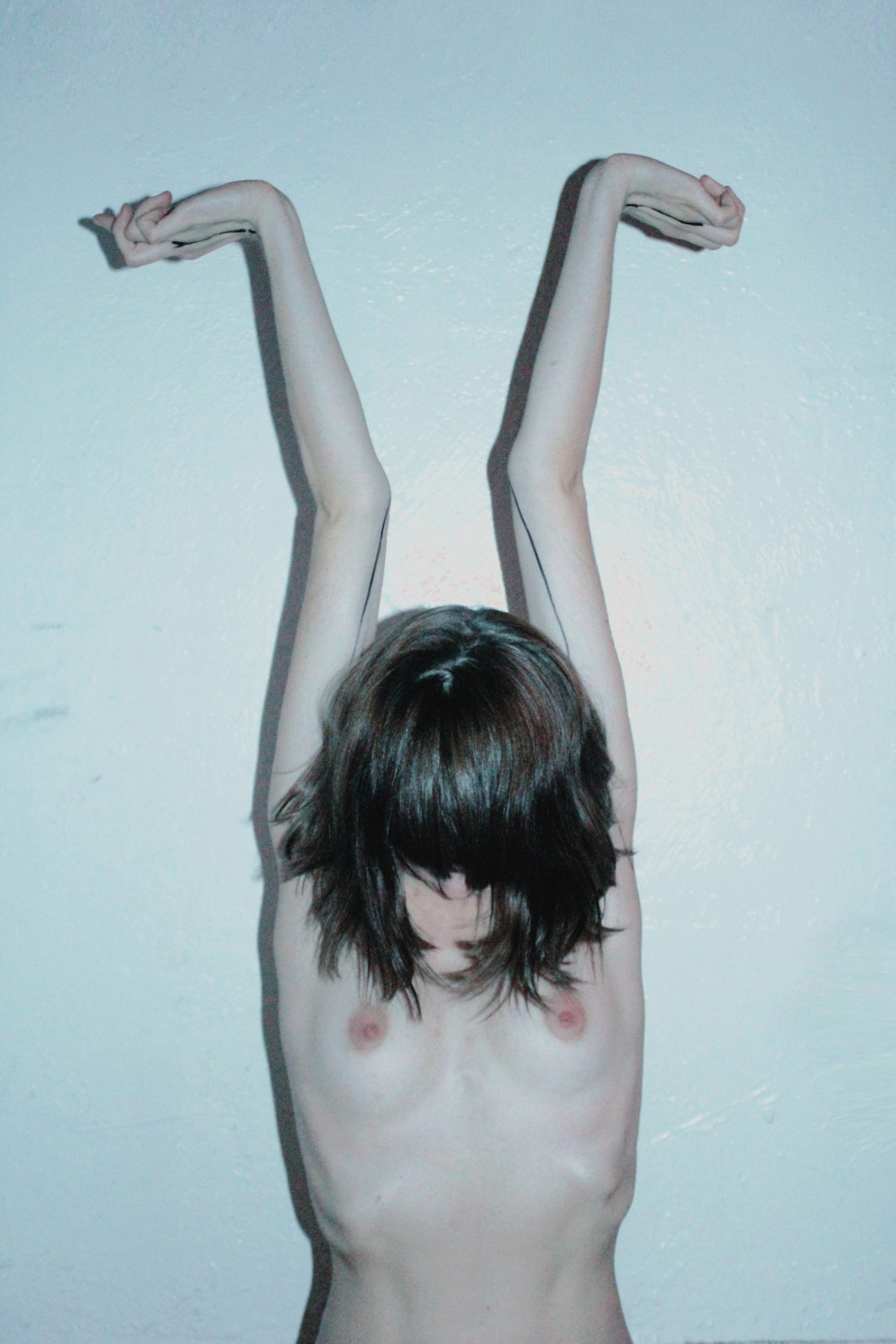
The above has almost certain been cropped. But I would wager its orientation was originally vertical. (The individual responsible for the image contacted me with assurances that the image was originally horizontal but was cropped to accentuate the vertical.) And although I think horizontal framing would have worked better (EDIT: Having seen a sample of the original image, it is better), I will admit that unlike the vast majority of portrait orientations, the image maker is clearly aware of the manner in which the shift affects how the image is seen.

The frame echoes the subject’s form. On its own, that is the worst of lazy justifications; however, in this case the poses, the simple line work of what I find to be one of the sexiest tattoos I have ever seen and the narrowed view work as a visual approximation of the feeling one gets from indulging in a much needed stretch.

Further, the portrait orientation allowed the photographer to be closer to the model, lending a sense of heightened intimacy while also preserving anonymity.

Finally, I would be remiss not to admit a large part of my reason for posting this is the model’s unnerving resemblance to someone upon whom I currently have a maddening crush.

The oft trotted proverb goes: good artists borrow; great artists steal.

Whether it was T. S. Eliot or Picasso who provided this sentiment and regardless of any inherent merit, this has become a prima apologia for shitty artists the world over.

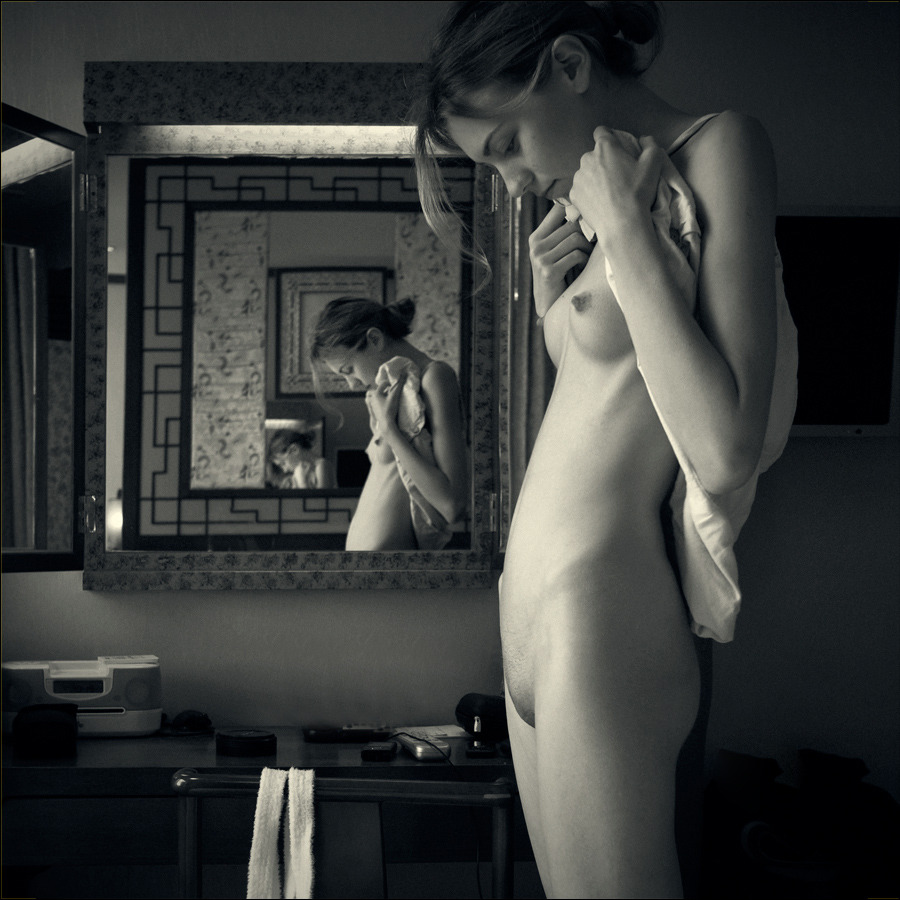
With its focus on a scene unfolding in a room lit from frame left, this image ostensibly borrows from Vermeer. Yet, unlike Vermeer—whose canvases present their subjects en media res: reading the final lines of a letter, pouring milk—this woman actions are ambiguous, her pose highly contrived in an effort to appear natural; however, consider what situation might require her to so pull her gown up around her shoulders and face away from a readily available mirror in order to stare down at her nude body?

I would be very surprised if the individual responsible for this image was unfamiliar with Vermeer. However, borrowing here from Vermeer is like asking a friend to lend you a designer sweater to wear with your new backless red dress. 

The theft that does work is from an artist I would wager is unknown to the image maker: VelázquezLas Meninas specifically

Mirrors have a way of fucking with subjectivity. Velázquez depicts the subject—that is, the king and queen—only in a faint reflection; the scene instead focuses on the artist—presumably Velázquez himself—painting. At the same time, note the painter is considering both his subject and we the spectators.

The mirroring in the image above is less complicated but does produce, if accidentally, an interesting effect. By angling the camera so it views the reflection without being itself reflected, as well as the inclusion of the reflection of the young woman’s face reflected from a smaller mirror along the so-called fourth wall gives the room an implicit dimensionality. An implicit dimensionality that, in effect, deletes the physical presence of the camera from the scene; muddling matters of subject/object, observer/observed along with the questions of exhibitionism and voyeurism accompanying them.

Groupo SitcomCactus 2012

I have no idea whether this is a print—though the bent edges look a bit too thick; or, if it is some type of instant film with which I am not familiar.

Either way I like it a lot. It handles bright sunlight in a fashion similar to Polaroid’s discontinued Spectra 990 instant film with a little bit more latitude for underexposure.

The manner in which the image is composed is sublime. The swath of golden light draws the eye from top left across and down the frame to the bottom right. There is a balance between positive space (skin) and negative space (the more underexposed parts of the frame).

Note: how the hand—you really have to look to see it—in the upper right balances the sliver of cushion or whatever in the lower left corner.

I normally do not like close ups. But this close up provides just enough context to determine that the subject is in a room, presumably seated in a chair with a potted cactus shading her mons pubis—and what a beautiful but scant shadow it casts on her skin—if you look close enough you can see its texture.

The cactus is a loaded, ambivalent symbol—needing careful tending, not too much or too little irrigation. They are also spiny, dangerously self-protective.

But while the cactus is certainly hers it is separated from her by a clay pot. As such it could represent something that from one angle seems a threat to her tender areas but when the light translates its form to shadow; its threat appears diminished—a little beautiful even.

This strikes me as a carefully constructed scene suggestive of a male and female perspective. It is explicit while simultaneously remaining completely aloof.

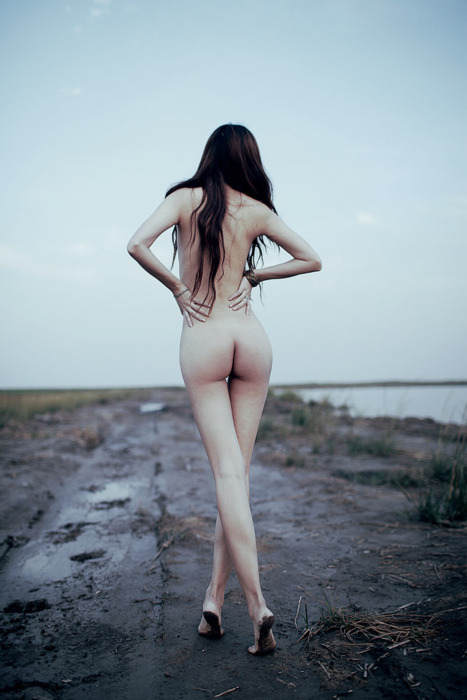
Why is there so often an direct relationship between sleek, high-production value and imagistic vapidity?

I mean, this image looks stunning. The color is controlled, Albers-esque. The light is just so—morning golden hour most likely, with just enough a kiss from the flash to provide a slightly unearthly skin tone.

But what is this photo trying to convey? All there is to go on is a naked woman with her back facing the camera, her legs crossed in a very contrived pose and the washed out and muddy track on which she stands has stained the bottom of her feet—somehow impossibly also visible.

As with 90% of all instances of vertical framing, nothing is added by this decision—except to make the woman appear taller.

This does succeed but recasts the image as a fashion image that is not selling fashion; sells an aesthetic instead. I suppose that’s fine but without something behind that aesthetic, it is all rather empty.

A better way to criticize this image is to imagine it framed horizontally. (Go ahead and keep the contrived posture.) How does her position in the environment change the questions you ask of the image?

For me, with a horizontal frame the questions I ask generally becomes less about what I think of her and her situation and more wondering what she thinks about herself and her situation.

The above frame would benefit from a slight shift down and right. Setting that aside—as well as my ambivalence at best toward the Instagram trend—this image is well crafted.

Come on, you may say, explicit images of beautiful young people fucking are not the sort of thing anyone appreciates because of technical merit.

I mean, yeah, this easily succeeds at level of beautiful young people fucking. But, where it blows—pun gleefully intended—the competition away is it’s carefully considered composition.

A lot of people like to drone on and on about composition this and rule of thirds that when all you really need is to realize that composing a visual image is—whether you realize it or not—almost identical to telling a story.

Just as image makers can only represent a limited sliver of the world within a given frame, the storyteller must determine what details serve the story and therefore bear inclusion; as well as those which are superfluous and therefore best excluded.

The skilled storyteller conveys not only the sense of a story but also something of what was excluded. William Carlos Williams’ poem so much depends is the perfect example. It describes two objects; but in describing only the two most necessary objects in the scene our imagination thrills at building a seamless world around them.

The fundamental difference between images and words is that the former allows for the whole and various parts to be taken in simultaneously; whereas even describe something simultaneous by saying: at the same time this and that happened, the linearity of the sentence privileges ‘this’ over ‘that’ by an ‘and’ length measure of time.

The composition of this image guides your eye over the various parts of the image while always reinforcing its place within the whole. For example: before I even take in the extent of his nakedness—fuck, his skin is like milk cooling in the shade—I see the muted variegation of the sedge on which he is splayed.

At the same time it all shifts into sudden focus and I see everything: his outstretched arms terminating in fingers—fierce with whiteness— tangled in the brown of her hair; his hands and her head meeting to form vertex of an inverted V which tenderly frames her right hand taking his erection and guiding into her mouth to a depth only a hair’s breadth above its edged tip.

And the wide gape of his knees, a second non-inverted V, re-frames her body between his legs where she is crouched as naked as he.

Edgar Degas After the Bath Woman Drying her Feet 1886

I do not buy the rationale behind the quip: “if you can’t masturbate to it; it’s art.”

Georges Bataille’s Story of the Eye is widely acclaimed novel featuring jaw-droppingly pornographic interludes. I read it in one evening six years ago during which time it proved necessary to bring myself to orgasm not once, not twice but thrice.

Am I implying an ‘Impressionist’ painting was intended as masturbation fodder? Well, yes. And not because I have used it as such or think you should—okay… that last part was a lie: I have and you should. But how is what was good enough to assist Degas in keeping the ‘paint’ from drying up in his brush no longer applicable to the question of how images affect us?

First, it seems egregious to delimiting this as not pornographic as well as devoid of sexuality in the same breath. It wasn’t like Degas’ politics weren’t bass ackwards and historical those with similarly conservative worldviews have a tendency to be a wee bit sexually repressed. But even if he was secretly a horn-dog holding a candle behind a glass plate negative so as illuminate some hot harlot blowing an aristocrat, the level of detail would have been at a level comparable what these days passes for soft-core porn.

I think there is a similar desire to show something taboo but the way Degas goes about it is just a little too sublime to at first glance see how devilishly clever he’s being. Yeah, the thought of a woman in the bath makes you think you might go all tingly down there if you focus on it too much. However: instead of sensationalizing the prospect he treats it as the mundane domestic scene it is.

The first thing I notice—and full disclosure I am as far from an expert on Parisian social mores in mid-to-late 1880’s as one person can get without expending effort—it would be unlikely for such a young woman to live alone. Why do I say she lives alone? Look closely—where is she drying her feet? Yes, she’s sitting in a chair covered with what seems to be a robe but since when are bathrooms big enough for armchairs and closets? There’s no indication of a tub and this looks like a bedroom or sitting room. It follows that she has finished her bath and moved out of the bathroom to sit in the chair and finish drying off. It could be husband isn’t home or she is a working girl but either way she is demonstrating behavior only becoming of a damp trollop.

Damp trollop or not, with the feminine touch of the robe laid over the back of the chair the space—although not probably her apartment in real life, becomes hers. If we stop to question whose things these are, the only conceivable answer is hers. However it happened, she has a space of her own. She has things and she does things just as we do. In other words, we are looking at woman who is, like us, deeply human.

The ‘we’ to which I keep referring is a reference to the fact that his work is without question voyeuristic. She is unaware of being watched by someone unseen to her.

There are three more things I have to mention about this image:

First, Degas began experimenting with photograph in the early 1880’s. It is impossible to not see the effects of that experimentation here: how the extreme foreground and background become increasingly blurred as you move away from the woman’s back—the point of focus; causing the scene to appear as if through a lens with a wide aperture/shallow depth of field.

Second, models always talk about never knowing what to do with their hands. Look at this I am reminded of something that I was told repeatedly in film school but I did not until now grasp the meaning: always motivate an action. In this case, the exaggerated act of drying her feet occupies her hands in a way that is already relaxed and natural. (The way her left arm is tucked between her leg and chest is my favorite thing.) I suspect when I model mentions she does not know what to do with her hands, the real fix is not to imagine things for her to do but ask instead: what is she to be doing in the scene.

Finally, this work stands out from the rest of Degas’s oeuvre; so much so that although I find Impressionism highly distasteful, this is one of my favorite paintings ever.

Pavel FlegontovDecember 13

bendmeover:

I spend a lot of time preoccupied with notions of community—how to foster, improve and sustain them.

I was raised in an insular, religious cultish community. It was neither the best nor the worst situation; it was just another thing that happened to me.

Somehow, I managed to survive it.

It’s now just shy of two decades since I cut ties with that life. It has been for the best, without question.

But I would be lying if I denied frequently feeling rootless—a tumbleweed tossed wherever the fuck the wind blows.

It’s not the group sex that gets me—although I am not opposed to that by any means; it’s witnessing the shame and stigma my former community directed toward any expression of sexuality transmuted into a sublime collective experience.