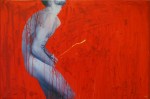
Eric PhillipsUntitled (2010)

As far as motifs go, decontextualized bodies in tinted bath water will forever remind me of Chloe Killip’s utterly breathtaking, Besher-esque typologies.

This image hails from a series called Washable Sins and three or four of the images wouldn’t have appeared out of place in Killip’s project–which is (I assure you) to pay Phillips’ work quite the compliment.

However, as much as I like this image–it’s a sterling example of how a dick pic can be classy in execution–my immediate association sends me in rather a different direction than Washable Sins; and if I’m honest, unfortunately, the sort of glossy homoeroticism Phillips work insists upon is neither as interesting or edifying as Killip’s precocious presentation.

(Also, if I’d only seen this image I’d be willing to give it the benefit of the doubt w/r/t whether or not it qualifies as #skinnyframebullshit; having seen the rest of the project, Phillips is a profligate skinnyframebullshiter.)

Ao Kim Ngân [aka yatender] – Untitled (2014)

A healthy human body can forgo eating for roughly a month and a half.

Dehydration will kill you in under a week–and this assumes a cool ambient temperature and minimal activity.

Hunger can be deferred; thirst commands an immediate response.

That’s the distinction that occurs to me browsing Ngân‘s work.

Her light fall series is obviously homage to Lina Scheynius’ preoccupation with documenting light. While the above is likely prefigured by Traci Matlock‘s mirror self-portraits.

Both Scheynius and Matlock are endlessly talented photographers. However, in a sense, in the realm of internet famous image makers, wearing such influences on one’s sleeve is potentially problematic.

That’s where Ngân distinguishes herself from thousands of other upstarts: her photos possess an unusual gravity. To get a feel for it, check out the stuff she’s shot of dancers in Ho Chi Minh City; not the way her single, static frames bristle with a sense of flowing, dynamic momentum.

Her personal work features less emphasis on momentum and more on stillness. In that way, it’s in line with Schneyius; however, unlike Schneyius there is a very profound sense that the stillness is in itself requires taxing concentration, is an exercise in willpower.

And this is where we get back to hunger vs. thirst. The work Ngân emulates is–in its sexual politics–interested in the overlap of representation and identity as a means of not only authorship but also as a relationship between the female gaze and the visualization of something not unlike hunger.

The lines between material and flesh in the image above, the delicate touch of the obscuring flowers here and the light on the knees, the position of hands and the texture of the dress and sheets here.

The subverted eroticism in the work is too intensely rendered, too pervasively interpenetrative to fit the framework of hunger. Even thirst seems entirely too willing to wait for fulfillment. This works walks a razor wire line of hope and frustration stretched between expectation and not fulfillment but forever expanding expectations.

Kellyanne BoisvertUnbend (2015)

Any good conceptual art is not unlike a kōan–various meanings and interpretations at once harmonize, contradict and morph. The longer you follow a thread, the more the blade of the idea sharpens.

My initial vector of approach to this piece is via the context of this wonderful Robot Hugs on how queerness is either ignored by hetereonormative culture or appropriated through fetishization.

Andre-OUntitled (2013)

I’m usually super skittish when it comes to images which amputate, decapitate or otherwise maim bodies in the imposition of a frame on a scene.

What makes me uncomfortable is the history of using the frame to decontextualize. A body in space becomes disembodied by way of what is included vs what is excluded. You have a veritable litany of images wherein bodies are essentialized to a metonymy–where a part becomes an objective referent intended to represent the whole.

My eyes practically bleed from the repetition of images wherein the autonomy of the subject is de-emphasized as a result of the simple fact that his/her/zir is rendered immobile by the removal of feet, legs.

I admit amputation isn’t always dehumanizing/violent; however, I consider an image that manages it is the exception that proves the rule. (Decapitation is. Always. Do not cut your subjects head off at the neck. Ever. There are literally ten thousand other (more creative ways) to preserve anonymity.)

This image doesn’t bother me. In fact, I’m rather fond of it–surprising given how fucking irredeemably terrible the rest of the image makers work is.

What makes me okay with this image–I think–is the relationship of her right knee to the lower left frame edge in tandem with the fact that she is leaning into the focal plane with her left shoulder and her head is counter balancing away from the camera. (Here I’m okay with the partial decapitation because it fits logically within the composition. Further, the exaggerated lulling of her head is more than a little reminiscent of this study of Bernini’s masterpiece Ecstasy of Saint Teresa.)

I’m doubtful she’s actually masturbating but unlike many other O-faced imagistic insinuations of similar ilk, the dynamics of motion are consistent enough that she could be.

Bo Widerberg – Frame from Love 65 (1965)

I wish I was better able to speak to this image. Specifically it’s composition–which appears like on of those perfectly inspired moments where the resulting photograph reads as devoid of any sort of rehearsal, premeditation or artfulness.

The truth is there is an abundance of all the aforementioned traits (not the alignment of the eyepiece with the angle of the baseboards, the whiteness of the black sweatered arms focusing the lens contrasted with the grey scale of the woman, the angle of the floorboards.

I haven’t seen this film–I’m not sure it’s even available. However, based upon this one frame I would wager that a prevalent theme is the challenge of sharing the world an artist sees through their mind’s eyes with another.

Also, I can’t look at this and not think of the initial sequence in Kieślowski‘s The Double Life of Veronique where Weronika is laying upside down on her bed staring at the expanse of the star filled night sky through a glass orb, which inverts and magnifies everything.

Source unknown – Title unknown (200X)

Make no mistake, from the standpoint of technique this image is inexcusably inept as far as execution goes–there’s neither rhyme nor reason to the composition (the slight leftward cant in combination with the proximity of the camera to the wall distracts from the action by emphasizing the visual clutter of the curtains, TV and radiator) and the focus is most likely set to infinity and as such the foreground goes a bit too soft.

For all its fumbling, the image does succeed–if I you can call it that–in several small but notable ways:

  1. It’s firmly grounded in an ephemeral moment, i.e. this couple in this room with a view of the winter landscape through the windows;
  2. Despite the idiocy of the composition, there is a sense of acknowledged and subsequently subverted voyeurism, i.e. it feels less like the couple is photographing themselves and more as if there a several other people in the room watching the events unfold and this image just happened to be snapped by the person closest to the action;
  3. The couple is clearly more interested in what’s happening between them than the fact that they have an audience, i.e. her focus on how the movements of her hand are affecting his arousal, the way he’s touching her shoulder in a manner that is both romantically possessive and simultaneously a plea not to stop what she’s doing to him. (Also, you gotta love the way his ass is clenched and the sloppy grins on both their faces.)

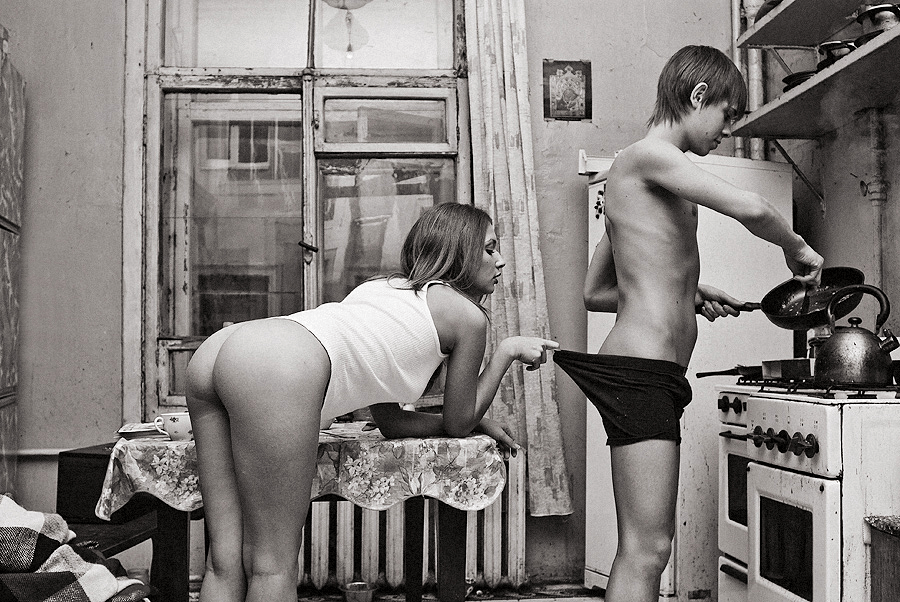
Igor Koshelev – Утро доброго дня (2010)

My Russian was never exactly, how you say: хорошо and the title of this seems untranslatable in an idiomatic sort of way. Best guess, it means something along the lines of the way you might pass a neighbor on the street and as if to indicate the pleasant weather, you were to say: looks like it’s gonna be a wonderful day.

I like the way the title functions here. It doesn’t add anything–only reifies what’s there. It’s the way a narrative image should be titled. Not that this is a narrative image, mind you but it’s at the very least on the right track: you have characters, setting and an inference of what’s happened previous and what will almost certainly follow (i.e. this is a new couple who’ve probably been up late into the night fucking and are about to digress into a diversion that will result in eating their breakfast cold).

There’s too many questions for me to suspend my disbelief enough to accept that this is representative of a narrative. I have no idea if this is her place or his. My suspicion is it’s neither–it feels like a while the parents are away the kids will play sort of scenario; yet there is nothing in the image that speaks to that question. (Also, I’m reasonably willing to bet this image was not taken in the morning. You stare at B&W negs long enough and you start to pick up subtle tones and textures. Gun to my head, I’d swear this was shot on an autumn evening in a decidedly northern latitude.)

This is really the only image of Koshelev that is tolerable. The rest are complete garbage–like truly fucking terrible–which is odd considering despite it’s flaws, this would seem to suggest that this might be the early work of a wonderful photographer.

Source unknown – Title unknown (date unknown)

mullets-make-me-moist:

It’s the hand on the thigh that kills me tbh

When it comes to response to sexual pleasure, bodies are not unlike musical instruments–some just line the sweet spots up beneath certain hands differently, others “you can’t love… until [they’ve] broken your heart a few hundred times.

So while a big part of what gets me about this is how angrily red his erection is–like in my experience it takes a good long bit of stimulation to achieve that color, mullets-make-me-moist is astute in drawing attention to the hands–the correlation between the way they move over this boy’s body and the way a theramin player performs is damn uncanny.

Source unknown – Title Unknown (date unknown)

This is meant to resemble the Pietà, a work–predominantly represented sculpturally–wherein the Virgin Mary cradles Jesus Christ’s crucified body.

In general, I’m not into religious art–it’s largely redundantly boring and although I realize the majority of it was conceptualized as a means of earning a living through the practice of one’s art while also encoding religious work with a humanist undertow.

Pietàs are a notable exception–there’s just something viscerally affecting about them.

It took seeing this image for me to realize why I dig Pietàs: art historically the aren’t exactly erotic in form of fashion but they are decidedly physical. Christ’s musculature assuming a taut not of will but driven by the pull of his body’s weight by gravity. The duality of the Virgin’s attention to both the emptiness of the vessel as well as the vessel itself.

If the Virgin did cradle her son’s body after he was taken down and before he was put into the tomb, he almost certainly would have been naked–after all  Mark 15:24 notes the soldiers guarding him gambled for possession of his garments.

With Pietàs there is always a feeling that the cloth in which Christ’s junk is shrouded, was a concession to the holy patrons that commissioned the works and less an interest of the artist.

So while I don’t think the above is well executed–I am entirely enamored with it as pushes the erotic undertow to the fore. (I think there’s a great deal of room to explore various erotic notions with this form: la petite mort, angel lust and any number of other coded references. (One of my favorite erotic Pietàs is by the incredibly talented Paula Aparicio.)

Further I think there’s a winking bit of blasphemy to this as Jesus–if he actually existed as a legitimate historical figure–was a 33 year old man with a 36 hour refractory period. Whereas, the gentleman pictured above is already risen again.