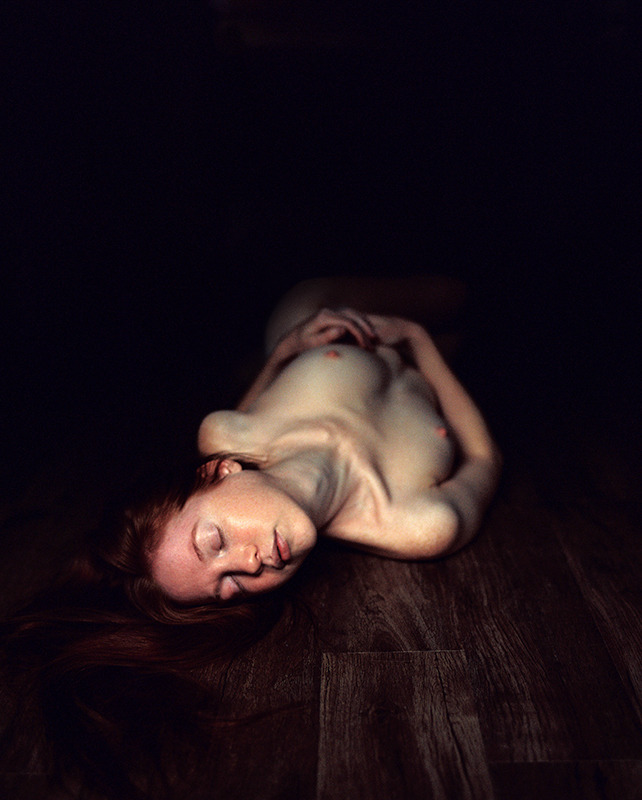
Iwase Yoshiyuki – Untitled (1966)

Yoshiyuki, it seems, was a sake magnate who upon being gifted a Kodak camera set out to document the so-called ama girls who harvested seaweed, shells, oysters and abalone from the cold waters off Japan’s Pacific coast.

This photograph is atypical of his work which frequently featured candid shots of topless divers, water, sand and nets.

It was likely produced as part of one of his ill-advised forays into the fine art nudes. Unlike those awkward, overly self-conscious dalliances re-staging previous scenes in an effort to transform immediacy into technical rigor, this manages to encapsulate Yoshiyuki preoccupations in a manner which transcends the context of its creation and becomes at once somehow both timeless and deeply resonant in its uncomplicated humanness.

Jesús Llaríano head (2014)

As in tune as I can be with logging my own process of reading images, this short circuits everything.

I’m not sure I can explain it without getting a little TMI but it reminds me of being fifteen. (Not that I saw anything like this in the flesh until almost a decade later…)

It reminds me of random, mundane things that would inexplicably trigger arousal so extreme it was actually painful.

I had already been chasing the same oxytocin/prolactin buzz for seven years as a way of smoothing out the jagged edges of my abusive adolescent existence and suddenly it was also effecting some sort of vaguely imagined autonomy over my own body.

As a friend puts it: it’s a real wonder all the masturbation didn’t inflict permanent nerve damage.

So yes: initially seeing this image resulted in me having to release some sexual tension.

Afterwards, I found myself enchanted by the way the image works. Although I’m not sure it’s ever justifiable to employ a frame as a means of dismembering a woman’s body, I can’t technically refute the decision as Llaría observes the dictum of amputating between joints instead of at them.

And there is a notable compositional logic supporting his choice. Note the repeated angle of the elbow which is not the model’s, the line of the lower half of the dresses’ buttons, the way the seam to the left of the lower button line softens the angel to echo that of the model’s right thigh only to have the same angle emerge again in the cocked angle of her right leg.

There’s also the matter of palate: excluding her bush, the image consists of three hues. The rust colored earth figures at the darker end of a spectrum that would include the more magenta tones in her skin; while the white in her slipper and dress are virtually identical. The blue of the dress makes everything else pop.

Let’s not forget texture, either–something about which I am often preoccupied. The skin doesn’t really have texture in this image; except juxtaposed between the dirt and the fabric of the dress the absence of texture becomes a null field. Unlike the ground or the dress you can’t imagine touching the model’s legs but you can recall what it was like to have touched such legs. The visual synesthesia suggests an insistent anti-objectification that subtly reminds that this is no less or no more than what you have always known.

I would be dreadfully remiss for also not mentioning that even though I am not female bodied and if I were I would not be comfortable wearing a dress, I’m more than a little obsessed with the dress.

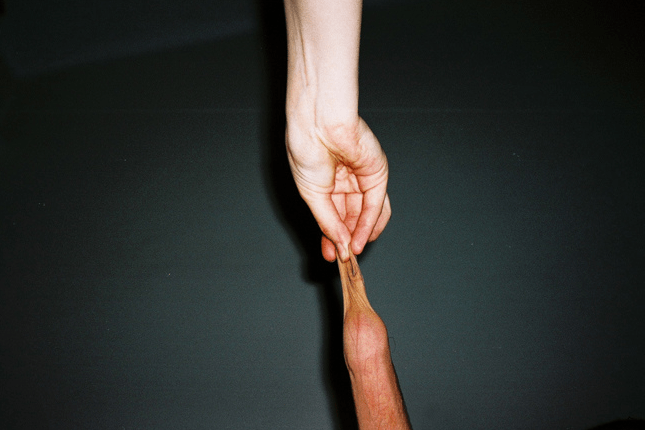
Bienvenido Cruz2.7323 (2014)

Have you seen Cruz’s Hell Is Other People 2 series yet?!?!! It’s so v. very fucking fabulous.

In fact, it’s so fucking fabulous that I’m forsaking the rule where I never post more than one .gif for every ten still images to post this.

The ramped grade along the back drop, tonal separation between the edge of the table and the wall and Ms. Damage’s pose/expression are pitch perfect.

The drumming fingers contribute unexpected movement while hinting at a sense of frustration but there’s something whimsical, perhaps even playful about the movement in such a stark image.

I don’t want to date myself–but hey, no one else appears interested so I suppose I might as well: this image reminds me of that Far Side where a guy sitting at a table is juggling several rubber balls with his left hand; covertly, his right hand scrawls on a sheet of paper: Tonight I strike…Death to the Left Hand! Death! Death! Death! The accompanying caption reads: Innocent and carefree, Stuart’s left hand didn’t know what the right was doing.

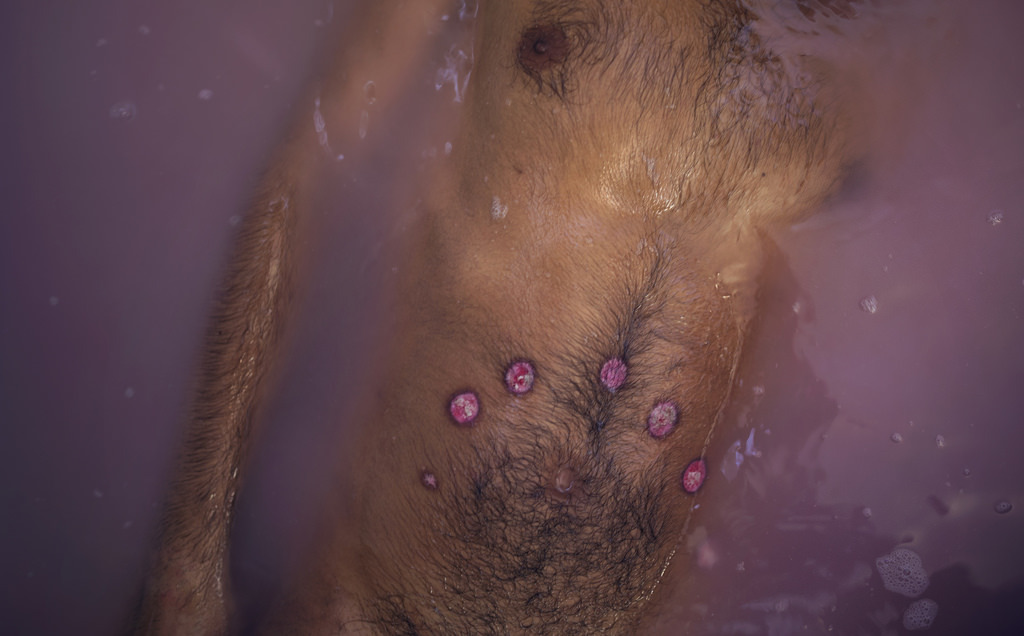
Angela Mary ButlerSeven Scars for Seven Stars (2014)

choomathy set the gold standard for bat imagery with her studied, Becher-esque typologies.

I’ve noticed a recent up-tick in similar work from far less talented image makers. But this images manages to distinguish itself in that it features a male bodied individual with a crescent of seven scars covering his mid-section.

It’s a strong image–and a glance at Butler’s work intimates she’s got some image making chops–but the image becomes more intriguing with the revelation that the scars belong to performance artist Miguel Suarez; who three days prior to this photo shoot enacted a performance piece where he lit a cigar seven times and put it out on his skin each time in the pattern reminiscent of the stars on the Venezuelan flag.

[Source: REDACTED]Title Unknown (201X)

I’m less than convinced posting this isn’t an ill-advised misstep: it’s irredeemably pornographic. produced by a pay-porn site whose ethos aren’t exactly in line with my own (or this blog) and it’s desaturated from the original (an marked improvement, actually).

Also, I am sure if I bothered to watch the video of which this is a part, odds are I would be repulsed.

Yet, this scratches entirely too many itches I’m feeling right now for any decision to exclude it not to smack of a certain degree of dis-ingenuousness. 

Frankly:  it really fucking turns me on.

Why?

I’ve noted previously my affection for and belief in the artistic potential in the visual dynamism of the ejaculatory act.

And although I am not every going to be first in line on ass play day, depictions of pegging appeal to me insofar as they implicitly flip the gender stereotypical, heteronormative script.

From what is glimpsed in this two second clip, my guess is this video flips the scripts but then amplifies the staged physical and verbal abuse to a level that would result in castigation were the gender roles not so clearly inverted.

What gets me about this clip–and I think it would’ve been enhanced in a wider shot–are the muscle tremors playing over his stomach. After all, he’s been brought to orgasm with an enormous dildo compressing his prostrate. His ability to exercise autonomous control over his body is effectively short-circuited; he is completely at the mercy of his partners.

It’s that feeling of being at the mercy of someone I trust completely is what I miss most about sex. Being pushed up against a wall and told in a whisper almost too soft to hear: you’re boundaries are bullshit. If you say ‘no’, I’ll stop. But you won’t say ‘no’.

And my desire to share that experience–to know the give and take of mutual needing–makes me thing this isn’t a two second clip but a much longer one. Where the woman continues to stimulate the man, reminding him there’s no such thing as too sensitive

Sasha KurmazUntitled (2010)

Folks are fond of reminding me of Helen Levitt’s notion that the only substantive difference between making work and thinking about making work is whether or not you’re running film through the camera.

I used to object; splitting hairs on the grounds that Levitt was a street photographer and I’m a landscape photographer.

Then I saw this photograph and chugged a big ol’ tallboy of Shutting the Hell Up™.

Great work has this way of transcending the specific confines that contributed to its creation

I’m reasonably sure Levitt would object to mention of her or her work in the context of the image above.

And I’m not sure I’d take issue with her quibble. Kurmaz’s work is largely derivative–borrowing wholesale, in turns from Ren Hang, Maurycy Gomulicki and Igor Mukhin.

As a result, his body of work is distinguished more by its high-gloss, fashion/lifestyle than a distinctive photographic voice.

Still, browsing his Flickr proves Levitt’s point: as long as you are shooting there’s liable to be some perfect storm of mitigating circumstances where good work stumbles through in spite of everything.

This is one such image. (Also, to his credit, Kurmaz seems very aware of this image’s ability both to read as homage and to accomplish something distinct from the work it clearly references–something that functions similarly only using music instead of images consider the Beastie Boys’ monumental Paul’s Boutique.)

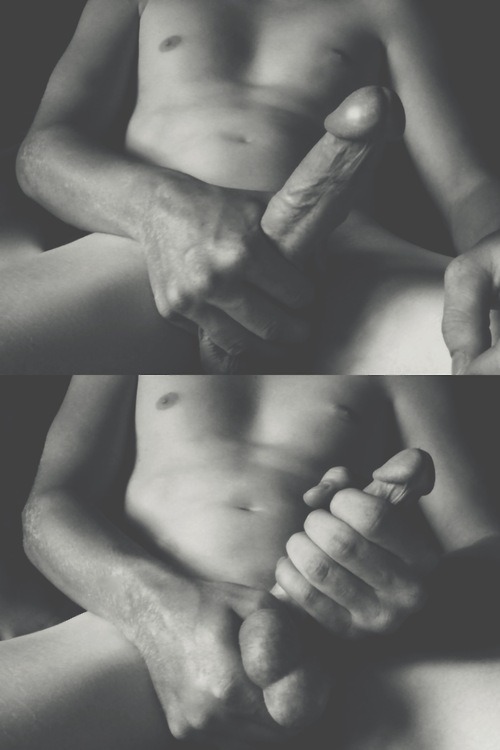
the-secretpervertsubmission to porn4ladies (2014)

Although these lack fully differentiated tonal range and the content/ composition announces them as cockshotus vulgaris, there is at least something charming about them.

I am probably being disingenuous–it being unwise to project the subconscious internal on the manifest external and label the result: interpretation–but this reminds me of Peter Hujar’s breathtaking portrait of David Wojnarowicz.

Whether or not that free associative jump stands up under interrogation, I think the common denominator–both depict male bodied individuals masturbating–is applicable here.

Adding masturbation by no means ameliorates concerns over presumptive entitlement associated with male-bodied exhibitionism but in this case the image reads less like look-at-what-I’m-doing-doesn’t-it-make-you-horny and more what-I’m-doing-makes-me-horny-and-I’m-curious-as-to-the-visual-mechanics-of-the-action.

Interestingly enough that does actually lead right up to what attracts me to these images: a very dear friend once confessed to me that although she masturbated frequently, she had only ever made herself come perhaps three times.

One of those times, she hadn’t intended to masturbate, she’d just been curious about her own genitals and employed a hand mirror to ease closer examination.

In her retelling, she didn’t realize she was going to come until it was too late to stop. Fifteen some years later, she still claimed it as one of the three best orgasms in her life.

For me, this image invokes the same feeling of someone explaining their sexuality to me not in an effort to invoke arousal–although if that happens as a side effect, so be it; but to instead share something true about themselves without fear of judgment or reprisal.

I can’t help but find that attitude incredibly sexy.

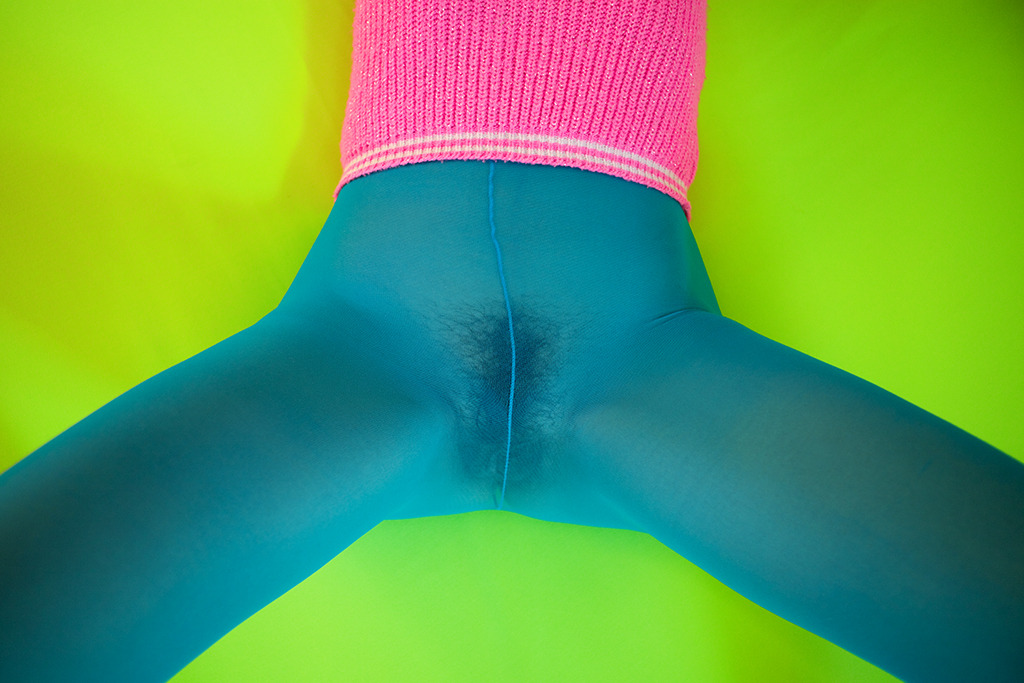
Maurycy GomulickiMINIMAL FETISH_9895 (2010)

This is problematic for the same reasons I took this gorgeous Kodachrome to task.

It’s a teensy bit off balance– the angle of the legs in relation to the lower corners and the uneven grading of the pistachio backdrop; however,  I’m unsure whether it’s a lazy approximation on the part of the artist or an expectation that viewer will get the jist instinctively round it up.

Don’t get me wrong, the interplay of colors is LOVELY. (So much so that when it disappeared from my likes before I could post it, wyoh enacted some of her ‘net wizardry and tracked it down from little more than my muddled recollection of it.)

Gomulicki is trained as a designer and painter. His work is fixated on both documentation and vibrant-to-the-point-of-surreality color palates. And I can’t look at this or any of his images without relating them to amandajas’.

I don’t think it’s difficult to see why: Jasnowski is an image maker preoccupied with image making as a mode of design, after all; and she deploys a strikingly similar palate in her work.

But that connection triggers another question: what is the relationship/where is the boundary between image making & design?

And how does any answer inform the question of the purpose of color in image making practice?

Katherine TurczanAnya and Carolina from Brezhnev’s Daughters series (201X)

In the indispensable Ways of Seeing, John Berger shows us the same painting–specifically, Van Gogh’s Wheatfield with Crows–twice.

With the first instance he presents it much as it would be encountered in a gallery, with the title and artist. However, the second time he merely labels it something to the effect of the last painting Van Gogh made before killing himself.

Criticism has been leveled against this scene. Chronologically, Wheatfield with Crows is only known to be one of the final paintings.

In my mind the criticism misses the point and by doing so goes a great distance towards proving the contention: context of presentation shapes the way a work is approached and subsequently understood.

Katherine Turczan’s work–to coin a phrase–really cultivates my pearl by representing both why fine art photography matters as well as why it’s–in the same breath–an intolerable, insufferably pretentious circle jerk.

Consider the ’essay’ which accompanies Brezhnev’s Daughters:

Brezhnev’s Daughters, the title of this project refers to what women call themselves in Dneprodzerzhinsk, Ukraine, the birthplace of Leonid Brezhnev and the industrial heartland of Ukraine.  The women say that they are Brezhnev’s children because they have inherited the future of the failing land and their father has abandoned them.

Dneprodzerzhinsk, Ukraine is about 8 hours from Kiev along the Dnepro River the heart of Ukraine’s mining and manufacturing production.  This area is like many cities in the east, an industrial wasteland with factory stacks ablaze filling the skyline.  The landscape takes on the quality of a bad Hollywood movie about the apocalypse. The industry in these towns is a double edge sword; one that contaminates and sickens yet employs most of its people.  This is where Ukraine’s working poor live.

In these parts of Ukraine it is very prestigious to work in the sex industry.  The industry offers economic opportunity to many women other than what the factories can provide. Their sexuality is their strength and they use it as a form of emancipation to support their families.  They are very proud of this.  Many young women work as welders during the day for pay that is not sufficient to feed their families, while at night they pole dance. Brezhnev’s Daughters is a portrait of these and other women in the industrial south who are faced with these complex choices. 

These photographs are made with an 8×10 camera and printed on Gelatin Silver Paper.

As far as such things go, it’s all but flawless. And without a doubt it enlivens/amplifies the resonance of the photographs. The trouble is: it also muddles them.

That which is distinct in Turczan’s work is not what makes the work’good’.

Katja, Mariya and Liana resemble thousands of other candid model shots produced by the internet hordes. (Admittedly, these were shot with a large format 8×10 analog camera.)

Karolina could very well be a reclaimed Jock Sturges’ discard; Yulia is a straight-up Atget heist.

What is distinct about Turczan’s work is where it doesn’t bother to sweep it’s shoddiness under the rug. Sasha is #skinnyframebullshit; Oksana avoids the same mistake (the difference for anyone who cares, is mentally reconsidering the shot given the opposite orientation and comparing and contrasting) but as with the previous image just isn’t an especially technically astute image even if both are alive in a way few of the other images are.

I do like the photograph I’ve posted here. It one of maybe three in keeping with the explanatory essay. But not only is it in keeping with the essay, there’s a dialogue between the contextualization and the work that sharpens both.

And it occurs to me that academnified fine art photography operates from the premise of creating work that clearly indicates both what it is and what it is not. Popular image making on the other hand starts and more often than not ends with the assertion this is interesting. Such taxonomical considerations are vital to my own process, but I think at a certain point you have to focus on what is instead of what isn’t. Too much work tries to be everything to everyone and ends up nothing to no one. But it’s interesting that the work which insisted clearly in its own specificity somehow manages to transcend that specificity more often than not.
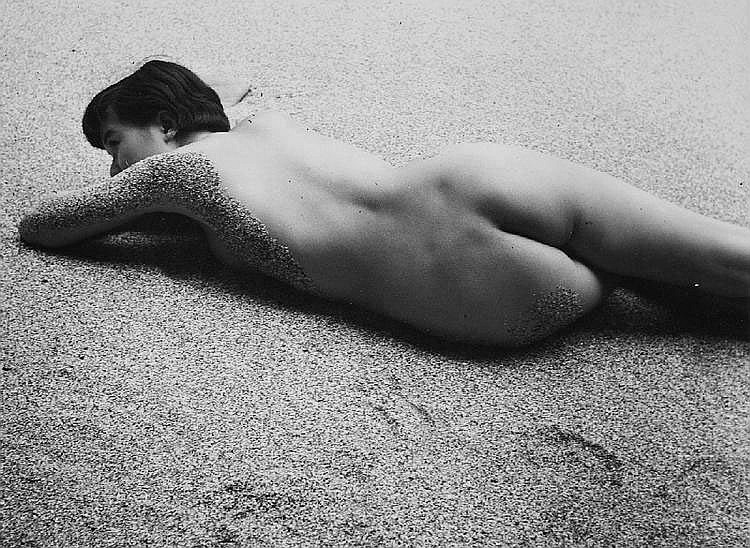
Ryan Muirheadyour picture out of time/left aching in my mind/shadows kept alive (201X)

I’ve heard that you can recognize a photographer
by how they continually compose the edges of their frames,

that each quarter-second decision to exclude, to define a boundary,
to say what will not be in the photograph

is as explicit as a thumbprint.

–Traci Matlock

I find this metaphor appealing for dozens of reasons.

From police commish to your average Jane on the street, the police procedural and its popularity have instilled a near universal awareness of the distinctive singularity of the human finger print.

Recently, I learned a bit about the methodology underlying dermatoglyphics; namely, a fingerprint consist of one of three patterns: whorls, loops or arch.

5% of all fingerprints are arches.

Every fingerprint is–in theory unique–but arched prints are, in effect, doubly unique.

I feel this contributes a certain added elegance to the metaphor. Yes, image composition is as explicit as a thumbprint; but, there are certain image makers whose composition is so distinctively singular, that they stand out at forty yards under bad light as belong to a particular artist.

Ryan Muirhead work is a good exemplar.

He prefers vertical frame orientation. And not to disappoint long time followers but I am not at all inclined to dive for my customary #skinnyframebullshit accusation.

Why? Well, there may be grounds for questioning where stylistic affectation ends and compositional logic begins—Muirhead’s wide framed images are more compelling (at least to my eye). ultimately though I can’t fault his skinny frames–they routinely contribute a preternatural dynamism, cleverly accentuate shape and form (rightmost image), ground portraits in a specific context, all while exploring a diverse range of technical nuance to precocious effect.

Given all that, I’m not entirely sure vertical orientation adds anything to this image. Don’t get me wrong–it’s one of the best conceived and executed nudes I’ve encountered in months, completely unlike anything I’ve ever seen. I am enamored by the way it finds a way for stillness and restlessness to coexist in the same space in time. The only word I can attribute to nature of the gaze is respectful.

Unlike many photographers whose work impresses me at first blush, researching Muirhead further did little to diminish my interest. In fact, this beyond on point interview over at This Is Imperfect honestly impressed the shit out of me.