Edward YsaisUntitled (2013)

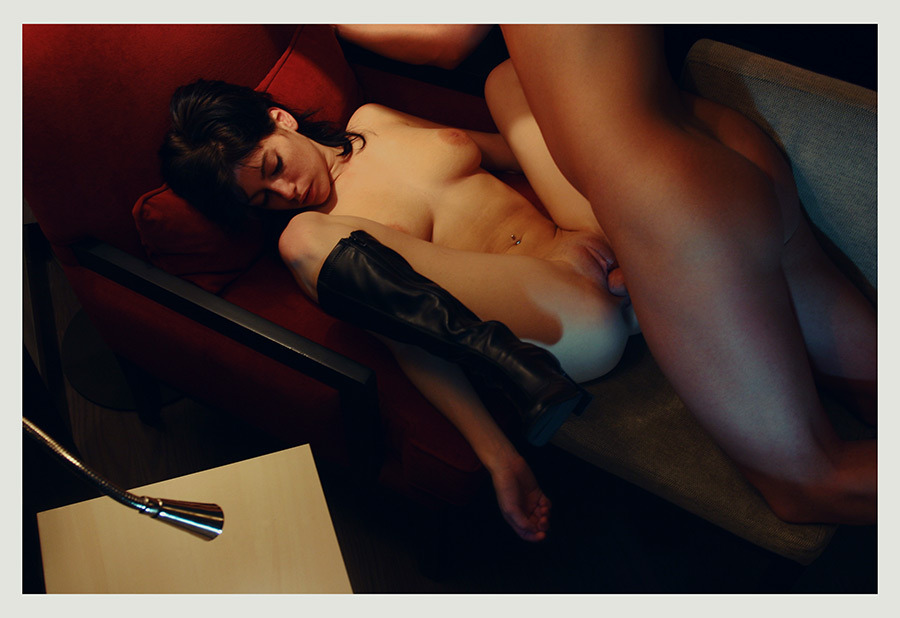
I’ve had this image saved as a draft for almost a year. There’s no arguing that it’s chiaroscuro is executed with skillful aplomb. It’s memorable, quality work and I like it… but I’m conflicted about it.

At first, I thought that the both women were the same person. That’s largely because I am absolutely awful when it comes to facial recognition. For example: If I’m meeting someone I don’t know all that well, when I scan a crowd I’m noting things like height, hair color, build and body language.

I don’t think these are the same women (it’s not entirely clear but the woman entwined with the man appears to have longer hair than the one in the mirror). So my initial impression of this as a critique of the male gaze–wherein the male surrenders to sexual bliss while the woman is condemned to a duality of experience wherein she not only experiences sensation but also stands detached monitoring and critiquing her the relationship between her experience and the male consumption of her experience.

Without that anchor, I’m not really sure what to make of the image. Is this a threesome? There’s a sheen on the woman in the mirror’s skin that could be suggestive of such a scenario. But it fears more like a nightmare–a woman dreaming about her lover cheating on her.

And that’s kind of where things start to unravel for me. In my experience as a dreamer, mirrors straight up DO NOT work like they are represented here. In other words, my experience is that the mirror only reflects a part of me–i.e. my head or I don’t have a reflection.

This dissonance opens a door to some critical considerations about the work. Yes, it’s pretty. Yes, the lighting is sumptuous. Yes, it’s almost certainly riffing on Velázquez‘s Las Meninas.

However, note the way Velázquez uses available light as the primary motivation for his composition. In other words, the perspective the viewer is presented is one which given the light renders a composition built around a masterful understanding of space–especially distance and depth.

Ysais’ image is alarmingly flat. The light functions to render the scene legible and in no way informs the composition. And once you follow that rabbit trail, you realize that due to the slight down tilt of the camera–presumably to compliment the mirror–the vertical slat of the partition at the extreme left of the frame is put askew. Further, the horizontal and vertical slats, transitioning to the bas relief to the damask pattern to the drape and the echoing drape in the reflection–the artifice of the frame becomes hard to suspend in favor of disbelief.

It’s something I’m discovering in my own work of late: the distance between a bad image and a good one is exponentially less than what separates good from great.

Igor PjörrtDying Star (2015)

My first thought is how this is riffing on Lina Scheynius.

And I say riffing on as opposed to ripping off with intent–the distinction is the same as the difference between stealing like an artist and mere mimicry.

Where Scheynius is interested in documenting light specifically and this frequently manifests as attention to the relationship of light to her body, self-portraiture is less destination than familiar landmark along the pathway.

Pjörrt, on the other hand, seems from the outset more interested in portraiture. Light, or more correctly low-light, does figure prominently in his work–and you should seriously browse his archive because the way he uses minimal ambient light is exquisitely masterful.

The only criticism I have is the erotic works tends to diminish the formal considerations of the more cinematic images by adopting awkwardly, contrived poses. Consider this self-conscious tangle of bodies vs a more legible and evocative image which retains a sense of oddity about the mechanics of how the body’s relate to one another.

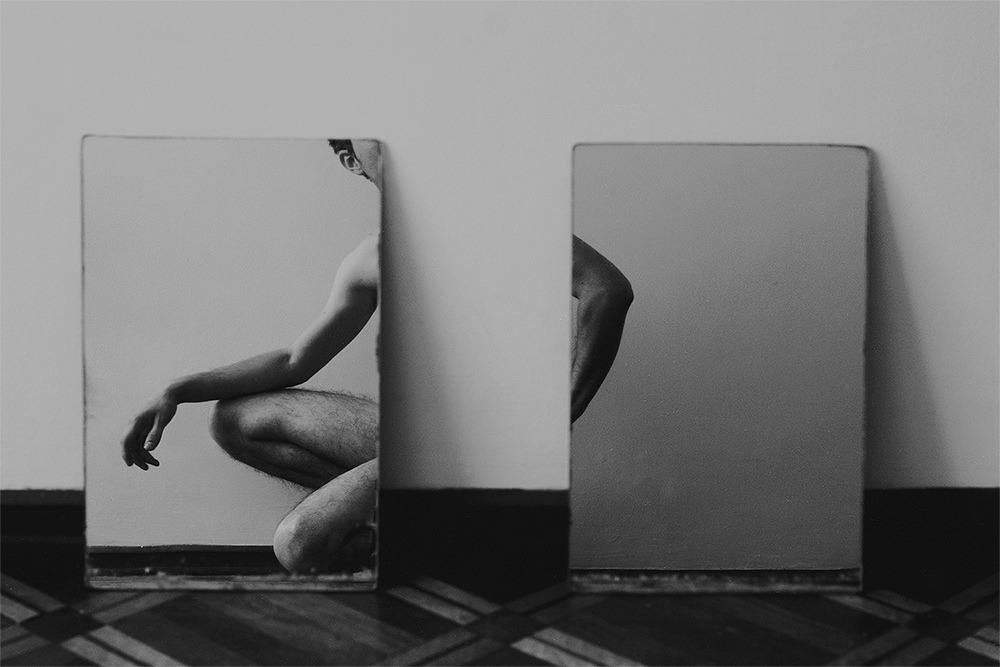
Faber Franco2rectangulos (2015)

When it comes to conceptualizing my own work, I’m like the cat that has to turn in circles a few times to find just the right spot/angle so that I can drift off.

I don’t know fuck all about Franco’s process; his work suggests a calculated effort in service of established momentum following a clearly planned trajectory. In other words, it’s less novice swordsman sheathing and unsheathing or otherwise sabre rattling, than samurai who only removes the sword from scabbard with the intent of using it to kill.

What I don’t understand is that although Franco seems to possess a complimentingly developed grasp of craft, I don’t follow his penchant for restricting the tonal range in his images.

Take the above for example: if it were mapped according to the zone system, we’d have roughly 5 full tones. In this the restricted tonal range does contribute to a sense of failing half-light (which is very much in character for the piece).

However, as there is a similar truncating of tonal range in virtually every image on Franco’s Flickr, it smacks a bit of a self-conscious stylistic ‘signature’–something I find frustrating given the overall quality of the work, taken as a whole.

I couldn’t swear to it but I’m reasonably sure there’s a Lynchian influence acting here–the primacy of angles in composition and interplay between super saturated complimentary colors.

And as much as I love most of Lynch’s work, I’m reminded of a criticism leveled against me after sighting Lynch as an influence back in college. Most of the people who claim or demonstrate influence from Lynch tend to use his work as an excuse to break rules before you’ve bothered to learn them properly.

In this case the tonal restrictions do evoke a Lynchian ambiance, while unfortunately overlooking the fact that although Lynch will definitely limit his tonal range for surrealistic effect, he almost always does so by amplifying those four or five zones to the moon while still maintaining a crisp, well defined luminous range. (As just one example consider Frederick Elmes’ cinematography in Blue Velvet, especially the scene where Jeffery finds Dorothy’s husband and the Yellow Man in Dorothy’s apartment.)

Source unknown – Title unknown (20XX)

My first partner loved the show Friends.

At the time, it seemed like a fair trade off. She’d ‘suffer’ through the latest von Trier or the odd early Bresson and in return I’d hold her while she giggled at the vapid banality of Joey and Chandler. (With hindsight, I definitely got the short end of the stick, but…)

There’s this one episode where the white cis men discover that they are getting free porn via their cable provider. They think it’s a stroke of luck but as things progress they begin questioning how it effects their perception of reality. If I remember correctly, Chandler mentions how while interacting with a teller at the bank, she never offered to take him back to the vault and seduce him.

It’s a knee-jerk, made-for-sitcom parsing of the ethics of porn w/r/t gender representation. But it does suggest a point (to me at least) that I feel is worth exploring; namely: whether the frame is an edge or a boundary.

In the case of the porn that Chandler and Ross were consuming, the frame is an edge. It is separated, so much as to be cut off from reality. However, due to the non-critical consumption–this fantastical representation of a reality that is at a remove from the one either inhabit, they begin to question why their world isn’t like the one they spend the most time considering.

In other words, when you spend too long studying a world unlike the world in which you live (without keeping in mind the fact that you are watching a discrete fantasy), you begin to note discrepancies.

However, some work–and the above image definitely fits in this category–where the frame is a boundary not an edge; a broader reality exists outside the frame. There aren’t people with stock, archetypal designations acting on sets. There are reminders that there are people, places and things beyond the limited view provided to the audience.

This is cool because there’s more hinted at beyond the frame’s boundaries. There are at least 5 people in this scene. Likely six, including the person taking the picture. (And the proximity to the action of the camera person, suggests that they are a participant in the proceedings.)

I love that the one guy is wearing stockings–which note have clearly been pulled on and off enough times that their is a rip opening in the left thigh–and cowboy boots. His scrotum is clearly still irritated from being recently shaved. And the hand that is presumably tracing it’s way up the right arm of the woman eyeing the camera. It all speaks to both the immediacy and intimacy of the moment but also that it exists within the context of a broader world beyond the outer boundary of the frame.

Source unknown – Title Unknown (19XX)

Ultimately, this isn’t technically a good photograph–it’s unclear what the woman at the extreme right of the frame is doing and given her position where the upper horizontal third of the frame insects with the frame edge and the dark shelf or curtain directly behind her, the eye drifts across the frame to her and her eyeline isn’t accurate enough to draw attention back to the act of cunnilingus.

Still I like the feeling of the image–the weary-yet-curious way she’s taken his hard on into her mouth, the way he’s watching her but also gently pulling her hair away from her face so that’s out of her way allowing him and the camera an unobstructed view. I love the way her hand is pressed against the other boys side–a means of communicating her own sexual response through touch since vocal cues may not be as readily interpretable given the present configuration.

Yes, everything is staged toward the camera but not in an overly winking exhibitionist sort of way. This is another example of an image where I wish I had been present with a camera to document things. (Although I admit, my personal preference would be for the woman and the boy going down on her to switch places. (MMF scenarios with bi-men are v. haute.)

Also, something that gets me about this picture and honestly any depiction of group sex is that seem to allow for something I feel stymied by in my day-to-day–namely, they allow a safe space for those participating to perform their sexuality in a way that isn’t intrusive, unwarranted or unwelcome.

That openness is something completely absent in my life and as much as the advice is: be the change you want to see in the world, this blog is really the only means I’ve found at maybe halfway accomplishing that feat.

Fabio BaroliEsto és peor (de Cristo à Tepes) from Apropriações Textuais series (2008)

I’ve featured a Baroli painting once before even if I didn’t know to whom to attribute the work at the time. (It remains one of my favorite images I’ve ever posted.)

Even though most of the attention he receives is due largely in part to the erotic/transgressive work, he has produced a broad spectrum of work.

These images (here, here, here and here) pull together a sort of comic book style confrontation with Chuck Close pastiche.

In other works, there’s the unmistakable flavor of Degas.

The unifying thread with these various approaches is likely a simultaneous attraction to and revulsion from the simple, direct compositional dynamics of murals. For example, although Diego Rivera tends to pack as much detail in his frames as possible, if you focus on the way Rivera presents individuals distinctly within the visual milieu, you’ll recognize their echo in Baroli’s rendering of his subjects.

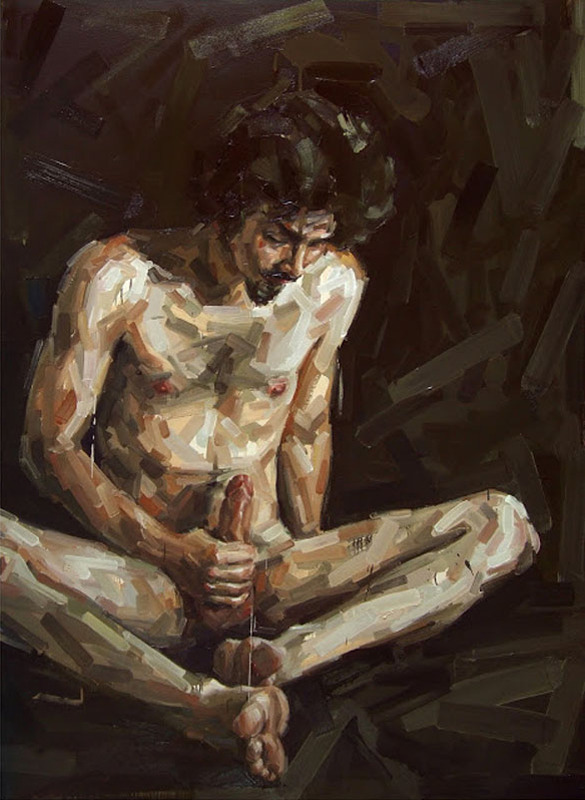
Honestly, I’m so enamored with his preoccupation with genitals and masturbation as motifs, that it’s difficult for me to step back and look at the work critically. If I do that, however, there’s some weird stuff going on. The linear application of paint–which often reminds me of band-aids, tends to remain broad and nebulous around the edges, become more refined as the shape of the subject is defined.

The use of layering and color is masterful. You can tell that the application is not just suggestive of an understanding of color theory, it’s a short of showing the seams of how painters achieve such sublime colors; however, the more bandage-esque suggestive of tonal accuracy fades when Baroli reaches the genitals of his figures. (Or, at least as far as penises go. His depictions of vulvas are really abstract.)

It’s clear that he is interested in the notion of the relationship between physicality and visual representation as well as sexual and individual identity. He’s obvious invested in fucking with those boundaries.

Also, there seems to be a certain perhaps reflexivity between his conception of genitalia and sexuality that could further perpetuate the sexualization of bodies. I’d wager he’s aware of this; and I see his preference for depicting erections as a likely effort to preempt such criticism. However, I’m not 100% convinced it succeeds.

As much as a dig the emphasis of solidarity of experience over embodiment in

Sujeito da Transgressão #4, it feels as if it’s predicated on an implicit gender bias that doesn’t necessarily turn me off of the image but renders me uncomfortable because the work still very much turns me on–if that makes a lick of sense to anyone other than the voices in my head.

Colby KernMore from table manners (2015)

Kern telegraphs his familiarity with Nan Goldin and Araki too much for my taste. (There’s some Ryan McGinley in there as well, which would at least be more in keeping with the work.)

It’s unfortunate because there are a couple of things his work does that turns out to be more interesting–at least to me–than the work he’s referencing.

For example: he has no qualms depicting graphic nudity. Yet, when sexual overtones emerge in the images, he always either partially or completely obscures his subjects genitals. Frequently, the frame edges or someone else provide assistance in such obscuring. It comes across as very nearly playful–which is why I think McGinley is perhaps the better reference to pursue given only the three aforementioned photographers.

I think this image is especially interesting because of the triangulation. The image maker is a participant in the image–he may not be casting that dark shadow on the lower table but with the guy looking at his hand covering the boys groin and the boy making eyes at the camera, the circular table cycles the eye continually around the frame. (I do think there should have been a third cup or no cups, however.)

Lastly, although I can’t figure out exactly how to explain it–I feel like there’s some genderfuckery at play in this. The boy stretched out on the table is both clearly masculine but the pose and the way he’s flirting with the camera are something one would typically see in fashion editorials target straight white cismen. Yet the placement of the blocking hand does more than anything to activate a sort of suggestion of androgyny. (Yes, if you follow the implication far enough–I’m pretty sure it turns out to be a problematic depiction. But it’s a sentimental image and when fine art folks eschew sentiment it’s not so much that sentiment in itself is bad; more the tendency to respond out of habit instead of thoughtfully. (It’s the same reason poets are told to avoid cliches, really.)

Giovanni Littlslr DionisiFull Bloom for Toh! Magazine (2015)

The delicate use of color in these is what initially commanded my attention. Each illustration features an ever so slightly different soft pastel background and the so subtle it’s almost pallid minimalism of the flowers focuses attention on the red to pink gradations evidencing vigorous stimulation.

As far the line work goes it always impresses me when someone can imply a great deal of detail with only the most minimal representation. And while I did immediately appreciate that here, there is definitely more to it.

Note: how the jaggedness of the lines which delineate the outer parameter of the essential form. (The hands in the second image approach a nearly cartoonish level of semiotic implication.) The less vigorous interior lines might, in another work, suggest vagary or something intended to be left open to the viewer imagination. But with these illustrations the unsubtle is the encaustic that enables mere implications to be more easily apprehended.

I read those gentler more seemingly ponderous interior lines as a statement on fragility/vulnerability. It’s a ballsy approach and I think it elevates the work substantially.